The short version#
True scarcity in Disney Lorcana stems from structural distribution choices rather than simple artificial hype.
- Kida
- Anna
- Darkwing Duck & Launchpad
- The Horned King
- Maleficent's Staff
- Camilo Madrigal
- Ursula
- Gaston
- Beast
- Grab Your Sword
Scarcity in modern trading card games is usually a matter of math and marketing. A publisher sets an rarity tier, tweaks the print run percentages, and prints a silver foil stamp on the bottom border. Pulling one becomes a lottery, but the scarcity itself is engineered from the top down. Disney Lorcana uses those standard rarity tiers too, from Common up to Enchanted. Yet the hardest cards to track down in this game rarely owe their scarcity to a pull rate alone.
True scarcity in Lorcana is structural. It happens when distribution choices intersect with how people actually play and buy the game. Sometimes a card is hard to find because Ravensburger packaged it inside a standalone co-op box that local game shops bought in limited numbers. Sometimes it sits inside an oversized promo kit meant strictly for organized play leagues, meaning it never hit a retail shelf in a booster pack. Other times, a card became scarce because players realized it was a four-of staple in competitive decks, pulling copies out of the trade binders and locking them away in deck boxes.
When a card's availability is tied to a specific distribution channel, a short-lived event, or a physical product format that retailers hesitated to stock, the secondary market reacts differently. You are no longer just fighting the odds of opening a booster box. You are hunting for items that left the factory under entirely different rules. The ten cards below represent those structural bottlenecks in Lorcana's growing history, from early set anomalies to specialized release formats that caught collectors off guard.
| # | Item | Set / Year | Rarity |
|---|---|---|---|
| 1 | Kida | Into the Inklands | enchanted |
| 2 | Anna | Winterspell | enchanted |
| 3 | Darkwing Duck & Launchpad | Attack of the Vine! | enchanted |
| 4 | The Horned King | Whispers in the Well | enchanted |
| 5 | Maleficent's Staff | Azurite Sea | enchanted |
| 6 | Camilo Madrigal | Shimmering Skies | legendary |
| 7 | Ursula | Ursula's Return | special |
| 8 | Gaston | Illumineer's Quest: Deep Trouble | special |
| 9 | Beast | Rise of the Floodborn | legendary |
| 10 | Grab Your Sword | The First Chapter | rare |
10. Grab Your Sword (The First Chapter)#
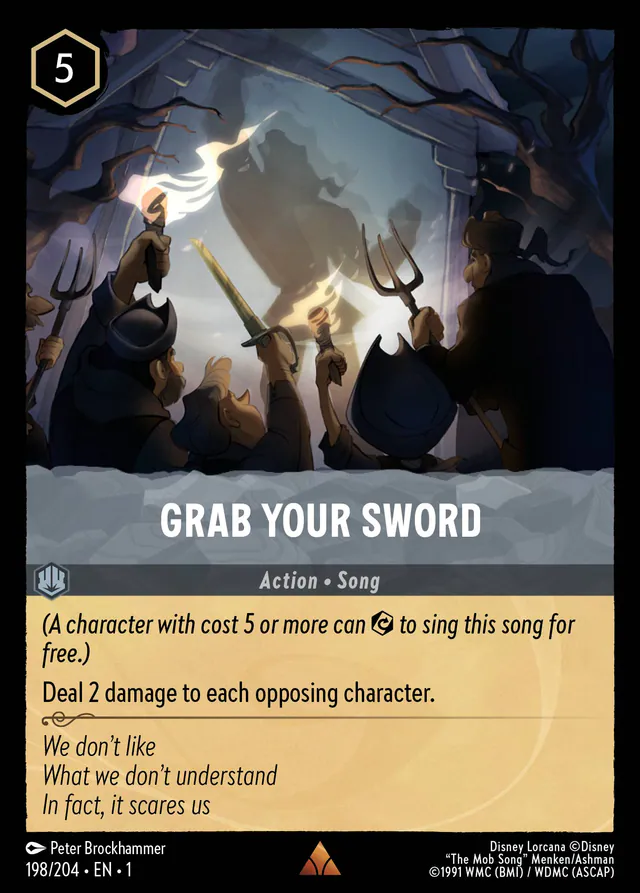 Grab Your SwordSee it on collecto.rs
You can buy a copy online right now in about four clicks. Yet finding one in the wild during the late summer of 2023 meant waiting outside a local game shop before sunrise or watching big-box store shelves get cleared in twenty seconds flat.
That initial rollout created a specific kind of scarcity. The First Chapter did not just sell out; it vanished before most people knew the game existed. As a rare, Grab Your Sword landed in roughly one out of every six booster packs. The math sounds friendly until you remember how few packs actually reached store counters during that first wave. Players needed four copies for steel decks, and collectors wanted clean foils for binders. Supply dissolved instantly.
While Beast relied on the legendary slot pull rate to drive its numbers down, Grab Your Sword faced a different wall entirely. It was a utility card caught in a distribution bottleneck. The card itself is not printed on gold leaf, but finding an unplayed copy from that original run takes real effort. Most spent their early weeks being shuffled on game store tables without sleeves.
When a set lands with that much friction, the condition of surviving copies becomes the real filter. Early printings carry the marks of a rush: slight centering shifts, soft corners right out of the wrapper, and foil scuffs from tight factory packaging. A pristine example from those first boxes tells a story about a very specific moment in the game's history, right when supply could not begin to match the room's energy.
9. Beast (Rise of the Floodborn)#
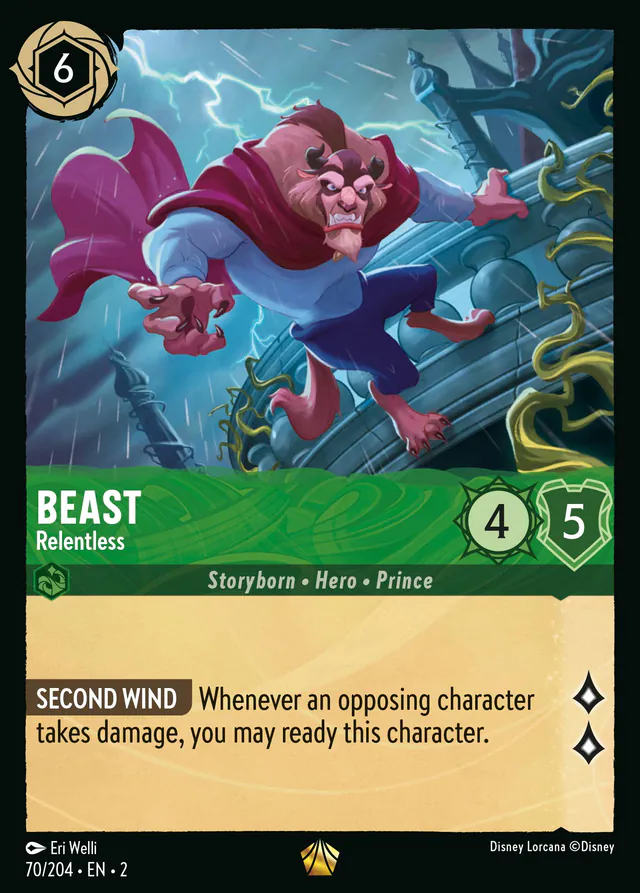 BeastSee it on collecto.rs
Packs of Rise of the Floodborn left store shelves months ago, and they are not coming back. Finding a copy of Beast from this second Lorcana release now requires hunting through secondary inventory rather than tearing open fresh foil. Legendary pulls from early expansion sets face a distinct kind of scarcity. When a set stops rolling off the printing presses, the pool of available singles freezes in place.
During the initial release window, players focused on building competitive decks while collectors tucked away clean copies. Beast sat right at the intersection of both groups. Legendary cards already carry low drop rates per booster box. As unopened boxes shifted from local game shops into private closets, the open market supply shrank quickly. What remains in circulation today is mostly tied up in active decks or personal binders.
Unlike Gaston, which arrived in a boxed quest set with a guaranteed card list, Beast could only be found by chance. You could buy an entire sealed case of Rise of the Floodborn boosters and still miss this specific Legendary card entirely. That randomness makes a card far harder to source years down the line. Fixed product releases maintain a predictable baseline of existing copies. Booster-only Legendaries rely entirely on how many packs were opened before the supply dried up.
Condition adds another layer to the search. Early Lorcana card stock was prone to light edging straight out of the wrapper. Finding a copy that escaped both factory scuffs and the wear of tabletop play takes patience. The search for early expansion Legendaries is rarely about waiting for a price drop. It is about waiting for a clean copy to surface at all.
8. Gaston (Illumineer's Quest: Deep Trouble)#
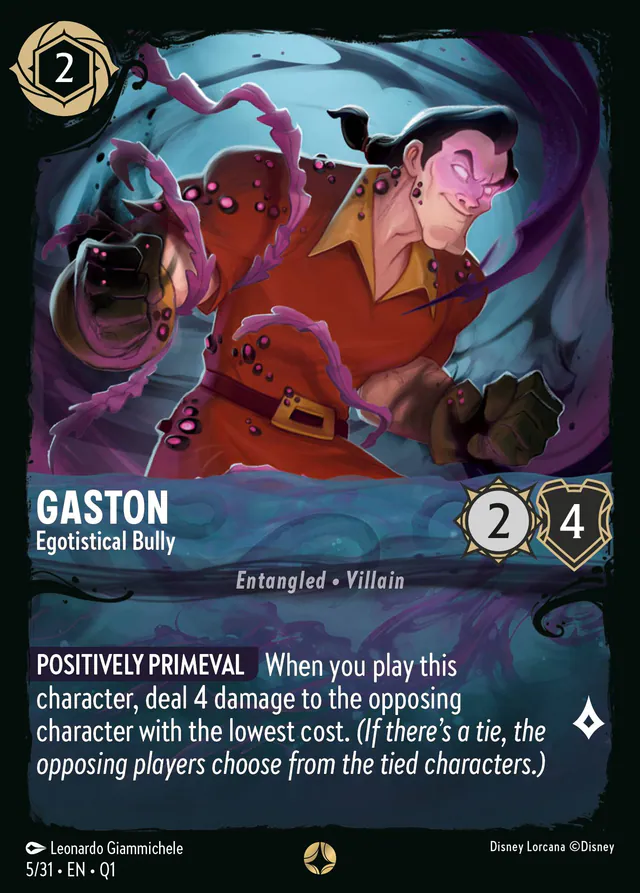 GastonSee it on collecto.rs
You buy the box, open the shrink wrap, and look at the pre-built deck sitting in the tray. Gaston is right there. No foil wrapper to tear, no random odds to calculate, no five-card pack variance. He comes in the set because the set is a closed loop. That predictable distribution makes this print trickier to source down the line than standard booster cards. Most people who bought Deep Trouble kept the contents intact to play the standalone game. Break the set apart, and the game disappears. Keep it together, and the card stays trapped in the box.
Like the standalone Ursula release, this print operates under a hard cap set outside the main booster line. Ursula established how isolated set print runs cap total supply early on. Gaston takes that constraint into a cooperative box format. You cannot pull him from a random pack sitting in a display draft box at your local store. The only way a single copy hits the open market is if someone decides to dismantle their complete Illumineer's Quest set.
That creates a different kind of scarcity than traditional pulls. Legendary cards like Beast rely on low odds across millions of foil wrappers. You can open a fresh booster pack today and theoretically land a Beast. Gaston requires someone to stop playing a self-contained game set. The raw total count of these cards remains fixed to the exact number of boxes printed for that single standalone product run.
When a card stays tied to a specific boxed experience, the secondary market shrinks quickly. Finding a clean single means relying on sellers willing to break up a complete product. That extra friction keeps this particular print out of circulation.
7. Ursula (Ursula's Return)#
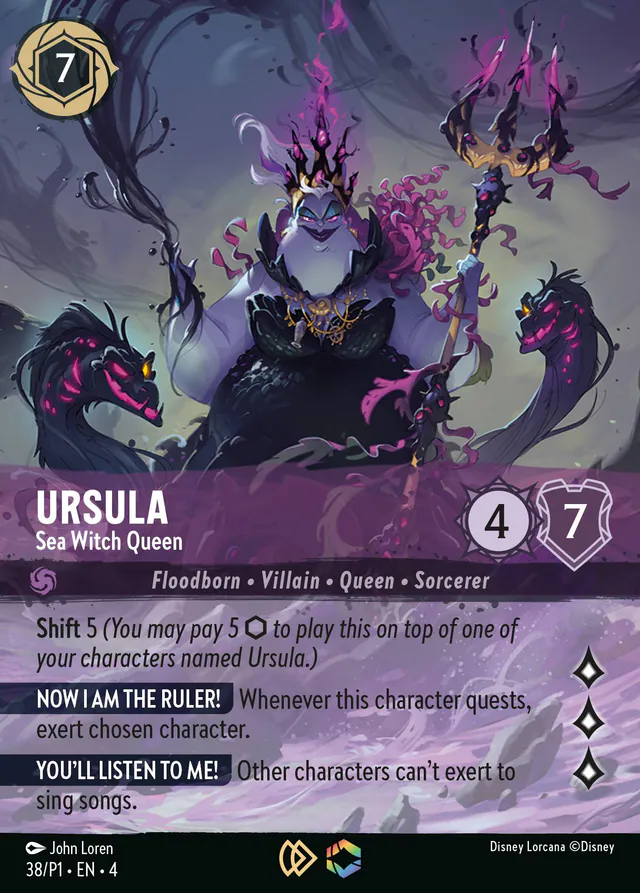 UrsulaSee it on collecto.rs
You buy a neat cardboard box, open the sealed foil envelope inside, and find the sea witch waiting for you on top of the pile. No booster pack wrappers on the floor. No bulk commons to slide into a storage shoe box. Just a fixed deck and one specific card printed exclusively for a standalone co-op scenario.
The Deep Trouble Illumineer's Quest set changed how scarcity works in Lorcana. Standard booster packs rely on random distribution across massive print runs. A boxed quest set operates like a closed system. Disney Lorcana printed this version of Ursula for a single product released during the Ursula's Return set, locking her behind a fixed retail purchase rather than a variable pull rate.
This creates a different kind of bottleneck than cards like Gaston from the same set family. Gaston forces you to buy identical boxed product if you want another copy, but his distribution stays tied to fixed starter contents. Ursula sits in a scenario deck designed to be played as an automated villain, meaning many copies remain sleeved inside complete quest kits rather than entering the single-card market. To get her individually, someone has to break open a functional standalone game.
Cards tied to special standalone releases tend to quietly drift away from circulation. Players keep the quest set intact for game nights, while collectors look for loose copies to complete character binders. When a card lives inside a self-contained board game experience rather than a standard booster box, finding one in clean condition without buying the entire set requires patience.
6. Camilo Madrigal (Shimmering Skies)#
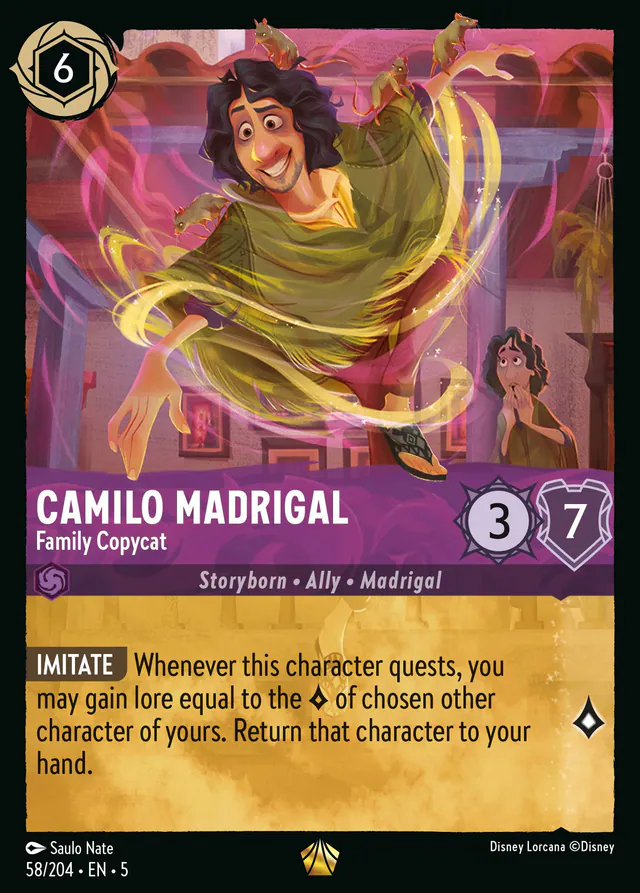 Camilo MadrigalSee it on collecto.rs
Forget what the market price suggests about this card. Shimmering Skies hit shelves with plenty of supply behind it, but pulling this specific legendary copy from a booster box is a stark exercise in basic math. The set distribution spreads its high-rarity slots thin across a massive checklist. You are not fighting a limited promo run or a closed product line here. You are fighting the standard probability of a late-era base set deck, where the odds sit firmly against you every time you tear open a pack.
While the standalone Ursula release locked its numbers behind a fixed boxed product, Camilo Madrigal relies entirely on the cold randomness of booster foil packs. You can open three sealed displays and still miss the card completely. That gap between total print volume and individual pull rates creates a specific kind of fatigue for anyone building a set from scratch.
legendary status inside Shimmering Skies means the card occupies a specific tier of standard rarity that collectors often underestimate. People expect promos and special editions to give them trouble. They forget that standard set legendaries require opening hundreds of individual packs or trading with someone who already beat those exact odds. The card sits squarely in the middle of this list because the challenge is not finding a copy for sale. The difficulty lies entirely in pulling one yourself without resorting to the secondary market.
5. Maleficent's Staff (Azurite Sea)#
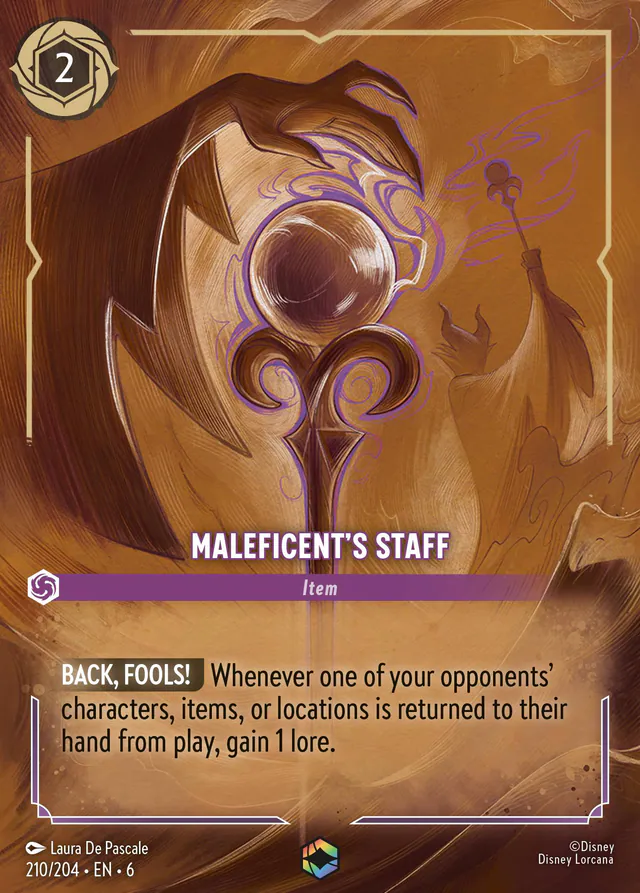 Maleficent's StaffSee it on collecto.rs
Why would anyone chase a stick? When Ravensburger gave item cards the Enchanted treatment in Azurite Sea, they changed the texture of a master set chase overnight. Characters usually pull the weight on showcase pages. They have faces, poses, and recognizable scenes from the films. An item has to work harder. Maleficent's Staff does that by leaning into the frame itself, stretching the familiar twisted wood and pale green flame across a full-art foil surface that lands in booster boxes with staggering rarity.
Pulling any specific Enchanted card from Azurite Sea means beating a long set checklist. Earlier entries on this list, like The Horned King, face a similar math problem where expansion checklists dilute your odds for any single high-rarity slot. But items introduce an extra layer of patience for collectors. Character cards dominate the rare slots in every set print run, leaving item cards with fewer total hits across a sealed case. You can open multiple boxes, hit the expected foil distribution, and still never see the staff clear the wrapper.
That scarcity shapes how you catalog a set like Azurite Sea. A line of characters looks complete until the blank space for an item card sits right in the middle of your binder page. It forces a choice between settling for the standard print or waiting out the single listing that actually matches your condition standard. When you upload your collection to collecto.rs, you can mark the Enchanted slot filled, export your set list to CSV whenever you want to check off remaining gaps, and see the full card art without a digital price tag tacked to the bottom.
4. The Horned King (Whispers in the Well)#
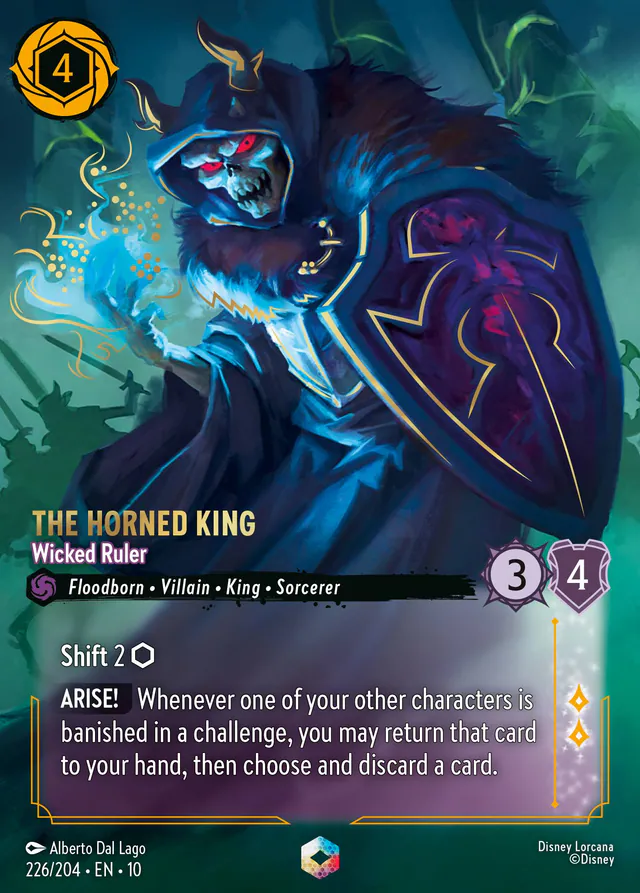 The Horned KingSee it on collecto.rs
Finding a foil version of an Item card like Maleficent's Staff is mostly a matter of brutal math, since single-card odds across booster boxes stay fixed regardless of what is printed on the cardboard. The Horned King presents a different problem entirely. When Whispers in the Well expanded the total card pool, the odds of pulling any specific Enchanted card dropped. The overall hit rate for the rarity tier did not improve to match the larger checklist. You are chasing one specific card out of a pool that keeps growing. The card itself features artwork that stretches across the entire frame, trading the standard character frame for edge-to-edge ink and a distinctive foil pattern. Pulling one from a pack requires beatable odds, but pulling this exact character requires dodging every other Enchanted slot in the set. That dilutes your chances every time a new expansion adds to the roster. If you are building a complete binder for this set, this is usually the card that leaves an empty slot on the final page while you open box after box. We built collecto.rs so you can track those open slots without keeping mental math of set lists or losing track of which variants you already own. You can document the exact printings in your collection, export your data whenever you want, and keep a clean view of what you are still hunting.
3. Darkwing Duck & Launchpad (Attack of the Vine!)#
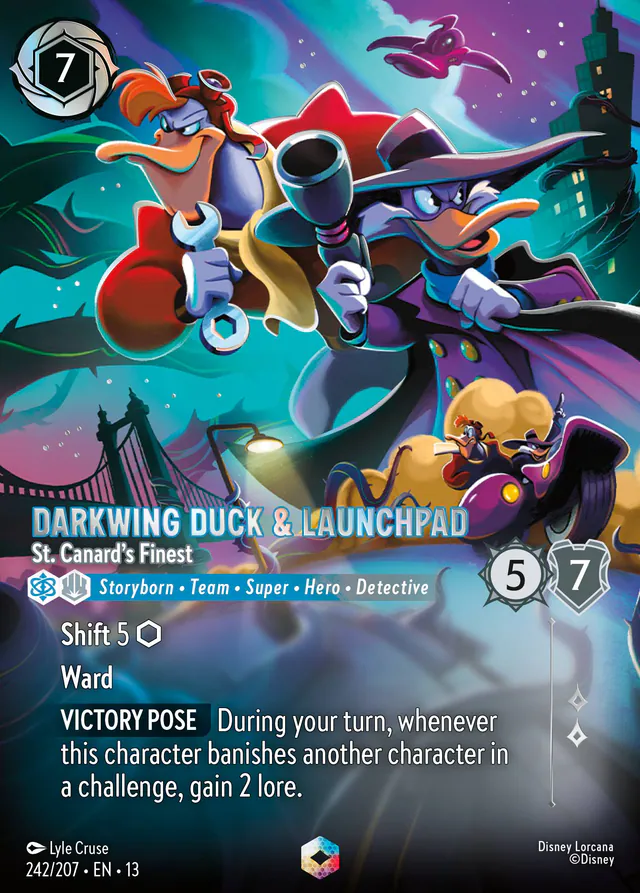 Darkwing Duck & LaunchpadSee it on collecto.rs
One in seventy-two packs contains an Enchanted card. Finding Darkwing Duck & Launchpad from Attack of the Vine! requires beat those odds, then beating the set checklist itself. Dual-character treatments sit at the intersection of low pull rates and specific expansion print runs, making them a double hurdle on the hunt.
While The Horned King relies on a growing general set checklist to split pull rates across dozens of possibilities, this duo locks its scarcity into a focused expansion context. You are not just pulling against the standard rarity curve of a main set. You are opening packs from a specific release window where the foil slot has to roll the highest tier, then land on this exact pairing rather than any other card in the expansion lineup. The math gets narrow quickly.
The card itself gives both characters space on the foil canvas without crowding either one. Disney Lorcana uses the Enchanted treatment here to blend full-art inks across a single frame, which makes the physical card distinct in a binder row. The ink finish catches light across both characters equally, rather than treating one as a background accent.
That combination of expansion-specific availability and double-character artwork creates a real bottleneck for set collectors. When you search for this card, you are looking for a print run that was already smaller than core set releases, filtered through the lowest pull probability in the game.
If you have this pair in your binder, collecto.rs lets you document the specific set details, track the condition of the foil surface, and export your entire catalog data whenever you want.
2. Anna (Winterspell)#
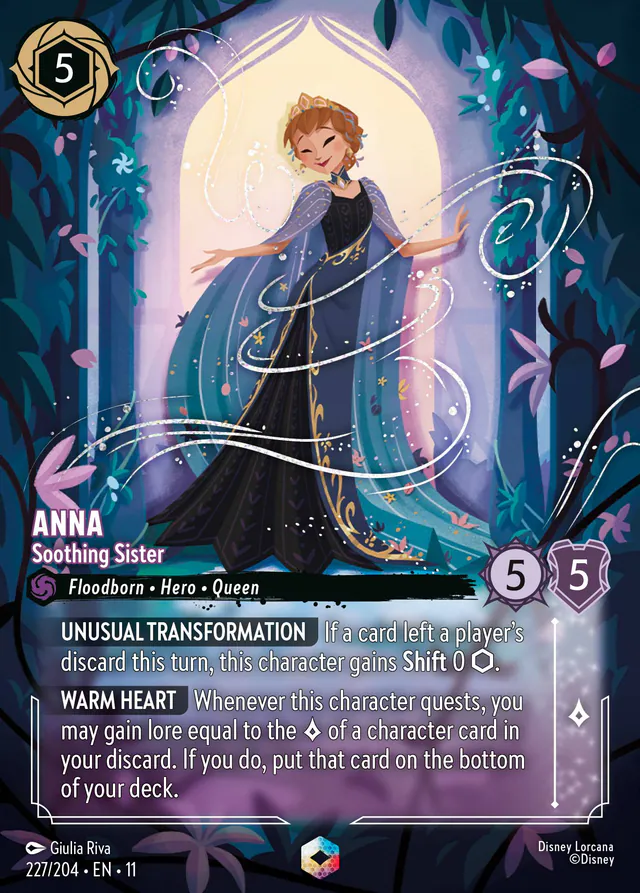 AnnaSee it on collecto.rs
The booster pack opens with a clean tear down the back foil seam. You slide the common cards forward, past the uncommon slots, straight to the back of the stack. Most times, the search ends on a cold foil uncommon. Once in every seventy-two packs, the foil catches the light differently, revealing the edge-to-edge ink layer of an Enchanted card. If you are looking for Anna from the Winterspell set, that pull rate is only the beginning of your math problem.
Winterspell sits in a specific niche within the Disney Lorcana release calendar. Unlike core expansions that stay in wide distribution for months, targeted seasonal sets move through retail channels in tighter waves. Big-box stores receive a set number of displays, sell through their initial allocation, and hand the shelf space back to the next wave. That tight window restricts the sheer quantity of sealed product opened by the community. When you layer the standard Enchanted odds over a shorter production run, the total population of this specific card stays remarkably small.
That tight supply curve sets Anna apart from cards like Kida, which came out during an era of wider, sustained core set availability. While Kida established the early baseline for what an Enchanted character hunt looks like across deep store shelves, Anna demonstrates what happens when those same odds hit a narrower distribution window. The card features a distinct edge-to-edge treatment that shifts her traditional Arendelle attire into a frosted palette, making it instantly recognizable from across a trading table. You are not just looking for a rare variant of a popular sister. You are hunting a specific print run that closed its doors faster than the main sets around it.
1. Kida (Into the Inklands)#
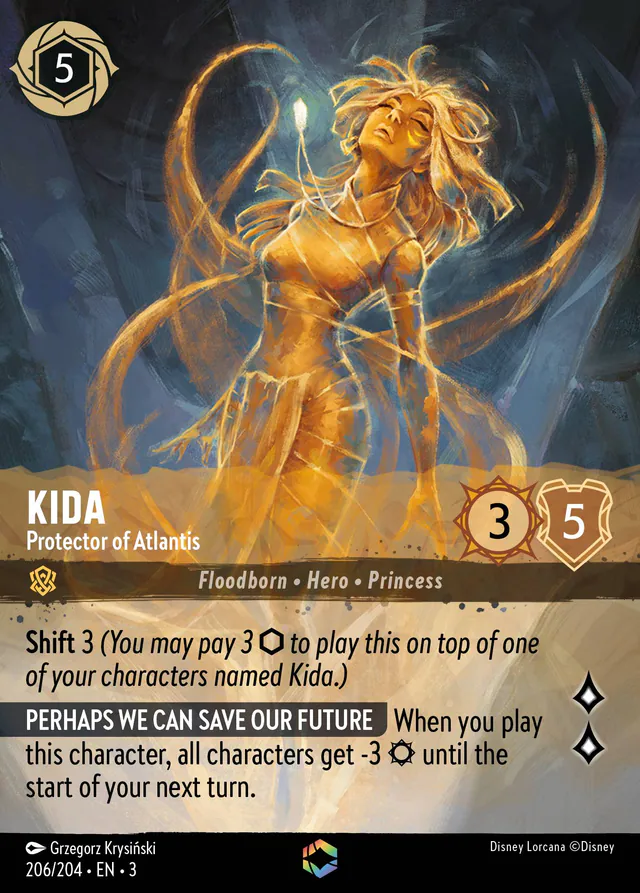 KidaSee it on collecto.rs
The foil catches the light across the glass frame on the table, and for a second, the deep blues of Atlantis look almost liquid. A friend leans over your shoulder, points at the lower right corner, and asks if you pulled it yourself. You tell them you bought it as a single three weeks after the set dropped, back when people were still arguing about the pull rates for the new Inklands boxes. They nod, look closer at the foiling on her spear, and stop asking questions. Some cards carry an aura that has very little to do with what happened in a tournament last weekend.
Into the Inklands pushed Lorcana into new structural territory with locations, but the Enchanted cards from this era hold their ground for a simpler reason. They marked the moment the foil treatments settled into something distinct. Where seasonal releases like Anna rely on short print windows tied to specific holiday inventory, early Enchanteds like Kida depend on the brutal, steady distribution of main-set booster packs. You cannot target a specific box or a localized store display to find her. You simply open packs, or you find someone who did.
That distribution math makes these early set Enchanteds a permanent benchmark for character collectors. The market fluctuates, but the physical pool of Inklands foil stock stays exactly where it was when the printer stopped running. Storing a card like this requires more than a binder sleeve. You want a record of the precise card in your hands, down to the corner wear you noticed under a desk lamp. collecto.rs lets you document these specific copies, record where they came from, and export your full inventory data whenever you want.
Collecting Lorcana shifts quickly depending on how you engage with it. If you build decks to play at a local game store, your definition of a hard-to-find card is whatever staple card is currently missing from trade binders. If you archive sets for display, the friction comes from products that skipped the traditional booster box model entirely, like organized play kits, standalone boxed sets, and promo promos distributed at specific conventions.
Ravensburger's distribution strategy continues to evolve with each new set. As the game expands, the structural choices made during earlier releases become permanent boundaries. A card that was difficult to source because of an unusual product format in the first year stays difficult to source, regardless of how many booster packs ship for current sets.
Tracking these cards means understanding where they came from before they reached a binder sleeve. If you are organizing your Lorcana sets, you can catalog your collection on collecto.rs. You can track card variants, log promos, and export your data whenever you want.
Frequently asked questions#
What makes a Lorcana card actually rare?#
Rarity in Lorcana goes beyond the symbol printed at the bottom of the card. While Legendary and Enchanted pulls are mathematically less frequent per booster pack, real scarcity often involves unique release formats. Cards distributed through limited boxed sets, promotional events, or specific product lines like the Illumineer's Quest series do not hit the market through standard booster boxes. That capped distribution creates true friction when you try to track down a specific copy.
Are Enchanted cards always the hardest to find?#
Enchanted cards carry low pull rates inside standard booster packs, making them consistent targets for collectors. However, special promo releases and specific boxed set variants can have even smaller total print runs. An Enchanted card from a widely printed set might exist in higher total quantities than a specialized quest print or a localized promo card. Frame, foil finish, and distribution method all contribute to real-world availability.
How should I store high-rarity Lorcana cards?#
Keep your cards in penny sleeves inserted into top loaders or rigid binder pages designed for trading cards. Lorcana foils use a textured foil layer that can show surface scratches if stored loose. Keep your collection away from direct sunlight and store binders horizontally or vertically without over-tightening the pages. If you track your collection on collecto.rs, you can log condition notes alongside your card entries.