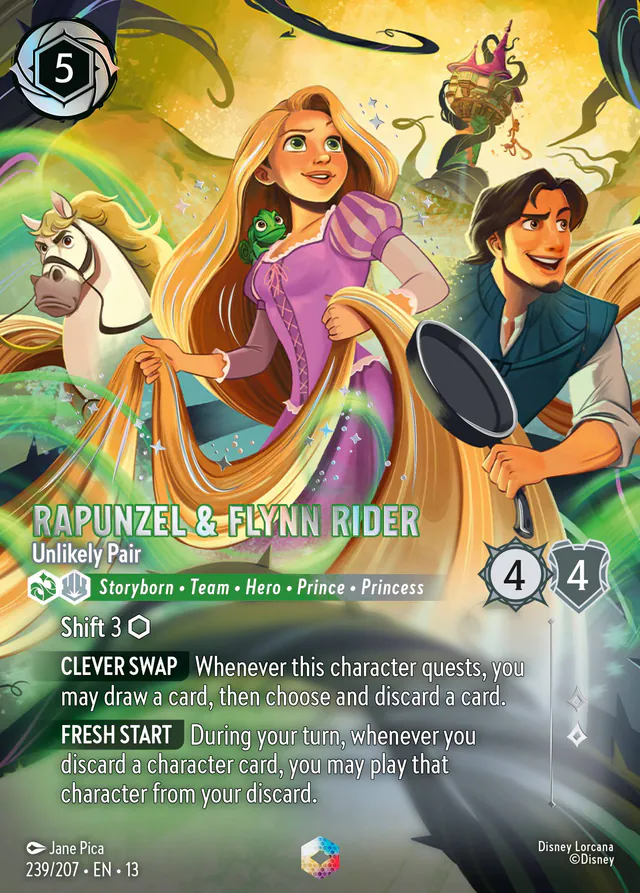
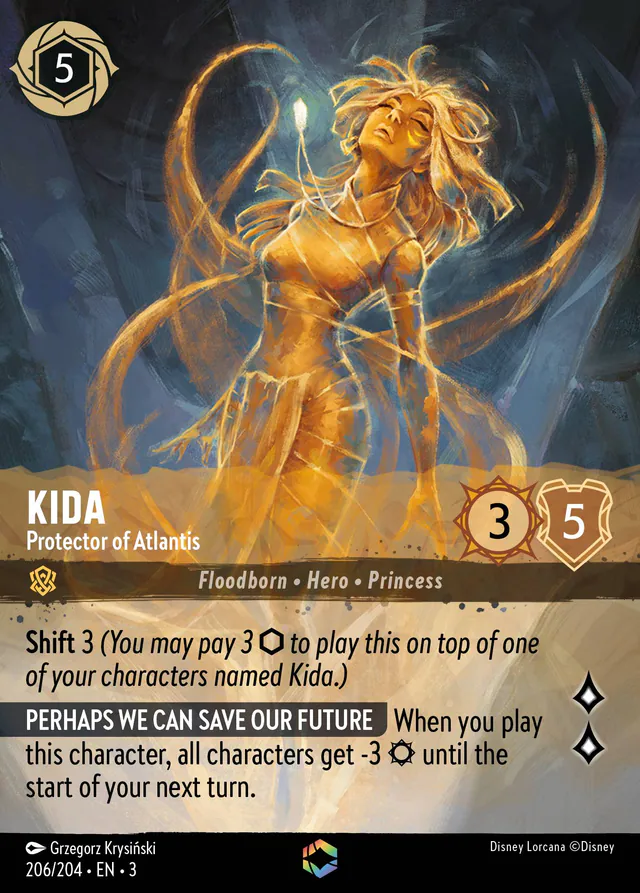
The short version#
Fabled treats every tier of rarity as a deliberate design choice, giving utility pieces the same mechanical purpose that the showcase printings give to presentation.
- Belle
- Circle of Life
- Maleficent
- Stitch
- Scar
- Genie
- Beast
- Motunui
- Sudden Chill
- Beast's Mirror
Every card game builds a hierarchy. Rarity symbols run along the bottom edge, sorting pieces from draft filler to display-case centerpieces. Most sets lean hard on that gradient. The commons do dull maintenance work, while the top tier carries the weight of the design budget.
Fabled approaches the sheet differently. Ravensburger built the set around an even spread of attention. The low-cost utility cards carry the same mechanical discipline as the showcase pieces. A common item card receives careful ink costs, specific timing windows, and distinct visual framing. It is not an afterthought meant to pad a booster pack. It solves an operational problem on the table.
At the other end, the showcase printings do not just add foil stamping and call it a day. They push the visual identity of the characters into distinct art styles, treating the card frame as an open canvas rather than a boundary. The rarity shift changes the card's function, moving it from game piece to art object, without abandoning the rules text printed underneath.
That balance shapes how you look at a binder. A set succeeds when the commons feel intentional in a deck box and the high-rarity printings feel earned on a display shelf. You notice it in the curve of the ink costs. You see it in how text boxes handle resource denial, location movement, and board wipes. Fabled gives a low-rarity utility piece the exact amount of design care required to make it playable, then turns around and gives a showcase legendary the room to breathe visually.
Whether you sleeve cards for weekly league play or slide them into nine-pocket pages, the set holds together. The ten cards ahead trace that design logic. They move through the commons that steady an ink curve, past the mid-tier threats that dictate field presence, and up to the full-bleed treatments that define the visual standard of the release.
| # | Item | Set / Year | Rarity |
|---|---|---|---|
| 1 | Belle | Fabled | enchanted |
| 2 | Circle of Life | Fabled | enchanted |
| 3 | Maleficent | Fabled | special |
| 4 | Stitch | Fabled | legendary |
| 5 | Scar | Fabled | legendary |
| 6 | Genie | Fabled | super-rare |
| 7 | Beast | Fabled | rare |
| 8 | Motunui | Fabled | uncommon |
| 9 | Sudden Chill | Fabled | common |
| 10 | Beast's Mirror | Fabled | common |
10. Beast's Mirror: Functional Simplicity#
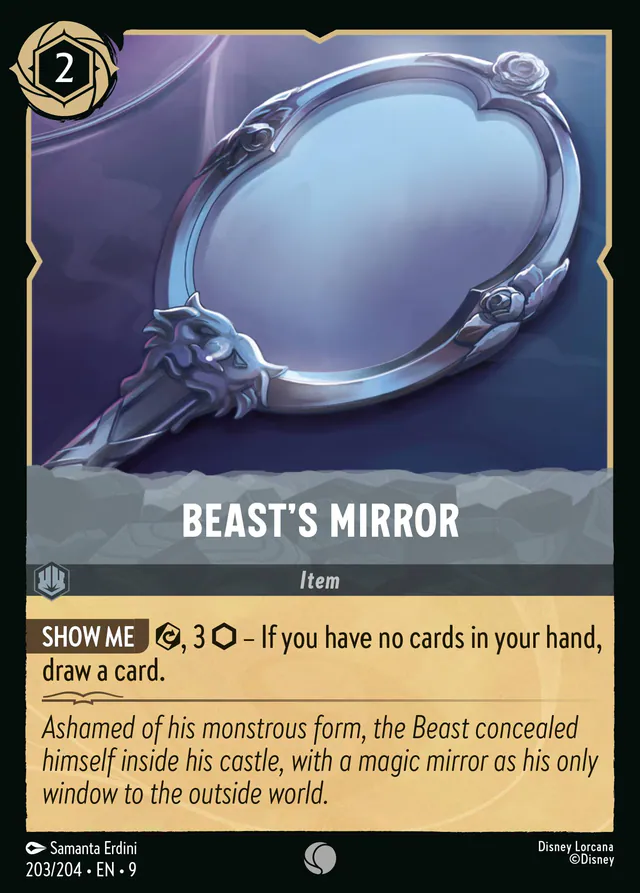 Beast's MirrorSee it on collecto.rs
Two ink to play, three ink to activate, and an empty hand becomes an active resource. Beast's Mirror sits at common in Fabled, tucked into the lower bracket of the set where utility lives without ceremony. The card asks for patience rather than tempo. You pay upfront, leave it on the board, and wait for the turn where your options run out. Then it does its job.
That quiet reliability is what earns it a place on this list. Sudden Chill disrupts the opponent's grip early, forcing an immediate discard to break their rhythm. Beast's Mirror works from the opposite direction. It looks at your own empty board state and builds back what you spent. Where Sudden Chill removes a choice across the table, the mirror hands you a fresh one. Neither card relies on high-rarity foiling or elaborate character art to justify its slot. Both prove that foundational game design often happens in the common sheet.
For a binder, common artifacts often get overlooked in favour of legendary characters or full-art treatments. That is a mistake if you care about how a set actually plays. Fabled balances heavy hitters with these spare, functional pieces. Beast's Mirror does not carry an inkwell icon, meaning you cannot convert it into ink if your curve stumbles. You play it with intent, or you leave it out entirely. That constraint makes it interesting.
When you log your Fabled sets on collecto.rs, this is the kind of entry that completes the picture. A master set is not just the showcase cards. It is the commons that did the heavy lifting during late-game topdecks, recorded down to the finish and condition.
9. Sudden Chill: Targeted Resource Control#
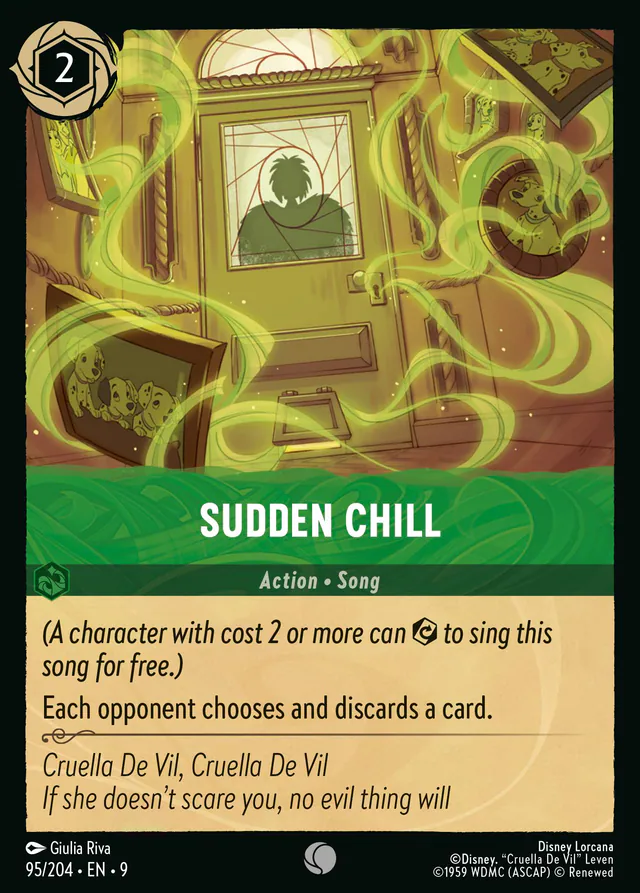 Sudden ChillSee it on collecto.rs
Most conversations about control tools dwell on expensive ink investments or flashy board wipes. Sudden Chill works in the other direction. It is a common action card that costs two ink to resolve, forcing every opponent to choose and discard a card from their hand. The effect is plain, almost blunt. Yet in the opening turns of a match, stripping away a single resource disrupts the line of play your opponent mapped out while looking at their opening draw.
That immediacy changes the texture of early turns. While an item like Beast's Mirror sits on the table waiting for you to empty your hand before providing steady card draw, Sudden Chill strikes outward immediately. It does not ask you to build around an engine or maintain presence on the board. You play it, your opponent loses an option, and the ink curve shifts slightly in your favor. It does not create raw advantage so much as it restricts what the other side of the table can answer with.
Cards like this matter to Fabled because they anchor the lower rarity tier in functional mechanics. A healthy card pool needs foundational tools that perform reliably without demanding rare slots or complex interactions. Sudden Chill fits into song-heavy strategies with equal ease, since any two-cost character can sing it for free. That flexibility lets you keep your ink free for characters while still trimming down the other player's reserves.
When you sort through a set, it is easy to let the common actions slide to the back of the binder. Sudden Chill earns its spot by proving that effective pressure does not require high rarity foil treatment. It does one specific job, does it early, and alters the tempo before the bigger pieces ever hit the board.
8. Motunui: Shifting the Field#
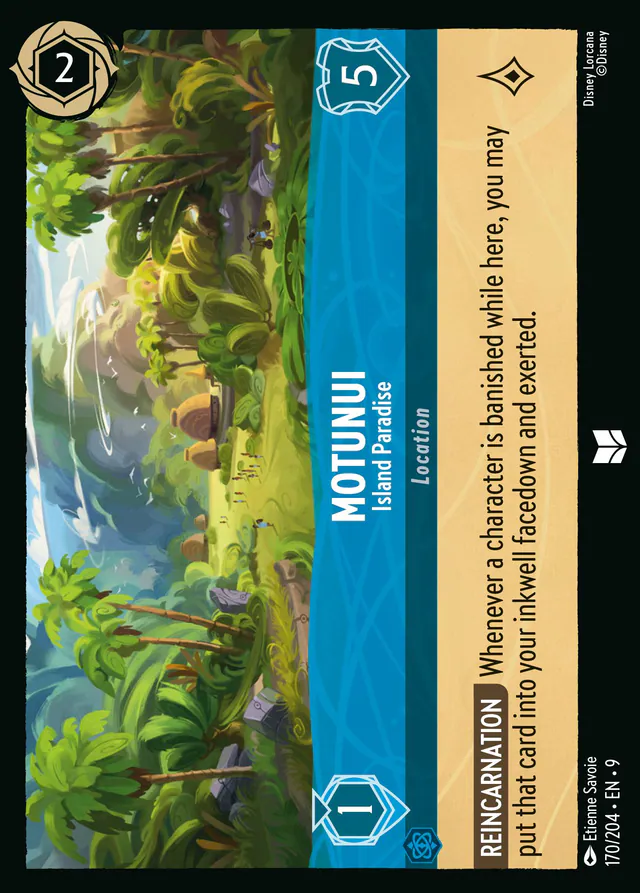 MotunuiSee it on collecto.rs
A playmat sits between two people. For three turns, the rhythm is strictly conversational. You tap ink, you push a character forward, they answer with a challenge, and the board resets to an empty middle. Then Motunui slides horizontally across the cloth. Suddenly the geography matters as much as the duel.
That horizontal orientation does real work. In Lorcana, characters handle the immediate chores: questing, trading, and keeping the inkwell fed. Locations give those characters somewhere permanent to exist. Motunui pulls your attention sideways. It offers lore passively, turn after turn, forcing your opponent to make an awkward choice. They can commit challenge damage to clearing the land, or they can watch you accumulate lore without risking a single tap.
While Sudden Chill alters the rhythm of early turns by stripping resources directly from a hand, Motunui changes the shape of the table itself. Sudden Chill happens once and leaves behind an empty space. Motunui stays put. It creates a stubborn anchor that lingers across turns, giving weaker questers a safe harbour and altering how your opponent sequences their ink.
It enters Fabled as an uncommon, which makes it easy to find and simple to test. That accessibility matters. You do not need a foil sheet or an inflated rarity symbol to see how a card reshapes match tempo. Motunui does not demand an entire deck built around island mechanics to justify its place. It asks for ink, takes up residence on the flank, and quietly collects lore while the characters in the centre absorb the hits.
When you log it into your collecto.rs binder, you can tag it by its mechanical role rather than just set order. It tracks nicely alongside your other Fabled locations, ready for whenever you want to export your list or rebuild a deck.
7. Beast: Raw Board Presence#
 BeastSee it on collecto.rs
What makes a card stay in a deck long after the novelty of a set wears thin? Often, it comes down to sheer reliability when ink hits the table. Beast sits in that pragmatic sweet spot for Fabled. While flashy pieces demand specific setups to justify their cost, a Rare printing like this answers a simpler need: stabilising your line and demanding an answer from across the mat.
Where Genie relies on layered abilities to bend tempo and reset lines, Beast takes a direct route. There is little subtlety in high willpower and steady strength, but that simplicity is its strength. A card that refuses to leave easily forces awkward trades. It forces an opponent to commit multiple challenges or burn removal they would rather save for an endgame push. In deckbuilding, predictability is its own kind of power. You do not always need a card to perform a magic trick; sometimes you just need something built to hold ground while you assemble the pieces behind it.
Fabled treats its Rare slot as the working engine of the release. The Super Rares capture immediate attention in pack openings, yet the cards that quietly steady multiple archetypes tend to sit one tier down. Beast exemplifies that balance. The card does not ask you to pivot your entire strategy around its text box. Instead, it slots into the midgame curve, absorbs pressure, and lets the rest of your ink perform its job. For those cataloging the set by mechanical function rather than just foil treatments, this is the sort of anchor piece that defines how Fabled actually plays.
6. Genie: Dynamic Interaction#
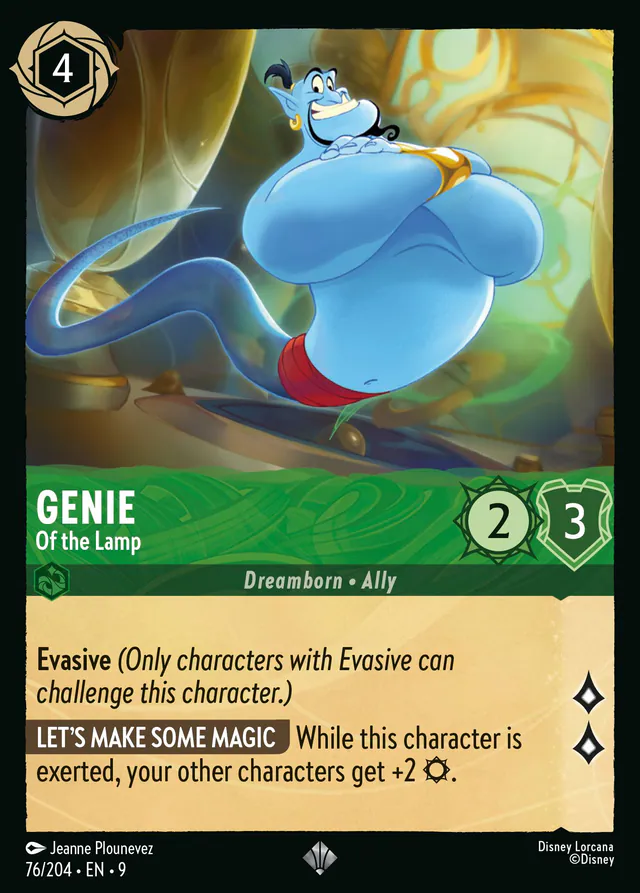 GenieSee it on collecto.rs
The temptation is to evaluate dynamic cards by how much ink they cost to drop, but that gets the math backwards. Value shows up in what happens to the table the moment they arrive. Genie sits in Fabled as a super-rare built entirely around disrupted rhythm, forcing choices on an opponent before they have settled into their turn.
While Scar relies on raw legendary presence to command an immediate response, Genie takes a sideways approach. He alters pacing through layered abilities that bounce threats, shift challenge math, and peel away momentum without needing sheer brute strength. That distinction matters across long matches. Heavy finishers arrive with clear warnings. Super-rare utility cards slip through gaps in sequencing, resetting an opposing board just enough to flip who dictates the exchanges.
Fabled treats dynamic interaction as an active discipline rather than a passive defensive trick. When you pilot cards like this, you trade raw stats for timing windows. You wait for an overextension, slide Genie into play, and turn a calculated risk into an awkward board state for the other side of the table. The card functions less like a wall and more like a detour, buying the exact amount of space your secondary lines need to come online.
Whether you sleeve cards to shuffle them every weekend or organize them into binders by set symbol and rarity stamp, pieces with flexible playlines reward closer study. They tell you how the designers viewed the back-and-forth flow of a match during the development of Fabled. If you track your master set on collecto.rs, you can log the super-rare slot, tag the foil variants, and export your entire index whenever you want to check your gaps against a trading binder.
5. Scar: Apex Threat#
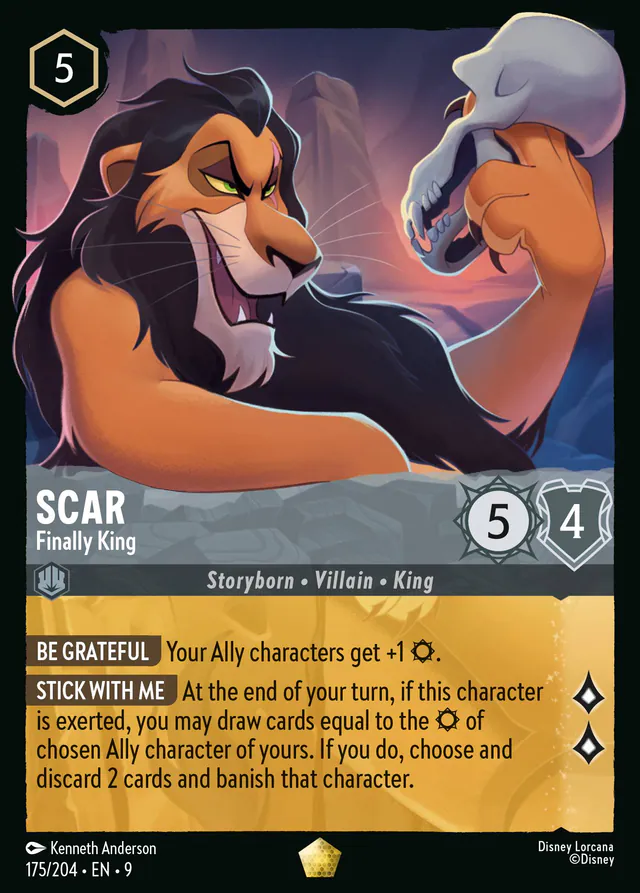 ScarSee it on collecto.rs
Across the table, your opponent sets down a fresh challenge target, counts their remaining unexerted ink, and exhales. That brief posture of relief is usually where Scar steps in. Cast onto the table as a Legendary threat from Fabled, he alters the arithmetic of the entire board state before the ink dries on the turn. There is no subtle setup here, and no waiting around for an engine to sputter to life over three rounds.
Where the playful Stitch nearby on this list disguises sharp, technical mechanics behind cheerful mischief, Scar makes no attempt at charm. His presence demands an immediate answer or a total revision of combat math. He does not negotiate with an opposing line. Instead, his presence forces an uncomfortable choice on your rival: expend vital combat resources to banish him now, or watch their established glimmers get cleared out on your terms. That immediate board tax defines what makes the top end of Fabled so compelling to build around.
Cards like this anchor a binder page as naturally as they anchor a tournament sixty. The Legendary foil treatment on Fabled captures that heavy, predatory posture in a way that flat matte scans never quite reproduce. In hand, the card stock carries that dense, imposing silhouette that feels earned at this rarity tier.
If you run him in a deck, he serves as an apex predator designed to seize tempo. If you slide him into a protective sleeve for your binder, he marks a milestone entry in the set’s heavy hitters. You can catalog your copy on collecto.rs alongside your other Fabled pulls, note the foil finish, and keep your full play set sorted right where you can reference it.
4. Stitch: Unpredictable Value#
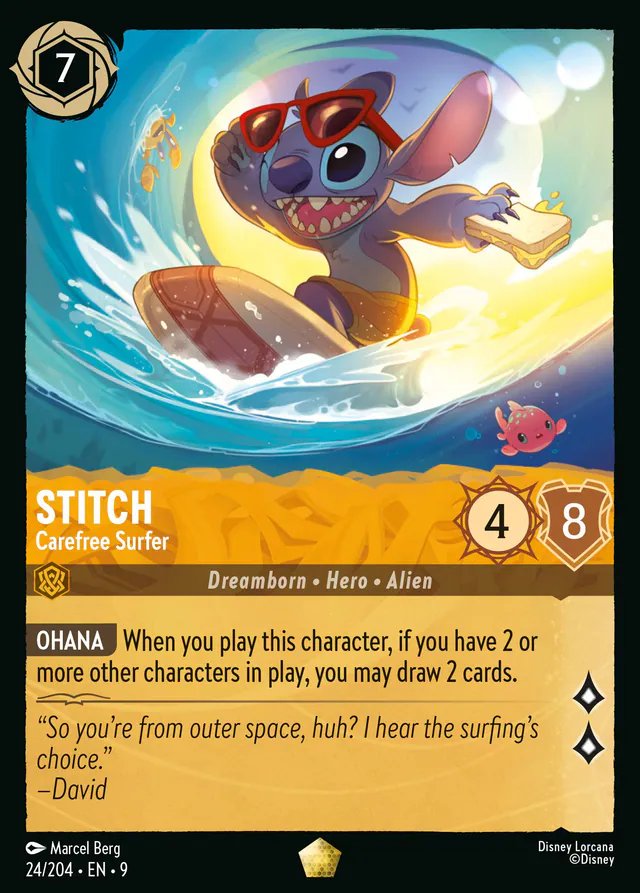 StitchSee it on collecto.rs
Serious mechanics usually dress the part, but Stitch ignores that custom entirely. Where Scar arrives with solemn posture to demand an immediate answer from across the table, this legendary card lands like an uninvited houseguest who instantly reorganises your kitchen. The illustration carries the chaotic, toothy charm of an animated rascal. Beneath the playful exterior sits an engine built for cold efficiency. It is easy to misjudge a piece when the art makes you smile, yet Fabled repeatedly uses that disarming tone to mask serious utility.
That tension between appearance and function gives the card its lasting pull. Some legendary printings feel heavy by design, loaded with intricate text meant to signify their weight before you even read them. This Stitch keeps the rules text clean and the lines punchy. It does not threaten to end a turn on its own. Instead, it alters the pace of the game by existing in an awkward space your opponent cannot comfortably ignore. A small alien causing disproportionate friction is faithful to the character, certainly, but it also reflects how Fabled treats the top end of its rarity sheet.
In a binder, it brings a bright patch of color that stands apart from the brooding villains and stately royalty filling adjacent slots. If you log your set progress on collecto.rs, you can track it alongside the rest of your Fabled legendaries and see that visual contrast in real time. The card proves that high-impact pieces do not need to look grim to command attention. It earns its slot through sheer, disruptive presence, showing that good design can be rigorous without ever losing its sense of mischief.
3. Maleficent: The Alternate Presentation#
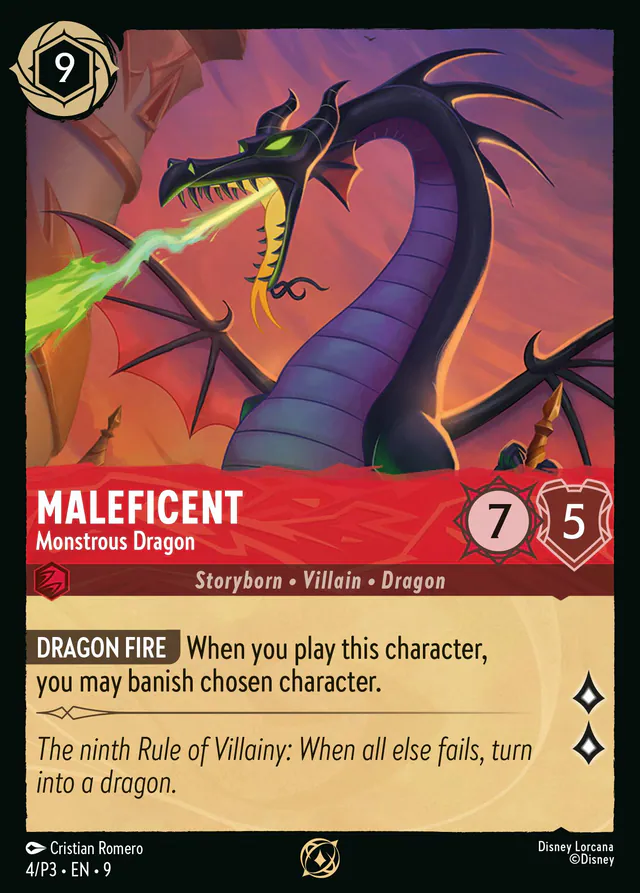 MaleficentSee it on collecto.rs
A friend spent twenty minutes at a local league night turning a card under a desk lamp. Nobody was playing a match. Three of us just stood there watching foil catch the light across an ink-black horn. That was Maleficent from Fabled, and the table went quiet for reasons that had nothing to do with lore totals.
This card belongs to the set’s special rarity tier, where Lorcana steps away from standard card anatomy. Regular cards rely on familiar layout furniture. You get clear borders, standardized text boxes, and predictable margins. Maleficent breaks those bounds entirely. The illustration drives the layout instead of sitting inside a window. The palette feels colder and heavier than usual. It treats the character as an architectural presence rather than a flat piece of animation cardboard.
Where Stitch proved that a chaotic character could house precise, cutthroat mechanics, Maleficent tackles the opposite side of the binder. She is about presence. Cards like Circle of Life handle major narrative beats by pulling the camera back. Maleficent pulls the camera directly in. The frame disappears, the horns encroach on the rules text, and the foil finish behaves like polished obsidian. It asks you to look at the card as a cohesive visual object rather than game pieces assembled from parts.
That balance matters if you sort your collection by visual identity. When a card rethinks how a border works, it earns its spot by standing apart from the fifty cards around it. You can log it in your collecto.rs account under Fabled to keep your rarity variants straight alongside your standard playsets. Export the record whenever you want. Seeing Maleficent on a screen is fine, but tracking it in a binder row reminds you what happens when print design takes real risks.
2. Circle of Life: Iconography in Foil#
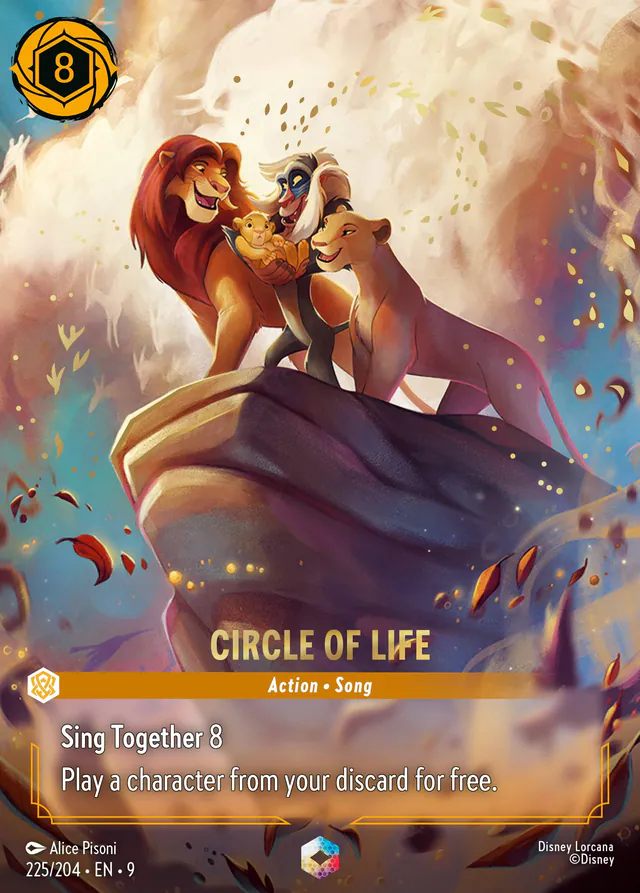 Circle of LifeSee it on collecto.rs
The booster pack crinkles open, the rear card slides into view, and the foil catches the overhead bulb with a broad stroke of sunrise gold. It is not a glint or a character portrait. It is the sweep of Pride Rock rising out of the mist, rendered across the borderless treatment reserved for the set's rarest pulls. When Lorcana debuted enchanted treatments, the focus fell squarely on glimmers. Collectors expected hero silhouettes and villain portraits pushed to painterly extremes. Circle of Life proves that narrative moments carry the exact same visual weight, turning an iconic song beat into a standout showcase piece without a face in the center of the frame.
Where Maleficent earns its rank by subverting familiar character borders with sharp, jagged villainy, Circle of Life takes the opposite path. It treats an action card as pure environmental storytelling. The card stock carries the panoramic depth of an animation background plate, but the foil patterning shifts the weight toward symbolic weight. You recognize the sunrise, the silhouetted assembly on the savanna, and the towering stone shelf before your eye ever drifts down to read the card text. It functions less like a playable spell and more like a permanent artifact of Disney lore.
That distinction matters when you build a binder around Fabled. Character enchanted cards will always command an audience, but cards like Circle of Life give the set its structural variety. They reward collectors who care about pivotal film history as much as glimmers with challenge stats. You slide it into an unclouded sleeve, drop it into the slot next to your song cards, and the page immediately feels complete. If you track your Fabled variants on collecto.rs, you can mark the enchanted foil distinction with a single tap and export the checklist whenever your master set plans shift.
1. Belle: The Showcase Standard#
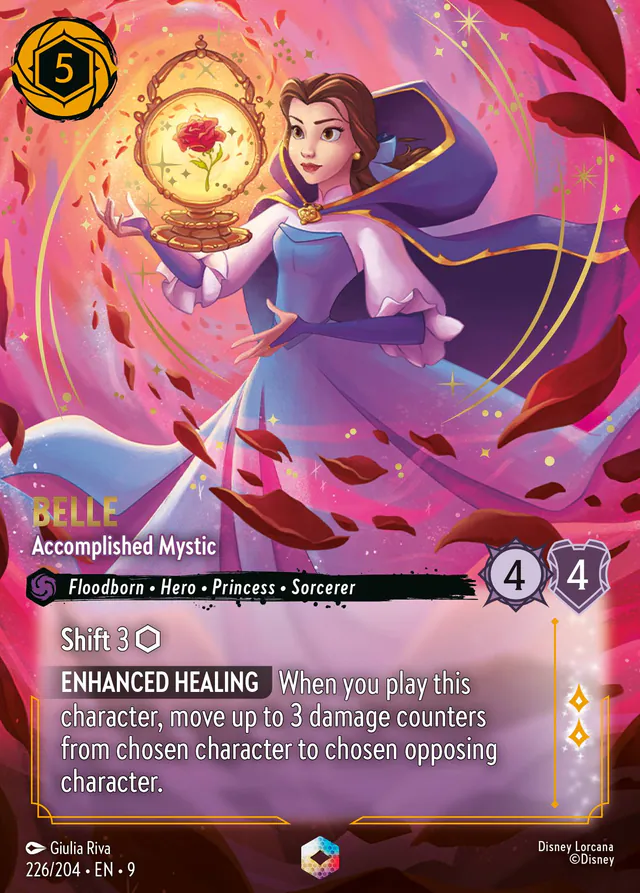 BelleSee it on collecto.rs
Can an enchanted card carry the visual identity of an entire expansion on its own shoulders? Fabled answers that directly with Belle, placing her at the summit of this checklist because she crystallises what the rarity treatment was designed to achieve. While Circle of Life captures a pivotal narrative event through ambient scale, Belle roots the set in an intimate character study. The contrast is deliberate. One frames a world, while the other gives you a person to care about.
The layout strips away the usual mechanical borders to let the composition breathe. You see the warm amber light, the delicate book spine, and the deliberate palette choices that separate this printing from standard binder fodder. Lorcana works best when its artists lean into storybook illustration rather than generic game assets. Here, the foil treatment works in service of the portrait rather than competing with it for light. The ink cost and stat lines recede into the corners, leaving the figure centered and calm amid the foil wash.
Collectors look for pieces that establish a set's visual ceiling. With this card, the design team demonstrated how to honor classic animation without simply screenshotting a cel from the archives. It feels purpose-built for the format. You can slip it into an inner sleeve, drop it into a magnetic holder, and understand why the enchanted tier exists. It does not need complicated rule text to justify the spot it occupies. The execution is confident, patient, and unmistakable across the table.
If you keep this in your collection, track it in collecto.rs with the full high-resolution scan so the surface foiling stays distinct from standard print runs. The archive lets you export your notes and variants whenever you need them.
A set list tells you what exists. The print run tells you how the designers think.
Fabled works because it refuses to treat the bottom of the rarity sheet as scrap paper. When common items and uncommons handle board states cleanly, the game moves well. When the rarest cards earn their footprint through deliberate, distinct art direction, the binder feels complete. The gap between a workhorse discard action and an alternate-art centerpiece is wide, but the design philosophy behind them remains steady.
That consistency matters over time. Card stock wears, metagames shift, and new releases crowd the storage boxes. The sets that hold their ground are the ones built with intent from the first common slot to the final foil layer. Fabled leaves that structure visible on every card face.
If you are sorting through your own playsets and foils, log them in your collecto.rs account. Add the variants, note the conditions, and keep your inventory organized by set and rarity. The data stays yours to export whenever you want. You can catalog your Fabled pulls and view your complete Lorcana collection anytime.
Frequently asked questions#
What makes the Fabled set distinct in Disney Lorcana?#
Fabled brings together mechanical shifts across multiple ink colours, pairing key utility commons and uncommons alongside high-rarity collector printings. It introduces varied card styles, including enchanted and special rarity versions, giving players functional depth and collectors specific visual targets within the same card pool.
How do enchanted cards differ from standard rarities in Fabled?#
Enchanted cards are alternate art printings featuring borderless framing and specialized foil treatments. They share names, ink costs, and gameplay rules with their standard counterparts, but their print frequency is lower, making them distinct catalog pieces for dedicated collectors.
Why track common and uncommon cards from Fabled?#
A complete view of any Lorcana set relies on the foundation cards that drive gameplay. Items like utility songs and repeatable ink engines show how the game evolves mechanically. Cataloging them provides a full account of the release rather than just a top-tier highlight reel.