Let's talk about the 1970s.
When most people picture that decade, they think bell bottoms, record players, and hair that took a lot of work. Fair. But something else was happening at the same time, and almost nobody outside Japan noticed.
Anime was growing up.
At the start of the decade, cartoons were mostly for kids. Fun, silly, and you could skip an episode without missing anything. By 1979, that was completely over. A bunch of stubborn directors decided animation could be serious. Characters started aging. Dying. Making bad choices they couldn't take back. Shows got real plots that carried across a whole season, so missing one episode meant you were lost.
These creators pulled ideas from history books, war stories, sci-fi novels, and weird art movies. They used lighting and camera angles like film directors. And they told stories about loss, identity, and survival that people still argue about today.
The ten shows and movies below are basically the blueprint. Every anime you love owes something to at least one of them. Let's go.
| # | Item | Set / Year | Rarity |
|---|---|---|---|
| 1 | Mobile Suit Gundam | — | — |
| 2 | Lupin The 3rd: The Castle of Cagliostro | — | — |
| 3 | Lady Oscar: The Rose of Versailles | — | — |
| 4 | Future Boy Conan | — | — |
| 5 | Belladonna of Sadness | — | — |
| 6 | Star Blazers: The Quest for Iscandar | — | — |
| 7 | Tomorrow's Joe | — | — |
| 8 | Anne of Green Gables | — | — |
| 9 | Aim for the Ace! | — | — |
| 10 | Microid S | — | — |
10. Microid S#
 Microid SSee it on collecto.rs
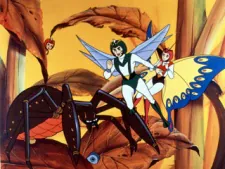
Everybody in the early 70s was making their heroes bigger. Osamu Tezuka went the other way and shrank his down to the size of a bug.
Microid S follows three tiny people trying to stay alive in a world that is suddenly enormous. And when you're that small, you notice things. A puddle isn't a puddle, it's a lake of chemical runoff. The pretty green countryside is actually poisoned. The air is full of smog. Tezuka took a kids' adventure show and quietly turned it into a warning about what factories were doing to Japan.
That was a big deal. TV anime wasn't supposed to make you feel bad about your own country. But shrinking the heroes made every gross puddle a life-or-death problem, which is a pretty clever trick. While Aim for the Ace! was digging into what was going on inside its characters' heads, Microid S pointed the camera outward and said, "Hey. Look what we're doing out here."
9. Aim for the Ace!#
 Aim for the Ace!See it on collecto.rs
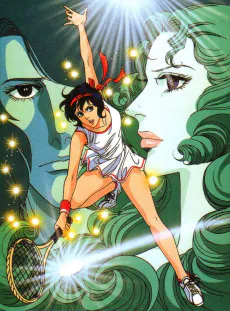
Twenty-six episodes. October 1973. Tennis.
I know. Stay with me.
Hiromi Oka is fifteen and joins her school's tennis club for one reason: she thinks the star player, Reika, is the coolest person alive. Then a new coach named Munakata shows up, takes one look at Hiromi, and puts her on the top team over girls who have been training for years. Everyone hates her instantly. She's exhausted. She's not sure she deserves it. Honestly, neither is anyone else.
That's the whole show, and it's incredible. Director Osamu Dezaki went wild with the visuals — split screens, harsh shadows, and his famous trick of freezing on a hand-painted pastel still right at the biggest moment. It made a tennis match feel like a knife fight. No magic super-shots, no glowing rackets. Just a teenager deciding whether to keep going. Every sports anime since has borrowed from this one.
8. Anne of Green Gables#
 Anne of Green GablesSee it on collecto.rs
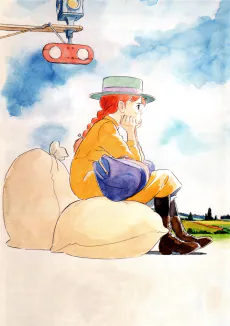
The 70s were loud. Robots, punches, spaceships. And then there's this show, where the biggest crisis is a misunderstanding about a hat.
Anne of Green Gables was directed by Isao Takahata with help from a young Hayao Miyazaki, which is a bit like finding out two future legends worked at your local coffee shop. It follows Anne Shirley, a talkative orphan with a giant imagination who shows up at a farm only to learn her new guardians wanted a boy. Whoops.
Over fifty episodes, Anne goes from a strange eleven-year-old to a grown-up dealing with real loss. Nothing explodes. Nobody fights. It just quietly takes its time. Tomorrow's Joe found its drama in tough city streets — this one found the same weight in a farmhouse kitchen. It proved anime could sit still and be beautiful, which is somehow harder than animating a robot.
7. Tomorrow's Joe#
 Tomorrow's JoeSee it on collecto.rs
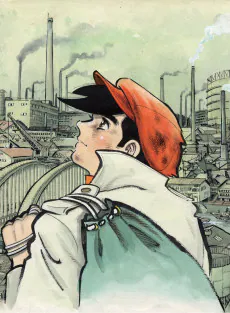
Here's a fact that never stops being wild: in the late 60s and early 70s, real protesters marched through Japanese streets carrying copies of this manga. Not as a joke. Joe was their guy.
The anime hit TV in 1970 and kept all that anger. Joe Yabuki is a broke teenage orphan running around a poor Tokyo neighborhood, picking fights with anyone who looks at him funny. He gets spotted by Danpei Tange, a washed-up boxing trainer with a serious drinking problem who sees something in him. What follows is juvenile detention, brutal training, and a rivalry with a fighter named Toru Rikiishi that people are still not over.
Nothing about it is glamorous. It's muddy alleys, empty pockets, and people the rest of the country had stopped thinking about. While Star Blazers was proving anime could go to space, Tomorrow's Joe proved you didn't have to go anywhere at all. A rainy street and a kid with nothing to lose was plenty.
6. Star Blazers: The Quest for Iscandar#
 Star Blazers: The Quest for IscandarSee it on collecto.rs
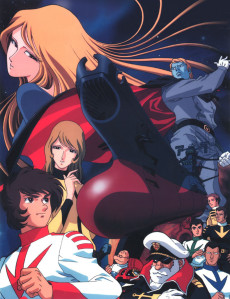
Okay, the setup here is bonkers, and I mean that lovingly.
Earth is dying. Aliens called the Gamilons have been dropping radioactive asteroids on the planet until there's barely anything left. Then a queen named Starsha, from a planet called Iscandar, sends word that she has a machine that can fix it. Small catch: Iscandar is 148,000 light-years away, and humanity has one year before it's over.
So what does Earth do? It digs up a sunken World War II battleship, turns it into a spaceship, and launches it into space. Obviously.
What made this show matter is that it kept going. Most TV animation reset every week — bad guy shows up, gets beaten, everything's fine. Not here. The clock ticks all season. People die and stay dead. Losses stick. Belladonna of Sadness was proving anime could be serious art in a theater, and Star Blazers proved you could do it on regular TV, on a Wednesday, with a ship made out of a boat.
5. Belladonna of Sadness#
 Belladonna of SadnessSee it on collecto.rs
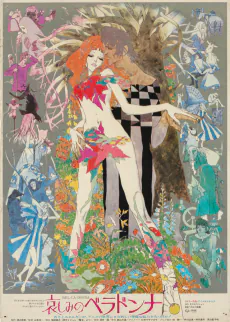
Quick heads up: this one is strictly for grown-ups. It's dark, it's disturbing, and it's not even a little bit for kids. Fair warning given.
Belladonna of Sadness came out in 1973, directed by Eiichi Yamamoto. It's the last film in the Animerama trilogy and the only one Osamu Tezuka didn't write or direct. The story is based on a real history book about witch trials, and it follows Jeanne, a peasant woman in medieval France who is treated horribly by the lord who rules her village and then abandoned by her husband. She turns to a dark spirit for power, and things get strange fast.
Visually, it's like nothing else from the decade. Instead of drawing frame after frame of movement, Yamamoto mostly used still watercolor paintings and slowly panned the camera across them, letting images melt and twist. There's a wild jazz soundtrack under all of it. It looks less like a cartoon and more like a nightmare someone painted. Where Star Blazers was clean, functional TV animation, this was somebody treating anime like fine art and daring you to argue.
4. Future Boy Conan#
 Future Boy ConanSee it on collecto.rs
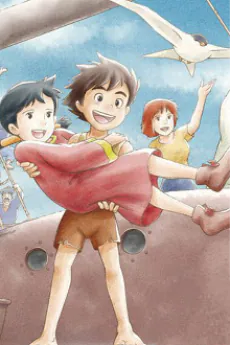
Picture a kid leaping across the rusted beams of a half-sunk skyscraper to catch a fish with his bare hands. That's the first thing you see. That's the vibe.
This was Hayao Miyazaki's first time directing, and you can already tell. It's set long after a war with "ultra-magnetic weapons" broke the continents apart and sank most of the world underwater. Conan grows up alone on a tiny island, then heads out into a world split between grim factory people and peaceful farmers.
The thing everyone talks about is how it moves. Water sloshes like it has weight. Machines clank like they're heavy. Conan runs like a real kid, if that kid could also climb a building. Most shows back then reused frames to save money — this one refused. Lady Oscar took huge drama and made it personal and lavish; Future Boy Conan took that same ambition and pointed it at a giant broken world. It's a TV show that acts like a movie, and it basically wrote the rulebook for everything Miyazaki did next.
3. Lady Oscar: The Rose of Versailles#
 Lady Oscar: The Rose of VersaillesSee it on collecto.rs
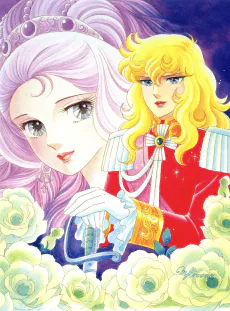
Forty episodes. October 1979 to September 1980. Powdered wigs, palace drama, and a revolution coming whether anyone's ready or not.
Riyoko Ikeda's story follows Oscar François de Jarjayes. Her father wanted a son, so he raised her as one, and she grew up to command the Royal Guard at Versailles. She's loyal to Marie Antoinette. She's also starting to notice that people outside the palace are starving. Those two facts do not get along, and watching Oscar get torn between them is the whole show.
Osamu Dezaki directed this one too, so expect the same tricks as Aim for the Ace! — dramatic freeze-frames, light streaming everywhere, everything cranked to eleven. While Future Boy Conan used giant landscapes to tell a giant story, Lady Oscar made the fanciest palace in Europe feel like a room with the walls closing in. It also permanently ended the idea that shows aimed at girls couldn't be as heavy as anything else on TV.
2. Lupin The 3rd: The Castle of Cagliostro#
 Lupin The 3rd: The Castle of CagliostroSee it on collecto.rs
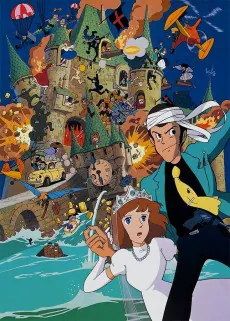
Lupin and his partner Jigen rob a casino, get away clean, and then discover the money is fake. Every bill. Beautifully fake, but fake.
So they follow the trail to Cagliostro, a tiny made-up country in Europe, and immediately walk into something much bigger. There's a young woman named Clarisse being forced to marry the Count who runs the place. There's treasure hidden under the castle. And to pull it off, Lupin has to rope in the swordsman Goemon, the untrustworthy Fujiko, and — best of all — Inspector Zenigata, the cop who has spent his entire career trying to arrest him.
This was Miyazaki's first feature film, from 1979, and it just glides. Nothing sits still. The car chase alone has been copied by animators for forty years. He also softened Lupin up, turning him from the manga's smug jerk into someone who genuinely wants to do the right thing, mostly. Where Lady Oscar went for tragedy, this went for pure fun — and proved animation could hang with any live-action adventure movie Hollywood was making.
1. Mobile Suit Gundam#
 Mobile Suit GundamSee it on collecto.rs
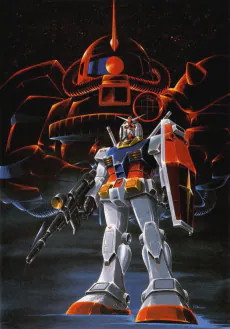
Before 1979, giant robots were basically superheroes. Unbeatable, heroic, showing up every week to punch a monster. Then Yoshiyuki Tomino asked a question nobody had bothered with: what if the robot were just... equipment?
Mobile Suit Gundam drops you into a war between the Earth Federation and the Principality of Zeon. Amuro Ray is a teenager who climbs into an experimental machine because his neighbors are about to die and there's nobody else. He's not chosen. He's not ready. He's just the kid who was standing there.
And then the show does something sneaky. The robot breaks. It runs out of ammo. Somebody has to fix it. The enemy soldiers turn out to have reasons that make sense, which is deeply annoying when you'd rather they were just evil. Nobody comes out of it okay.
It flopped at first, by the way. Ratings were bad. But older fans found it, model kit builders went feral for the designs, and the whole thing came roaring back. While Cagliostro won people over with charm, Gundam won by being honest about war. It invented an entire genre, and forty-plus years later the franchise is still going.
Look at that list again and it's a little startling how much of it still shows up in things you watched last week. The camera moves, the serialized storytelling, the idea that a cartoon can break your heart — all of it got figured out by a handful of people in the 70s who refused to be told animation was the kiddie table.
No computers. No huge budgets. Just paper, paint, and some very stubborn opinions about what stories are worth telling.
Thanks for hanging out. Now go watch one.
Frequently asked questions#
Why were the 1970s so important for anime history?#
This is when anime stopped being just for kids. Directors like Hayao Miyazaki, Isao Takahata, and Osamu Dezaki started telling longer, more serious stories and invented the visual tricks — moody lighting, split screens, dramatic freeze-frames — that anime still uses today.
What genres defined 1970s anime?#
Five big ones: sports shows built around rivalries, adaptations of classic Western novels, space operas, the birth of the "real robot" genre, and gritty stories about scrappy outsiders.
Where should a beginner start with 1970s anime?#
Start with Lupin The 3rd: The Castle of Cagliostro. It's a movie, it's about two hours, and it's just plain fun. If you'd rather do a series, Future Boy Conan holds up great and moves fast.