The short version#
Springer volumes capture hyper-specialized moments in scientific and technical history, turning complex disciplines into tangible physical reference works.
- Precision Manufacturing
- Universe of Scales : From Nanotechnology to Cosmology
- Advances in Cryptology – EUROCRYPT 2018
- Digital Holography and Three-Dimensional Display
- Machine interpretation of line drawing images
- Partial differential equations in action
- Density Functional Theory
- Macro-engineering
- The Letters and Papers of Jan Hendrik Oort
- Die Chemie der Pflanzenzellwand
Springer titles occupy a specific corner of book collecting. They are rarely bound in calfskin, they almost never feature deckled edges, and they show up on yellow-and-white laminated covers that look remarkably similar whether the subject is theoretical cosmology or concrete technology. People do not buy them to decorate a library wall. They buy them because a small group of researchers needed to capture a discipline at a precise moment, and Springer printed five hundred copies to make sure it survived.
These are working texts. For decades, Springer-Verlag built a catalog by publishing the hard edge of scientific and technical thought. When a new subfield emerged, a symposium met, or a definitive monograph took ten years to write, it usually ended up in one of their series. The press treated niche topics with serious production standards, printing dense formulas, fold-out charts, and complex diagrams on paper meant to handle heavy desk use.
Collecting these volumes is about tracking those specific moments of clarity. A good Springer collection often focuses on a single line of thought: how cryptology shifted in the late 2010s, how visual computing solved basic line rendering, or how microphysics scaled up to macro-engineering. The books themselves record the shift from tentative working papers to accepted discipline. They show you the exact math, the original notation, and the errors that got corrected in the second edition.
Because many of these titles had short print runs and went straight to university stacks, finding clean copies requires patience. Ex-library stamps, margin notes, and highlighters are part of the territory, but clean reference copies are out there. Here are ten volumes that show what happens when hyper-specialized research gets turned into physical print.
| # | Item | Set / Year | Rarity |
|---|---|---|---|
| 1 | Precision Manufacturing | Springer | — |
| 2 | Universe of Scales : From Nanotechnology to Cosmology | Springer | — |
| 3 | Advances in Cryptology – EUROCRYPT 2018 | Springer | — |
| 4 | Digital Holography and Three-Dimensional Display | Springer | — |
| 5 | Machine interpretation of line drawing images | Springer | — |
| 6 | Partial differential equations in action | Springer | — |
| 7 | Density Functional Theory | Springer | — |
| 8 | Macro-engineering | Springer | — |
| 9 | The Letters and Papers of Jan Hendrik Oort | Springer | — |
| 10 | Die Chemie der Pflanzenzellwand | Springer | — |
10. Die Chemie der Pflanzenzellwand#
 Die Chemie der PflanzenzellwandSee it on collecto.rs
A research chemist opens a package in 1910, turns to the title page, and finds four hundred pages dedicated entirely to the primary wall of a plant cell. No introductory summary. No broad generalities to hook a casual reader. Just meticulous structural diagrams, chemical equations, and precise observations on plant tissues bound in dark cloth. That relentless focus is the hallmark of early twentieth-century German scientific publishing.
Springer built its reputation on these hyper-specific monographs. At a time when many academic presses printed broad overviews, German houses leaned heavily into deep, exhaustive specialization. Die Chemie der Pflanzenzellwand sits squarely in that tradition. It isolates a single biological structure and dissects its chemical makeup until there is simply nothing left to record. The text expects you to bring your own foundational knowledge to the table; it exists purely to push the boundary of what was known about cellular botany at that exact moment.
That uncompromising approach creates a very different reading experience than something like The Letters and Papers of Jan Hendrik Oort. Where the Oort papers draw their power from the sprawling, human narrative of radio astronomy unfolding through personal correspondence, this volume operates like a sealed laboratory notebook. It offers no background drama or historical commentary, only the raw, methodical output of early structural chemistry. It is scientific record-keeping stripped of all decoration.
For a collection centered on the history of science, this book represents a specific peak in physical documentation. The paper stock, the dense typesetting, and the unhurried layout reflect an era when publishers gave complex subjects the physical room they required. It remains a stark reminder of how specialized scientific print used to be.
9. The Letters and Papers of Jan Hendrik Oort#
 The Letters and Papers of Jan Hendrik OortSee it on collecto.rs
Most history of science books give you the polished conclusion after someone cleaned up the lab bench and straightened the timeline. This volume gives you the working correspondence instead. Jan Oort spent decades mapping the Milky Way, predicting the solar system's outer icy shell, and building the observational foundation of radio astronomy. Instead of a biographer's summary of those years, these papers preserve the raw mechanics of that work: drafts, letters, institutional fights, and the slow accumulation of evidence before a hypothesis earned its name.
That emphasis on raw primary material sets this apart from other foundational titles on this list. Where Die Chemie der Pflanzenzellwand established its authority by presenting a finished, highly structured system of modern plant chemistry, Oort's papers record the messy, unvarnished process of getting there. You see a field forming in real time through working notes and candid letters rather than a final textbook layout.
Springer published this collection to preserve the archival record exactly as it sat in the Leiden University Library. That makes it an essential reference for anyone tracking the development of mid-century astrophysics. The pages document how early radio telescopes moved from experimental equipment to standard tools, and how a small group of researchers redefined our understanding of galactic structure.
When you catalog primary source volumes like this on collecto.rs, keeping track of editor annotations and original archival call numbers helps maintain the context of the physical edition. Having those details indexed alongside your other scientific texts keeps the history of the field clear and searchable whenever you pull the book back off the shelf.
8. Macro-engineering#
 Macro-engineeringSee it on collecto.rs
Ninety-nine percent of engineering literature concerns things that fit on a flatbed trailer. Macro-engineering lives in the remaining fraction: projects so vast they alter regional hydrology, shift coastal geography, or require decades of continuous earth-moving just to set a foundation. When Viorel Badescu compiled this volume for Springer, he was not collecting speculative science fiction. He gathered the cold, structural calculations required to build mega-structures that most people only discuss in theoretical broad strokes.
Books like this show why Springer occupies a specific niche for technical collectors. Where general publishers stick to high-level history or popular summaries of large infrastructure, Springer prints the actual stress equations, material requirements, and environmental impact models. Macro-engineering demands this level of precise physical documentation. Without the rigorous mathematical underpinning, an ambition to dam a strait or tether a space elevator remains a sketch on a napkin. The text treats these planetary-scale ideas with the same methodical, unglamorous precision that a municipal codebook applies to a sidewalk curb.
That methodical approach creates an interesting contrast with other technical landmarks on this list. Density Functional Theory recorded the quiet mathematical frameworks that allowed computational chemistry to simulate reactions at the atomic level. Macro-engineering works in the opposite direction, scaling physics up until the blueprint collides with the earth's crust. Both volumes capture moments where theoretical physics had to be written down clearly enough for someone else to build on it.
For a shelf, it is a heavy physical presence that anchors a collection of modern applied science. If your library focuses on infrastructure, planetary engineering, or the limits of structural physics, this is the blueprint volume. You can log it in your collecto.rs catalog alongside your smaller monographs, track its place on your shelf, and export your entire index whenever you want.
7. Density Functional Theory#
 Density Functional TheorySee it on collecto.rs
You do not buy a monograph on Density Functional Theory to read on the train. People call these texts dense, but that is the wrong word. They are compressed. A single page of equations in a late-twentieth-century Springer volume often holds a decade of quantum chemistry experiments, collapsed down into mathematical syntax that software can actually compute.
What makes this specific theoretical physics entry stand out is how it anchors modern computational science. Before DFT became the standard way to model electron structures in molecules and solids, quantum mechanical calculations for complex systems were practically impossible. The equations were too large for any computer to solve in a human lifetime. Springer’s physical texts recorded the exact mathematical frameworks that bypassed that bottleneck, translating pure physics into code that runs today in every materials science laboratory on Earth.
Look at how this functions compared to its neighbour on this list, Partial Differential Equations in Action. That text balances theoretical rigor with direct physical application, showing you how math maps onto the observable world. Density Functional Theory works in reverse. It takes the overwhelming, unmanageable reality of multi-electron physics and strips it down until it fits inside a workable mathematical frame. It is less about describing a physical system and more about making that system computable.
For a collector, these physical volumes capture the moment theoretical physics became a practical engineering tool. The paper is heavy, the notation is uncompromising, and the bindings hold up to decades of reference work. If you keep your computational physics texts alongside your applied mathematics volumes, this is the book that explains why those algorithms actually work.
6. Partial differential equations in action#
 Partial differential equations in actionSee it on collecto.rs
What happens when the pure abstraction of modern analysis meets the messy reality of fluid mechanics, acoustic scattering, and elastic wave propagation? You end up with Sandro Salsa's Partial Differential Equations in Action, a text that sits right at the intersection of mathematical rigor and physical application. Springer published it to bridge the gap between abstract functional analysis and the concrete models engineers and physicists build every afternoon.
Where the monograph on Density Functional Theory recorded the quiet theoretical foundation for decades of chemistry, this volume takes a different path. It keeps its sleeves rolled up. Salsa introduces Sobolev spaces, maximum principles, and weak solutions, but he anchors every proof to a physical phenomenon you can measure with a sensor or see in a laboratory tank. The equations are not presented as museum pieces under glass. They are working tools designed to predict how heat diffuses through an engine block or how stress spreads across a bridge girder.
For a collector of mathematics literature, Springer's graduate texts from this era represent a distinct moment in academic publishing. The typography is clean, the margins accommodate actual marginalia, and the binding holds up to decades of flat-open study. The paper stock used in these editions resists yellowing better than most mid-century trade paperbacks, making second-hand copies surprisingly durable additions to a working library shelf.
If you keep a shelf dedicated to applied mathematics, this text belongs alongside your foundational analysis volumes. You can track your physical copies, note the condition of the dust jackets, and document edition variants directly in your collecto.rs catalog. The platform exports your full dataset as CSV or JSON whenever you want to move your record keeping elsewhere.
5. Machine interpretation of line drawing images#
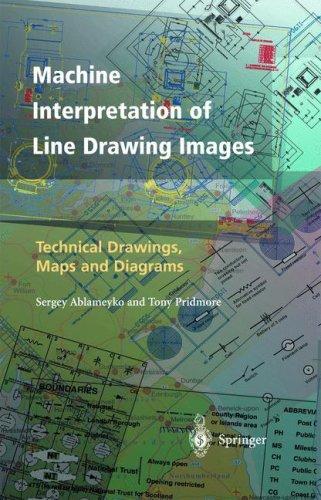 Machine interpretation of line drawing imagesSee it on collecto.rs
A scanner beam moves across a sheet of white paper, tracing a hand-drawn circuit, a floor plan, or an engineering schematic. The computer sees only a grid of black and white pixels. This book details the exact algorithmic work required to turn those static pixels back into vectors, nodes, and geometry—teaching a machine to recognize that three straight lines meeting at a corner form a wall rather than a random splash of ink.
Published during a pivotal era for computer vision, this text records the transition from simple image processing to genuine spatial interpretation. Early researchers were not just filtering noise out of low-resolution scans. They were building formal grammars for graphics, creating systems that could parse human drafting conventions without human intuition. Springer printed these early technical frameworks with precise diagrams, preserving the foundational logic that later made automated computer-aided design, OCR, and modern spatial computing possible.
Where the text on Digital Holography and Three-Dimensional Display captures the physical shift from optical film to digital photonics, this volume addresses the software problem sitting right behind it. It documents how researchers taught systems to translate raw visual data into structural meaning. For anyone tracking the history of computing, it marks the moment hardware stopped just storing images and started reading them.
Books from this period of computer science present a distinct cataloging challenge. Paper quality, code block formatting, and fold-out algorithmic charts vary wildly between printings. Storing these details on collecto.rs keeps your technical library clear, down to the edition, printing year, and schematic inserts. You can export your data whenever you need it.
4. Digital Holography and Three-Dimensional Display#
 Digital Holography and Three-Dimensional DisplaySee it on collecto.rs
Physical holograms required darkrooms, high-vibration isolation tables, and silver halide plates that smelled faintly of vinegar while they dried in the dark. This text captures the exact window where that physical glass gave way to sensor arrays and light modulators. Springer published it right as optical physics moved the heavy lifting from chemical baths into code, turning three-dimensional reconstruction into a software problem.
Where Machine interpretation of line drawing images documents the software side of teaching computers how to see 2D vectors, this volume tackles the hardware physics of projecting light back out into space. It covers the mathematics of diffraction patterns alongside the messy engineering reality of laser coherence lengths and spatial resolution limits. You get the wave optics formulas on the left page and the physical constraints of early digital micromirror devices on the right.
Technical literature from this transition period is easy to overlook because the hardware dates quickly. The liquid crystal displays described in the middle chapters belong to a specific generation of lab equipment that mostly lives in university surplus bins today. But the core physics of light-field reconstruction has not changed. The algorithms laid out here for computing phase shifts remain the foundational math behind modern head-mounted displays and holographic microscopy.
For a technical library, it marks the line between classical physical optics and digital photonics. It documents a moment when optics laboratories stopped buying photographic developer and started writing GPU shaders.
3. Advances in Cryptology – EUROCRYPT 2018#
 Advances in Cryptology – EUROCRYPT 2018See it on collecto.rs
Three hundred and twenty-eight papers went into the review queue for Tel Aviv in April 2018. Sixty-nine made the cut. That roughly twenty percent acceptance rate tells you something about how conference proceedings function in modern computer science. They are not historical summaries written after the field settles down. They are the actual mechanism of discovery, printed while the code is still hot.
Springer published this three-volume set under their Lecture Notes in Computer Science series. Inside, you find the first formal treatments of post-quantum lattice primitives alongside attacks on active TLS implementations. While the physical volume on optical physics sitting just above this entry captures a slow hardware migration across decades, EUROCRYPT 2018 records security architecture breaking and resetting over a matter of days. It is a snapshot of zero-knowledge proofs, secure multi-party computation, and symmetric ciphers right at the point of impact.
For anyone building a library around cryptography, these yellow-spined trade paperbacks carry a distinct appeal. They were never meant to look pretty on a coffee table. They are working manuals, produced quickly for research libraries and university departments. Finding copy-clean sets with crisp spines takes patience, mostly because the people who originally bought them tended to drag them between lab benches and reading groups.
Tracking multi-volume proceedings across different revisions and ISBNs can get messy fast. You can log each volume of this set on collecto.rs with its exact publication data, export your records whenever you like, and keep your technical shelf organized alongside your older leather monographs.
2. Universe of Scales : From Nanotechnology to Cosmology#
 Universe of Scales : From Nanotechnology to CosmologySee it on collecto.rs
What happens to your sense of scale when you stack a silicon atom next to a spiral galaxy on the same logarithmic line? Most scientific publishing picks a shelf and stays on it. You buy a text on subatomic spin, or you buy an atlas of deep-space radio sources, and neither mentions the middle ground where human beings actually sit.
Springer published Universe of Scales to bridge those physical orders of magnitude. The book takes the reader from the nanometer dimensions of modern materials science up through biological tissue, planetary geology, and cosmic structure. It does not treat these jumps as separate disciplines. Instead, it maps how physical laws shift, break, or hold firm as you add zeros to your measurements. The prose stays grounded in real observational data, showing how tools like scanning tunneling microscopes and orbital observatories collect the raw metrics that make these comparisons possible.
Where Eurocrypt 2018 captures the fast, precise snapshot of a single year in software security, this volume takes the opposite approach. It builds a permanent, bird's-eye framework for viewing physical reality across twenty-six orders of magnitude. The print quality matters here. Cross-disciplinary charts and comparative scale diagrams require precise line work and dark inks to remain legible across dense pages.
For anyone building a shelf around the hard sciences, this volume serves as a central reference index. It anchors the hyper-specific monographs around it, giving context to every specialized study in your collection.
1. Precision Manufacturing#
 Precision ManufacturingSee it on collecto.rs
Two pieces of steel rest on an optical flat under a sodium lamp. A light line shifts by half a wavelength, and someone makes a pencil mark on a logbook that will govern a machine tool for the next twenty years. Precision Manufacturing lives in that thin band between what a workshop can draw and what a surface plate can measure. It approaches the subject not as a set of recipes, but as an error budget where thermal expansion, tool wear, and machine kinematics all pull against the same thousandth of a millimeter.
Springer published this work for the engineer who needs to know why a spindle drifts after four hours of continuous operation. The text breaks down high-precision machining, ultra-precision grinding, and non-traditional optical surface finishing with rigorous mathematical models. It does not skip the tedious physics of chip formation or pretend that vibration isolation is simple. Instead, it systematically builds the groundwork required to turn raw metallurgical stock into components that fit together without forcing. You get the exact equations for surface roughness alongside practical descriptions of how sensor feedback loops correct for tool deflection in real time.
Where the companion volume Universe of Scales takes you on a sweeping tour from subatomic particles to galactic clusters, this text locks its focus entirely on the sub-micron realm of human manufacturing. It is a narrower lens, but far denser for it. The diagrams of hydrostatic bearings and interferometric positioning systems are clear, uncompromising, and drawn for readers who intend to build real hardware. If your collection touches on modern industrial design, mechanical engineering history, or the physical limits of toolmaking, this volume belongs on your shelf. You can catalog your copy on collecto.rs to track its edition details, note condition markers, and keep your technical reference library organised alongside the rest of your collection.
Technical books age differently than fiction or trade non-fiction. Some Springer volumes get rendered obsolete by new software within five years, turning the physical book into a historical artifact of how engineers thought in a specific decade. Others remain the only complete treatment of their subject forty years later, cited in current papers by researchers who keep a physical copy within arm's reach of their keyboard.
That tension between active reference work and historical record is what makes this area of collecting worth your time. You are building a shelf of specific answers to hard questions. The condition matters, the edition matters, and tracking down a copy without library pocket tape on the flyleaf takes effort.
If your Springer volumes are currently sitting in scattered stacks or buried in an Excel sheet, you can log them on collecto.rs. You can track publication years, catalog numbers, and condition notes, and export your data whenever you want. It gives your reference library a permanent home.
Frequently asked questions#
Why do collectors track specialized Springer volumes?#
Springer publishes highly specific academic and technical texts, often in limited runs for research libraries. Collectors value them because they document precise moments of scientific progress, specialized methodologies, or historical research conferences that are rarely reprinted in hardcover.
What makes academic and conference proceedings collectible?#
Conference proceedings like the LNCS series from Springer contain first-edition printings of foundational papers in computer science and mathematics. For shelf builders focused on technical history, these original print runs capture breakthroughs right as they were presented to the scientific community.
How should I catalog technical and scientific books?#
Keep track of edition numbers, publication years, series names, and physical condition. Technical volumes often have precise identifiers like ISBNs or library stamps. Using a clear cataloging platform like collecto.rs helps you track metadata and shelf location without clutter.