The short version#
Monarch redefined Flesh and Blood by introducing Talent mechanics like Soul and Blood Debt. These ten cards showcase how the set balanced tactical depth, thematic art, and format-defining design.
- Blasmophet, the Soul Harvester
- Lumina Ascension
- Rouse the Ancients
- Raydn, Duskbane
- Nourishing Emptiness
- Tome of Torment
- Deep Rooted Evil
- Gallantry Gold
- Blood Drop Brocade
- Time Skippers
Monarch changed the math of Flesh and Blood. Before its release, resource management was largely a matter of pitch values and action points. Monarch introduced light and dark talents, forcing players to manage entirely new zones and costs. On the Light side, charging the Hero's Soul turned cards into a banked resource for late-game turns. On the Dark side, Blood Debt turned the banished zone into a ticking clock that punished indecision with direct damage.
These mechanics gave Monarch a distinct tempo. Shadow heroes like Chane and Levia traded their own life total for explosive turns, turning the banished zone into an extended hand. Light heroes like Prism and Boltyn built long-term value, setting up turns where multiple attacks gained Go Again off a single charged card. The set made the spatial layout of the play area matter in a way it had not before.
Monarch also marked a shift in visual identity. The contrast between Solarium luminance and Netherwraith decay gave the set a clear aesthetic boundary. The card design mirrored this tension. Light cards used bright, metallic frames to signal passive value waiting to be tapped. Dark cards relied on muted, bruised palettes, visual cues for effects that extracted a tax every turn they remained unaddressed.
Evaluating Monarch means looking at how these two poles reshaped both Constructed and Limited play. Some cards earned their place by enabling entirely new deck archetypes that survived multiple format rotations. Others stand out because their talent costs created high-stakes sequencing problems on every turn cycle. The ten cards ahead represent the set at its most deliberate, where talent mechanics, class identity, and card art pulled in the same direction.
| # | Item | Set / Year | Rarity |
|---|---|---|---|
| 1 | Blasmophet, the Soul Harvester | Monarch | token |
| 2 | Lumina Ascension | Monarch | majestic |
| 3 | Rouse the Ancients | Monarch | majestic |
| 4 | Raydn, Duskbane | Monarch | majestic |
| 5 | Nourishing Emptiness | Monarch | majestic |
| 6 | Tome of Torment | Monarch | majestic |
| 7 | Deep Rooted Evil | Monarch | majestic |
| 8 | Gallantry Gold | Monarch | common |
| 9 | Blood Drop Brocade | Monarch | common |
| 10 | Time Skippers | Monarch | common |
10. Time Skippers#
 Time SkippersSee it on collecto.rs
You sit down across from a Runeblade player with a plan for your turn. They drop two attacks, trigger an aura, and pass back to you with no resources left in their pool. You look at your hand and realise your carefully planned chain collapses because you lack one single action point. Monarch fixed that problem for everyone, right at the bottom of the pack.
Time Skippers sits at common rarity, which meant almost every player cracked a few copies during release drafting. It is a humble pair of legs with a simple job: destroy them, pay one resource, and gain an action point. Before this set, that kind of turn-extending utility was largely locked behind specific class mechanics or higher rarity equipment. Monarch opened the door, giving generic access to action point manipulation so any hero could patch a awkward turn or push a final attack across the line.
That accessible utility makes it a natural counterpart to Blood Drop Brocade, another common equipment piece from the set that smoothed out resource management for any deck. Where Blood Drop Brocade provided a reliable single resource when your pitch math fell short, Time Skippers provided the action point needed to actually spend it. Both cards proved that Monarch’s most influential designs were not always the flashy legendary equipment sitting in the foil slot. They were the practical tools that made deckbuilding feel more flexible across every hero class.
Equipment like this belongs in a ledger, even if it cost you pocket change to acquire. You can log your first-edition foils and draft bulk side by side in collecto.rs, tag them by set, and export your entire collection history whenever you want.
9. Blood Drop Brocade#
 Blood Drop BrocadeSee it on collecto.rs
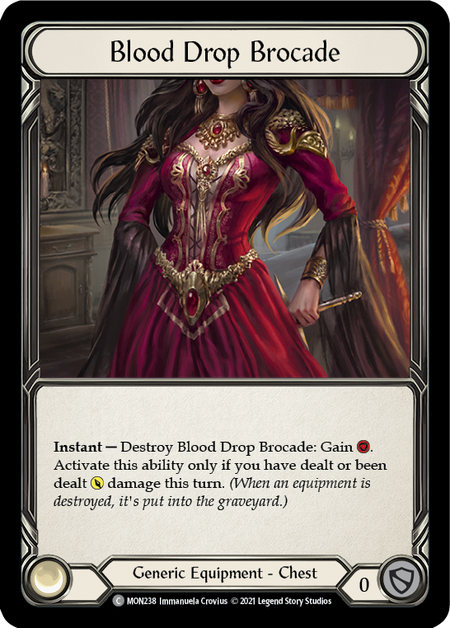
High-rarity Majestic equipment usually steals the headline in any Monarch breakdown. Yet this common torso piece solves a problem every player runs into at some point during a long turn. Blood Drop Brocade sits in your equipment slot until you need to fix your resource math. You destroy it, gain one resource point, and carry on with your combat chain. It costs nothing to play, blocks for one, and requires zero setup beyond having it equipped at the start of the game.
While Gallantry Gold turns a specific class strategy into a lethal push, Blood Drop Brocade works through quiet efficiency. It does not dictate your deck design or demand a specific weapon setup. Instead, it offers a single moment of clean flexibility. That simplicity made Monarch a distinct set. The design team built mechanical depth into the lowest rarity slots, ensuring that deck construction felt open even if your collection was just starting out.
Gear like this changes how a match flows. That extra resource point often means the difference between playing a card from your arsenal or ending your turn early. Because it sits on the board from the first turn, your opponent knows it is there, waiting to bridge a gap in your resource costs. You trade permanent defense for a one-time tempo boost. It is a fundamental trade-off that teaches core turn management. You do not need a binder full of legendary pulls to build a deck that responds precisely when pushed. Monarch gave players those tools right out of the booster pack.
8. Gallantry Gold#
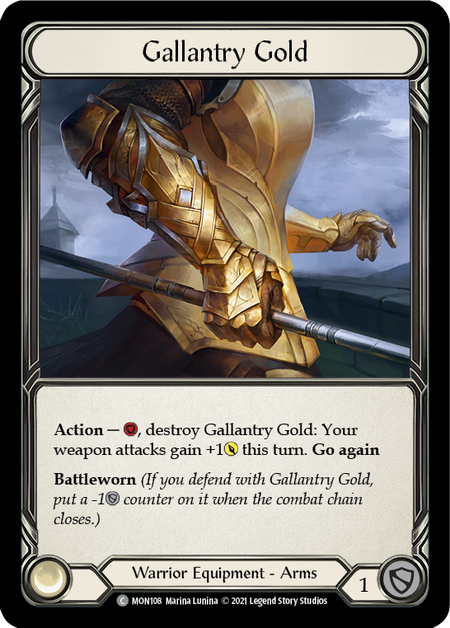 Gallantry GoldSee it on collecto.rs
One resource point. That is all it costs to equip Gallantry Gold, but the leverage it gives a Warrior during an attack step transforms how combat plays out. Played as a Common equipment piece in Monarch, it sits in the arms slot waiting for the exact turn you intend to push maximum damage through a defense block.
Monarch shifted how equipment interacted with class mechanics. Previous sets often treated arms pieces as passive stat boosters or simple block options. Gallantry Gold changed that rhythm by granting a generic weapon attack plus one power for the entire turn when cracked. For a class built around chaining weapon swings and threatening go again, that single extra point of power forces an opponent to over-block or accept a devastating hit effect. It turns a standard attack pattern into a lethal sequence without requiring a massive investment of pitching.
Compare this to Blood Drop Brocade, another Common equipment piece from the same set. Where Blood Drop Brocade solves an immediate operational problem by generating an extra resource when you take damage, Gallantry Gold forces a tactical choice onto your opponent. Both cards show how Monarch built deep, competitive strategic options directly into the Common rarity slot, making high-level decision trees available to every player regardless of pack luck. Blood Drop Brocade keeps your turn alive when you are behind, but Gallantry Gold closes out the game when you are ahead. It remains a masterclass in elegant, low-rarity card design that defined the Warrior identity throughout the Monarch era.
7. Deep Rooted Evil#
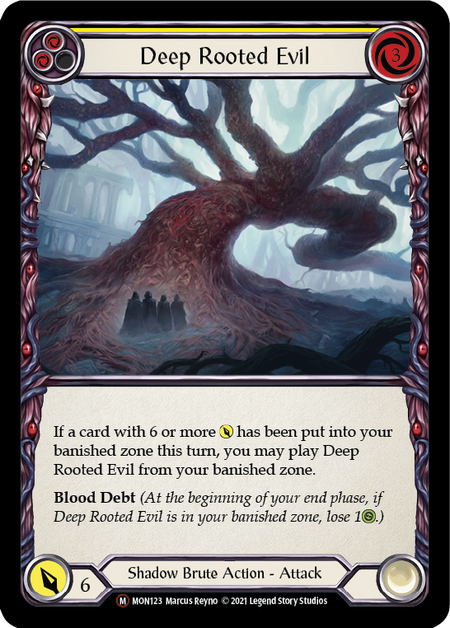 Deep Rooted EvilSee it on collecto.rs
You watch your banished zone all game, waiting for the right moment to turn a spent card into an active threat. Your opponent watches it too, trying to count how many problems you have waiting in the dark. Deep Rooted Evil makes that tracking painful. If you have pitched or banished an Attack Action card with a blood debt this turn, you can play this card directly from your banished zone. It does not wait in your hand or sit on top of your deck. It waits in the one place your opponent wants to ignore.
Monarch introduced the Shadow talent to test how much risk players would accept for relentless momentum. Cards like Tome of Torment demand health in exchange for card draw, forcing you to win before your own mechanics consume you. Deep Rooted Evil plays the same high-wire game from a different angle. It gives the Shadow talent its recursive backbone, turning a temporary exile into an endless supply of pressure. Every time it returns to the arena, it punishes defensive playstyles that rely on outlasting your initial hand.
Printed as a majestic in Monarch, the card defined how players built around the banished zone. It requires specific setup, but the payoff is a threat that refuses to stay dead. You do not run it because it is simple to play. You run it because it turns your discard pile into a second hand, making every spent resource feel like a deferred attack.
6. Tome of Torment#
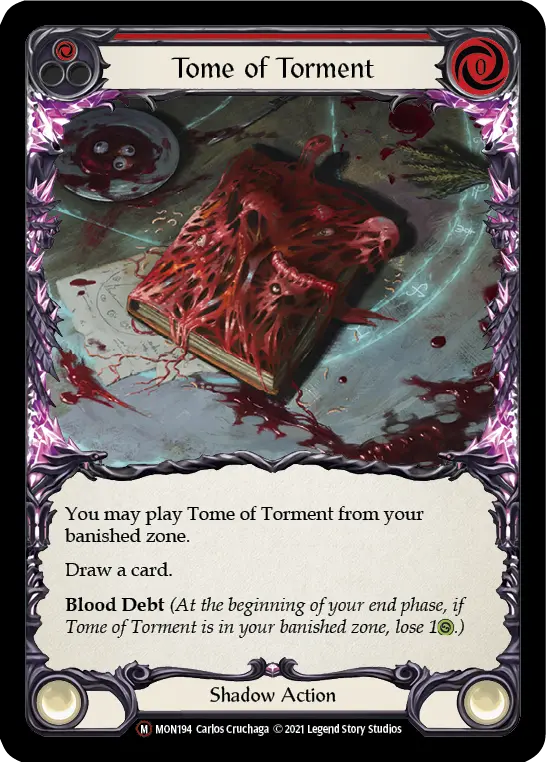 Tome of TormentSee it on collecto.rs
What does it cost you to draw two extra cards when you are already bleeding? In Monarch, the Shadow talent answers that question by turning your life total into currency. Tome of Torment sits at the center of that exchange. It is an action card that does nothing while sitting in your hand, forcing you to pitch it, defend with it, or banish it through one of your hero abilities. The real power triggers once it enters the banished zone. If you have taken damage that turn, you play it directly from banishment, pay the single resource cost, and draw two fresh cards to reload your attack.
That conditional play requirement separates it from other draw engines in the set. Nourishing Emptiness requires a completely clear graveyard to yield its massive value, demanding strict control over your combat chain from the deckbuilding phase onward. Tome of Torment asks for something far more immediate and visceral: a willingness to absorb a hit. You accept a disadvantage during your opponent's turn to build an explosive response on your own. It rewards players who read combat math clearly and recognize when three life points are worth two fresh options.
This majestic card showcases the exact mechanical identity that made Monarch memorable. It turns the banished zone from a graveyard substitute into a secondary hand, changing how both players evaluate every attack. When you log this card into your collecto.rs account, the set metadata tags it under Monarch with its majestic rarity stamp. You can view your Shadow cards alongside your classic talents, tag specific printings, or export your complete list as a CSV file whenever you want to retool your deck lists.
5. Nourishing Emptiness#
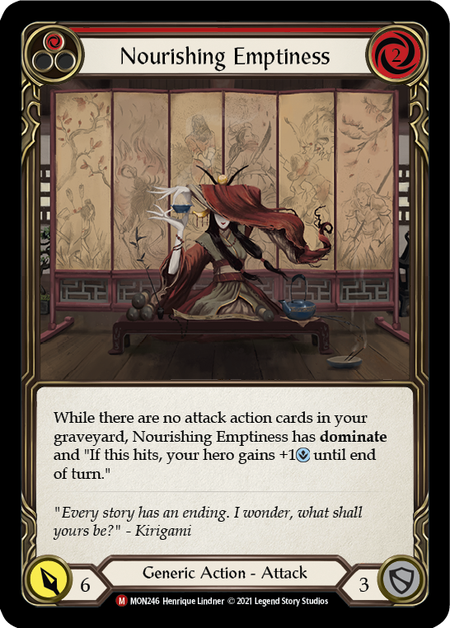 Nourishing EmptinessSee it on collecto.rs
Most players see six generic defense as the ceiling for a standard block card, but Nourishing Emptiness completely flips how you evaluate stats on a Majestic generic. You look at a card with no pitch value, zero defense, and six attack for a single resource, and the immediate reaction is to move past it. Then you read the text. If you have no generic cards in your graveyard, it gains Dominate and hits for six while creating a Ponder token on hit. That is a massive tempo swing for minimal cost, provided you build your list to respect the requirement.
That strict condition changes how you think about deck construction entirely. Where Tome of Torment asks you to lean heavily into a deeply populated banish zone to draw your extra cards, Nourishing Emptiness forces you to strip your list down to the absolute bare minimum of generic cards. You might run this single Majestic copy as your only generic card in the entire deck just to guarantee the condition triggers every time it hits the pitch or hand. It demands total commitment in the deckbuilding screen, turning a dead card in the wrong build into a terrifying late-game finisher in a specialized one.
Monarch introduced plenty of complex engines across its light and dark talents, yet this card stands out by rewarding restraint instead of expansion. It gives generic slotting a distinct identity within the set. In a binder or a digital ledger, it serves as a reminder that value in Flesh and Blood does not always come from stacking synergistic triggers. Sometimes it comes from leaving the graveyard entirely empty.
4. Raydn, Duskbane#
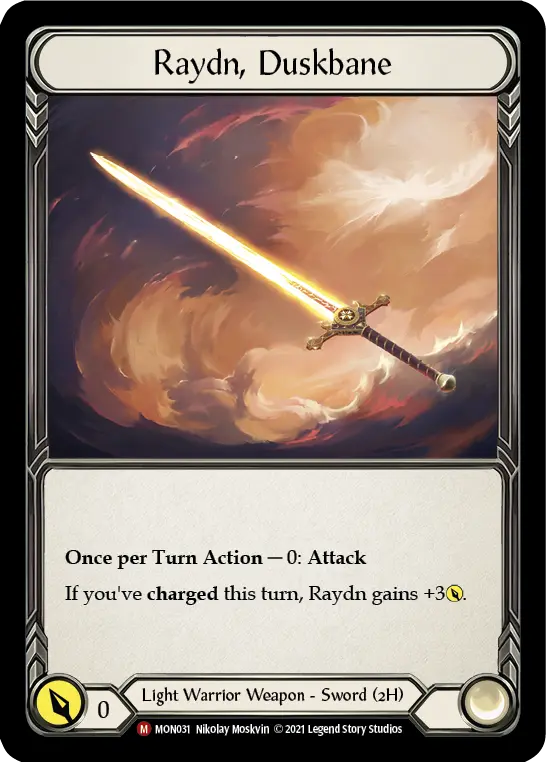 Raydn, DuskbaneSee it on collecto.rs
Your opponent pitches a card, attacks for four, and hands the turn back to you with three pitch points floating in their pool. That is the rhythm of Light Warrior. Raydn, Duskbane defines that pace. This weapon from Monarch does not rely on pitching resources from your hand to strike. Instead, it gains attack power whenever a card enters your pitch zone during the turn. It turns the basic mechanics of resource management into a direct threat, demanding a complete rethink of how pitch zones operate.
While Rouse the Ancients relies on tearing through your hand to link heavy attacks together with go-again momentum, Raydn works off the passive buildup of your turns. It rewards players who build their decks around precise pitch curves. You do not need to float massive pools of energy to generate pressure. You just need to keep the cycle moving. Every card sent to the pitch zone adds weight to the sword, turning routine turns into lethal sequences without draining your hand.
As a Majestic, Raydn represents the core identity of Monarch. The set pushed class design into distinct, thematic directions, and Light Warrior sits squarely on the edge of aggressive resource generation. It asks you to track where every card lands, shifting focus from what you play to what you set up for later. It is a piece that rewards deep format knowledge and precise deck construction. If you want to keep track of cards like Raydn alongside your Monarch collection, collecto.rs gives you a quiet place to log every rarity, track your cards, and export your complete data whenever you want.
3. Rouse the Ancients#
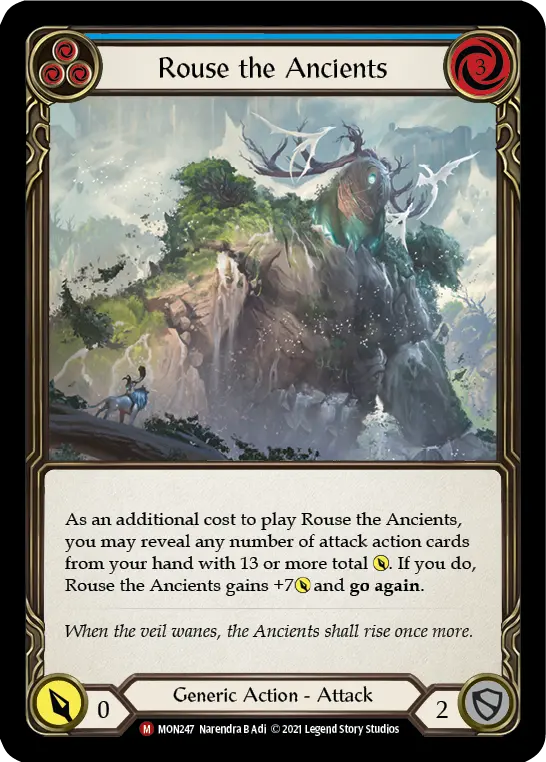 Rouse the AncientsSee it on collecto.rs
Majestic equipment usually gets the framed display treatment, but a generic action card often does the actual heavy lifting in your deck. Rouse the Ancients looks simple at a glance. You pitch cards with six or more attack, gain action points, and send a massive generic attack straight at your opponent. It turns heavy, clunky hands into immediate momentum without requiring a single class-specific synergy.
Monarch introduced pitch-value tension to Flesh and Blood on a scale players had not dealt with before. Light and Shadow talents forced hard choices in deck building, demanding specific card types in the pitch zone to enable your best plays. Rouse the Ancients bypasses those rigid talent requirements entirely. While a card like Lumina Ascension demands a strict setup within the Light archetype to yield results, Rouse the Ancients asks only that your deck hits hard. If you run big attacks, this card converts that raw power into additional go-again turns across both Blitz and Classic Constructed.
That flexibility gives this Majestic card its staying power. It bridges the gap between massive single-hit turns and wide, multi-attack chains. You do not need to pivot your whole strategy to make room for it. You just need enough brute force in your list to feed the cost. When you organize your Monarch binder, it is easy to focus on the flashy cold foil equipment that defined the set's release. Setting this card alongside them reminds you that smart, efficient generics are what actually win games on Sunday afternoon. You can track your copies and export your entire Monarch list anytime on collecto.rs.
2. Lumina Ascension#
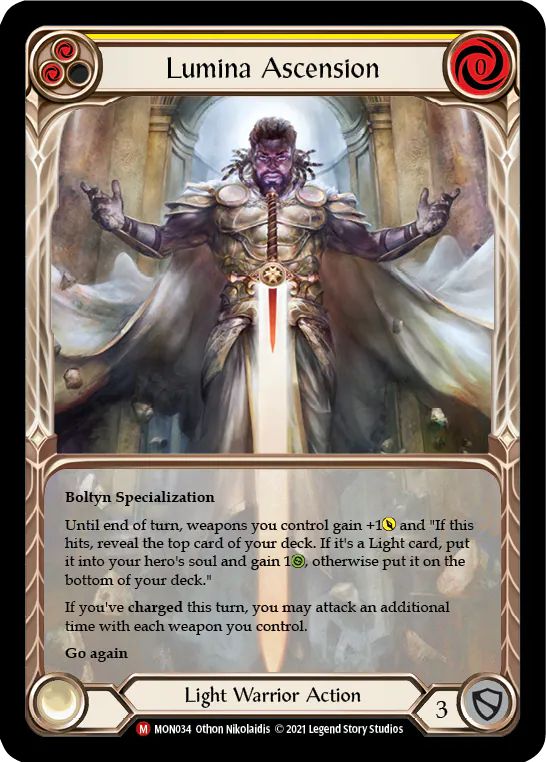 Lumina AscensionSee it on collecto.rs
Two action points, three health, and a fresh hand of cards off a single turn. Lumina Ascension does not just support a Light Boltyn build; it shifts the entire pace of the match the moment it hits the stack. Printed at Majestic rarity in Monarch, this action card remains the absolute gold standard for explosive turns in the Light archetype.
Playing it requires setup, but the payoff breaks the fundamental math of a standard turn. You charge your soul, pitch a yellow card, and suddenly every weapon attack gains go again while gaining health on hit. While Rouse the Ancients bridges heavy-hitting attacks with generic go-again momentum, Lumina Ascension concentrates that power specifically into Boltyn's light-aligned talents. It turns modest pitch values into an avalanche of extra attacks, drawing cards directly off weapon hits and leaving your opponent with impossible blocking choices.
That flexibility makes it a permanent fixture in deckboxes rather than a piece that sits in a binder. The card demands respect during deckbuilding because every additional copy in your deck multiplies the threat of a lethal turn from a seemingly empty hand. Monarch introduced complex talent mechanics to the game, but few cards capture the satisfaction of a fully realized Light turn quite like this one.
When you log your Monarch collection, tracking Majestics like this alongside your equipment gives you a clear picture of your playables versus your trades. You can catalog your Lumina Ascensions, track foils, and export your entire inventory list whenever you want to swap pieces with another player.
1. Blasmophet, the Soul Harvester#
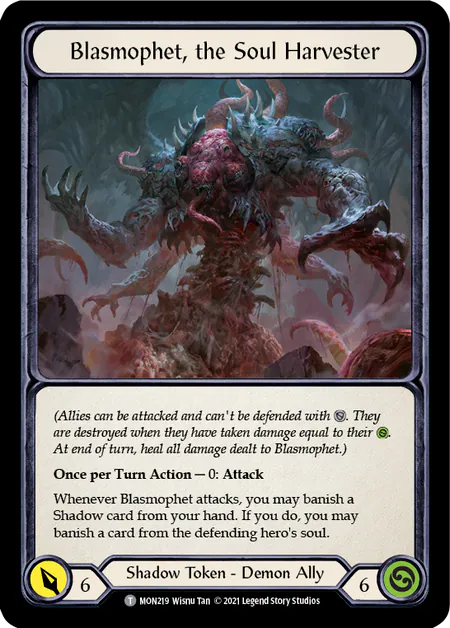 Blasmophet, the Soul HarvesterSee it on collecto.rs
A card sleeve sits empty on the playmat while someone searches their token stack for three minutes. That delay is usually the first time a Shadow Demon Blade player realizes how much terror Blasmophet actually commands. Monarch introduced two opposing philosophies to Flesh and Blood, and while the Light side leans on burst turns like Lumina Ascension to stack damage, Blasmophet works through sheer mechanical gravity. It is the Shadow archetype distilled into a single piece of cardboard: heavy, demanding, and impossible to ignore once it hits the table.
Printed as a token in Monarch, Blasmophet acts as the ultimate payoff for Chane and the wider Shadow talent pool. Bringing it out requires commitment. You banish your soul, balance your blood debt, and manage a graveyard that constantly threatens to consume your own life total. When it lands, your opponent stops playing their game and starts figuring out how to survive yours. It forces awkward blocks, ruins carefully planned pitch rotations, and shifts the entire tempo of a match toward dark magic.
That tension is what makes collecting Monarch so rewarding. The set rests on a knife-edge balance where every play carries a literal cost to your hero. Blasmophet represents the peak of that design ethos. You can track the state of a Monarch card pool by how worn the token corner gets from frequent play, or keep a pristine copy set aside just to anchor a Shadow hero display. Whether you log it alongside your main decklist or index it as part of a complete set binder, it stays one of the most distinct mechanical anchors from an era that changed how heroes spend their resources.
Monarch remains a reference point for how Flesh and Blood expands its mechanical vocabulary. The introduction of Soul and Blood Debt proved that the game could support asymmetric resource systems without breaking the fundamental back-and-forth of combat chains. Every set since has built on the foundation laid by Sol and Shadow, but Monarch captured that transition at its most uncompromising.
For anyone holding these cards in a binder or a deck box, they represent a specific moment in the game's design history. The physical cards reflect that shift, from the specific foil treatments on Light cards to the darker framing of the Shadow set. They mark the point where Legend Storyteller expanded what a hero card could demand from the player holding it.
If you are organizing your Monarch cards, collecto.rs gives you a clean place to log your master set, track specific printings, and keep your inventory organized. You can export your data whenever you like.
Frequently asked questions#
What makes the Monarch set significant in Flesh and Blood?#
Monarch introduced the Light and Shadow talents to Flesh and Blood, alongside four new heroes: Prism, Boltyn, Chane, and Levia. It expanded deck-building rules by requiring players to balance Talent cards with hero-class cards, fundamentally altering game mechanics.
What is the difference between Light and Shadow mechanics in Monarch?#
Light heroes utilize the Soul mechanic, charging cards into a dedicated hero zone to power up future attacks and abilities. Shadow heroes rely on Blood Debt, banished zone interactions, and sacrificing health for explosive turns.
Can I use Monarch cards in current Flesh and Blood formats?#
Yes, Monarch cards remain legal in constructed formats like Classic Constructed and Blitz, provided the specific card has not been banned or suspended. Always check the official Legend Story Studios banlist for current rules.