The short version#
True scarcity in Flesh and Blood comes down to distribution methods, early print runs, and niche releases rather than just high market prices.
- Springboard Somersault
- Nuu, Alluring Desire
- Prism
- Forged for War
- Toe the Line
- Hyper Inflation
- Kayo, Strong-arm
- Crow's Nest
- Danger Digits
- Ironrot Gauntlet
Price tracks demand. Scarcity tracks history. In Flesh and Blood, the cards that prove hardest to acquire rarely line up with the ones breaking sales records on market aggregators. High price tags usually signal competitive utility in the current meta or the prestige of a Cold Foil finish from a main set. Scarcity is a different beast entirely. It belongs to distribution logistics, short print runs, and quiet decisions made during the game’s earliest days.
Legend Story Studios built Flesh and Blood around local game stores and in-person play. Because of that focus, how a card left the warehouse matters far more than its rarity symbol. A legendary equipment card from a mainline booster set might command a thousand dollars, but thousands of booster boxes were opened to find it. The card exists in known quantities across trade binders and deck boxes worldwide.
Compare that to a promo handed out exclusively to tournament organizers at an early Judge conference, or a specific printing tucked inside a localized demo deck meant for a single region. These releases bypass the standard opening of booster packs. They do not appear in bulk box openings on video streams. They drift into personal collections, get played without sleeves at casual events, or sit forgotten in storage boxes under LGS counters.
When these niche cards surface, they challenge how we think about a collection’s completeness. Tracking down a serialized card requires capital. Tracking down an obscure mechanical variation from an early hero deck requires patience, sharp eyes, and an understanding of how Legend Story Studios distributed their cardboard in the early years. The ten cards below are difficult to find not because everyone is bidding on them, but because so few people ever received them in the first place.
| # | Item | Set / Year | Rarity |
|---|---|---|---|
| 1 | Springboard Somersault | Ira Welcome Deck | promo |
| 2 | Nuu, Alluring Desire | Part the Mistveil | marvel |
| 3 | Prism | Hero Card Promos | promo |
| 4 | Forged for War | Welcome to Rathe | super-rare |
| 5 | Toe the Line | GEM Pack Promos | promo |
| 6 | Hyper Inflation | GEM Pack Promos | promo |
| 7 | Kayo, Strong-arm | Hero Card Promos | promo |
| 8 | Crow's Nest | Local Game Store Promos | promo |
| 9 | Danger Digits | Arakni, Web of Deceit Blitz Deck | common |
| 10 | Ironrot Gauntlet | Dorinthea Hero Deck | common |
10. Ironrot Gauntlet (Dorinthea Hero Deck)#
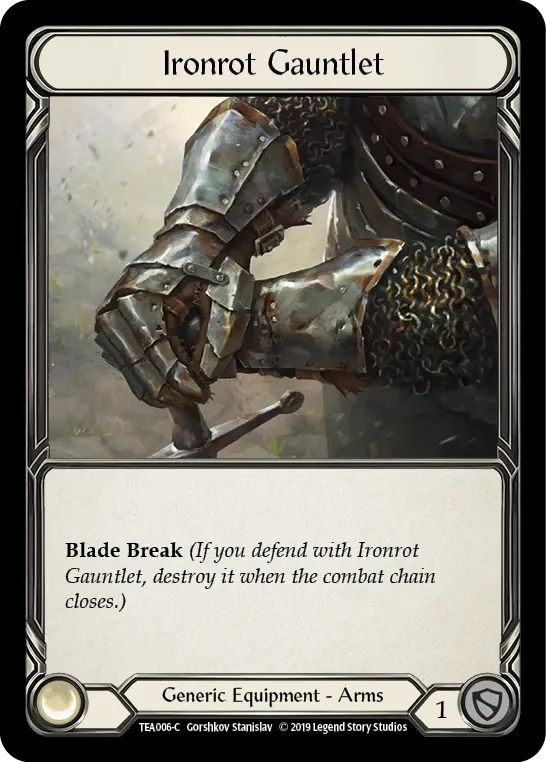 Ironrot GauntletSee it on collecto.rs
Common cards are meant to be thrown away. You open a booster, sleeve the rares, and leave the bulk on the game store table. Ironrot Gauntlet from the Dorinthea Hero Deck flips that logic entirely. It is a common piece of equipment, but finding one in pristine condition requires a specific kind of luck.
Preconstructed decks sit in an awkward space for preservation. Players open them to play immediately. The cards go straight onto kitchen tables, armory mats, and un-sleeved play surfaces. By the time anyone realizes a specific printing matters, most copies already have chipped edges and white corners. Like Danger Digits, its rarity comes from a fixed printing window rather than a low pull rate from booster boxes. Once the preconstructed deck leaves store shelves, the supply hard-stops. The difference lies in how people treated them at the time. While promo cards often go straight into binder sleeves, starter deck pieces take the full impact of actual play.
This specific printing carries the early set formatting that disappeared as the game expanded its production runs. The card text and layout reflect a moment when the game was still finding its footing. Finding a copy today that escaped the fate of most starter deck commons takes patience. You are looking for a card that someone bought to play with, but somehow forgot to play with.
9. Danger Digits (Arakni Blitz Deck)#
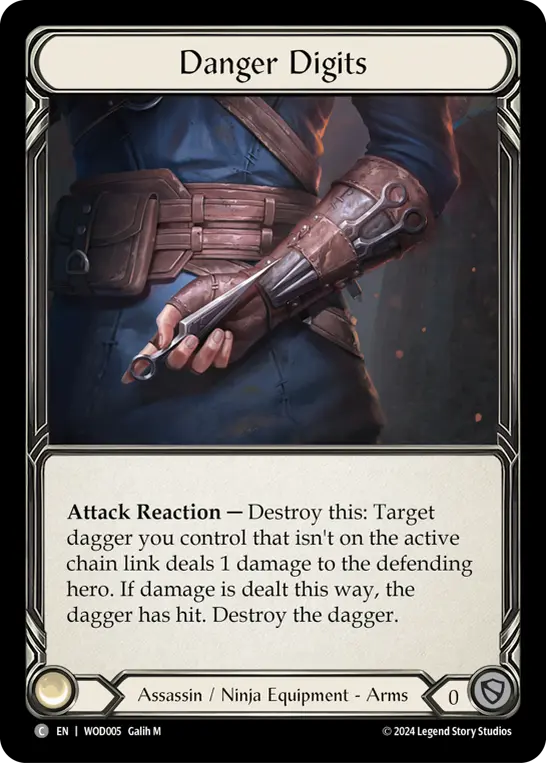 Danger DigitsSee it on collecto.rs
One per deck. That is the exact distribution model for Danger Digits, a common action card tucked inside the Arakni, Web of Deceit Blitz Deck. Preconstructed products create a specific kind of scarcity that differs from booster packs. When a set goes out of print, the supply of every card inside it freezes instantly. You cannot pull another copy from a rogue pack found in a store display case years later.
Most players buy a Blitz deck to play it immediately. The cards get shuffled without sleeves on kitchen tables, crammed into deck boxes, or separated into bulk boxes once the strategy falls out of favour. The common rarity label on Danger Digits is deceptive. In practice, finding a copy in pristine condition years after the print run ended requires hunting down sealed product that survived the open-and-play lifecycle.
This pattern mirrors what happened to the Ironrot Gauntlet from earlier starter products. While that piece of equipment suffered because players discarded it as basic starter gear, Danger Digits faces a tight bottleneck simply because it was tied to a single assassin deck list. If you did not buy that specific preconstructed deck during its retail shelf life, your only path to a copy today is the secondary market.
When a card only exists because a specific box left the factory floor, its long-term availability depends entirely on how many of those boxes stayed sealed. The secondary market eventually absorbs the loose singles, leaving a finite pool of undamaged copies spread across private binders.
8. Crow's Nest (LGS Promos)#
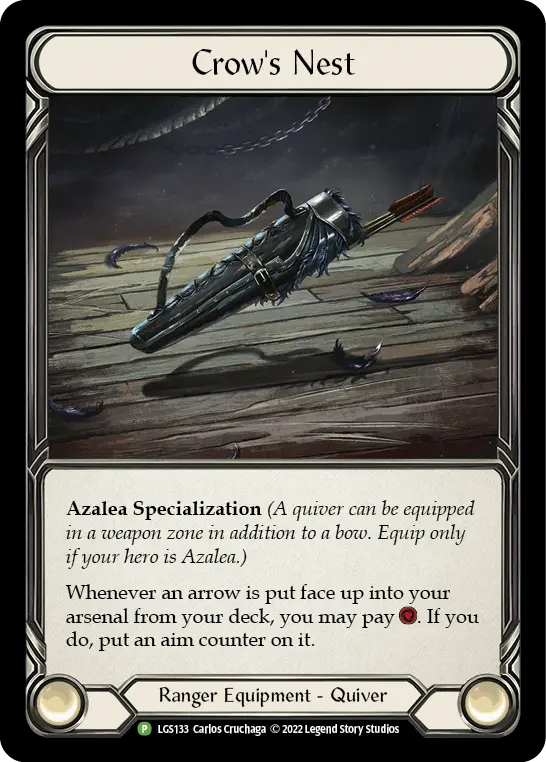 Crow's NestSee it on collecto.rs
A plastic folding table flexes under the weight of trade binders. Overhead fluorescents hum over four players arguing about combat chain resolution while the store owner cuts open a cardboard mailer behind the register. Inside that box sits a stack of black-bordered promo envelopes. How many arrived depends entirely on how many people showed up to play last month.
That reliance on local store infrastructure makes cards like Crow's Nest remarkably elusive. The card exists because a small business opted into a Organized Play program, unpacked a shipment, and handed it across a counter. If a store closed, lost its status, or simply tossed the leftover promos into a back closet after a Friday night, those copies effectively vanished from the global supply pool.
While fixed-run releases like Danger Digits lock in their total population the moment a preconstructed deck leaves the printer, store promos splinter their supply across thousands of independent locations. You cannot simply count the total print run and know what remains accessible. Some ended up double-sleeved in competitive decks, others sat forgotten in damp basements, and a fair portion never left the foil pack.
Tracking down a Crow's Nest requires hunting through the fragmented inventory of local communities rather than watching major secondary market platforms. It belongs to the Local Game Store Promos set, carrying a promo designation that hides its true scarcity behind regional distribution quirks. When a card depends on the survival and diligence of brick-and-mortar hobby shops, finding a clean copy years later becomes less about raw capital and more about patience.
7. Kayo, Strong-arm (Hero Card Promos)#
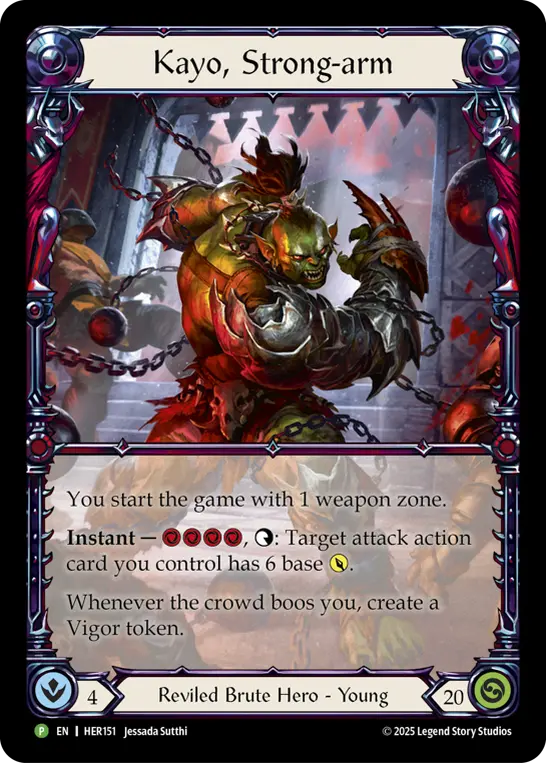 Kayo, Strong-armSee it on collecto.rs
A player sits down at a game store table in late 2019, slips a card into a clear sleeve, and rolls a six-sided die. If it lands high, Kayo doubles the base attack of his next attack action. If it lands low, that attack halves. Most players at the time saw a fun, erratic Brute hero suited for casual kitchen-table games. Few realized the physical card in their hand would become one of the hardest Hero Card Promos to source once the game blew past its initial print runs.
Early hero promos like Kayo, Strong-arm were handed out in tight event settings long before the game reached global distribution networks. You had to show up to specific local organized play events when the player base was a fraction of its current size. Stores received small allocation envelopes, handed them out to participants, and that was it. Many of those copies ended up unsleeved in draft boxes or lost in trade binders before anyone treated early Flesh and Blood promos as long-term historical artifacts.
While a card like Crow's Nest depends on how many local stores actually requested and ran specific event kits, Kayo belongs to that first wave of hero promos where total physical supply was capped by the sheer obscurity of the game's earliest months. If a store received eight copies for an afternoon tournament, those eight copies represented the entire regional supply. Finding one today in clean condition means tracking down a player who was in the room before the rest of the world caught on, recognized what they had, and kept it safe.
6. Hyper Inflation (GEM Pack Promos)#
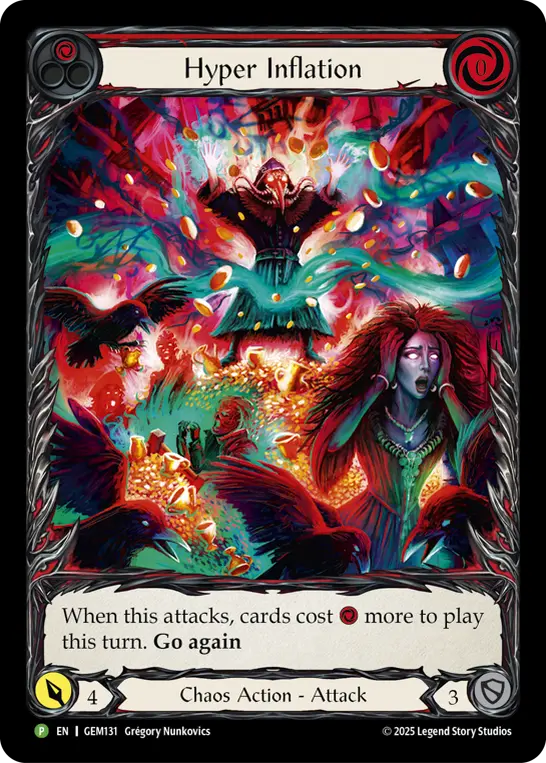 Hyper InflationSee it on collecto.rs
People call these pack fillers until they try to find one. Hyper Inflation sounds like a joke name for a card about resource management, but the distribution model made sure nobody was laughing when they tried to complete the set.
Most cards enter circulation through standard booster boxes sitting on store shelves. You buy a box, open the packs, and trade away the bulk. Hyper Inflation never touched a retail shelf. Labeled as a promo rarity within the GEM Pack Promos series, it arrived through a strict distribution pipe. Local game stores received GEM packs directly from Legend Story Studios to reward tournament organizers, judges, and active participants. You could not buy your way into a stack of these packs at a counter. You had to show up, run events, or win games.
While early hero cards like Kayo, Strong-arm relied on the raw novelty of an undiscovered game to limit their numbers, GEM Pack Promos suffered from precise, intentional scarcity. Legend Story Studios controlled the exact quota shipped to each regional hub. If a store ran three events a month instead of four, those extra packs simply did not exist. Players opened the foil wrappers immediately looking for high-tier equipment, meaning unplayed copies of lower-profile promos like Hyper Inflation vanished into casual decks or got tossed into unsorted storage boxes.
Finding a copy today is less about tracking high-profile auction houses and more about finding the judge who kept their reward envelopes sealed in a closet for three years. When you add Hyper Inflation to your collecto.rs catalog, select the GEM Pack Promos set name and promo rarity tag to track how it fits alongside your other organized play rewards.
5. Toe the Line (GEM Pack Promos)#
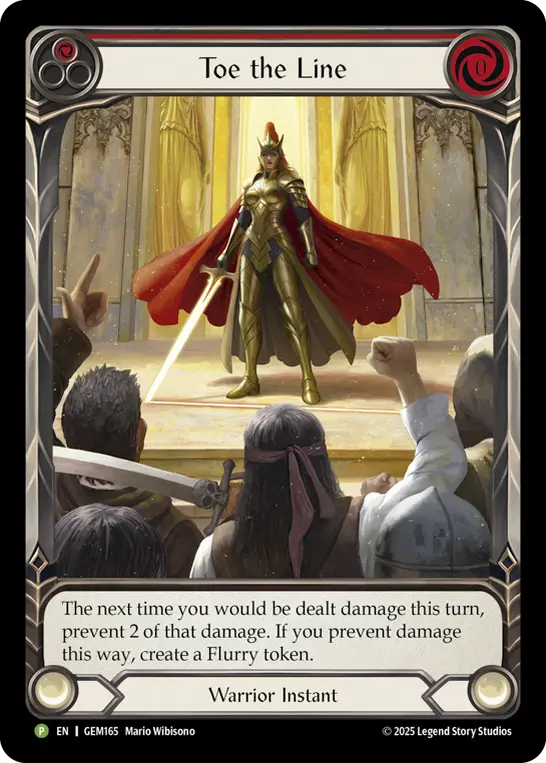 Toe the LineSee it on collecto.rs
What happens when you restrict a distribution channel to local game store counters? You get GEM pack promos. These foil cards arrive in small paper envelopes, handed out by tournament organizers as incentives for weekly organized play. They exist because Legend Story Studios wanted players inside physical stores, sitting across from each other on Friday nights. Because of that specific distribution model, these promos were never sold in sealed booster boxes or tucked into retail tins. Your local shop received a fixed allotment based on player turnout, opened the brown shipping carton, and handed them out one by one until the box was empty.
That creates a different kind of scarcity than something like Forged for War. Where that debut set card is rare simply because the initial 2019 print run was small, GEM pack promos depend entirely on local event attendance and store compliance. Some stores saved them for top-eight finishes. Others handed them to anyone who paid an entry fee. A few packs sat forgotten in backroom storage closets for months. The exact surviving count per card is notoriously hard to pin down.
Then comes the set-based demand. Players do not just want these for display. They want specific promo variants of staples to match the exact deck builds they run at higher-tier events. A player building a high-rarity Blitz deck will spend months tracking down matching copies of a specific promo card just to keep the visual tone of their deck consistent. You cannot buy a case of boosters to hunt for them. You have to find the person who sat in that store, won those matches, and kept the card in a sleeve ever since.
4. Forged for War (Welcome to Rathe)#
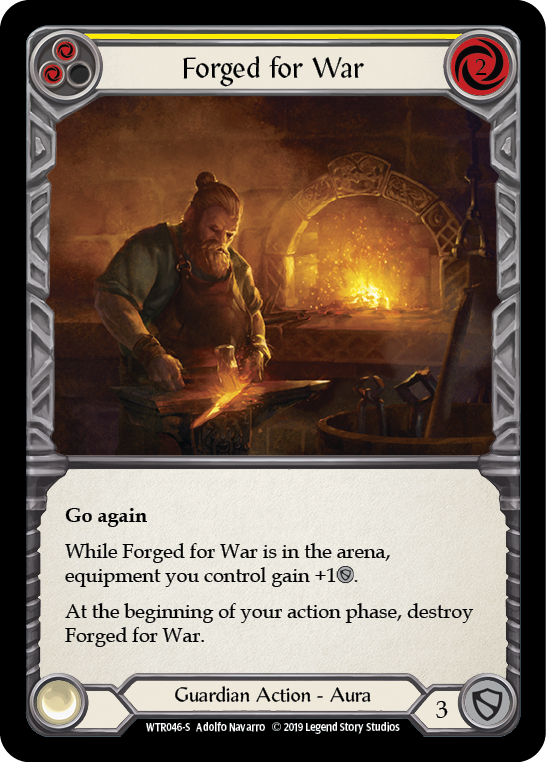 Forged for WarSee it on collecto.rs
One super-rare in every sixteen packs sounds generous until you try to buy one today. Welcome to Rathe launched Flesh and Blood into a market that had no idea what was coming. The first print run vanished into draft pods and kitchen tables, where cards were handled, shuffled, and tucked into deck boxes without sleeves. By the time the game took off, the damage was done. Most copies of Forged for War were already wearing white along their borders.
Super-rare as a designation did not survive into later sets. Legend Story Studios retired the rarity tier entirely, which leaves this card stranded in a specific era of design. It sits higher on this list than the Prism hero promos because those event rewards were handed out to people who knew precisely what they were holding. Prism went straight into top-loaders. Forged for War went into forty-card sealed decks and got scraped across felt mats.
Finding a copy in any condition requires patience. Finding one with clean corners requires a seller who opened a booster box in late 2019 and forgot about it in a closet. The foil layer on early Alpha printings is notoriously sensitive to humidity, adding another hurdle for anyone chasing a clean copy. The supply was small to begin with, and playable attrition claimed the rest.
When you add this card to your collection on collecto.rs, record the condition and printing details in the item notes. You can export your full catalogue data as a CSV file whenever you want to back up your records or audit your set binders.
3. Prism (Hero Card Promos)#
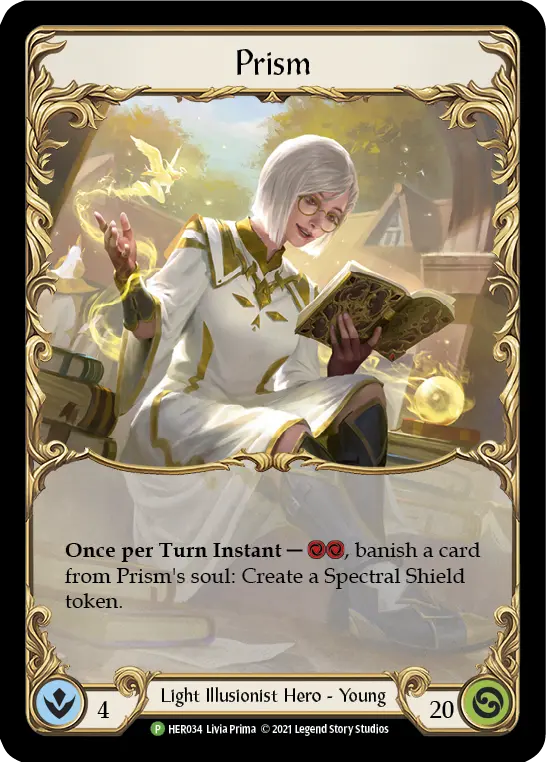 PrismSee it on collecto.rs
A judge in a black polo shirt slides a sealed envelope across the table at a Calling event. Inside is a copy of Prism, printed on heavy stock with full-art treatment and a foil finish that catches the convention center fluorescent lights. You put it straight into a top loader. You do not play it in your deck that afternoon. You do not even leave it in your deck box.
Event rewards like this hero card promo occupy a different kind of scarcity than something you pull from a booster pack. When you open a box of a main set, the odds are cold math. Marvel pull rates push those limits to extremes, as cards like Nuu, Alluring Desire demonstrate in modern releases. But event promos are bounded by attendance, tournament structure, and a specific weekend in time. Once that event ends, the supply stops entirely.
Prism represents a major era in the game's competitive history. Players who earned these promos were participating at the highest level during her run as a dominant hero. That creates a specific holding pattern. Most copies did not end up in store display cases or trade binders circulating at local game nights. They went straight into the personal collections of the players who fought through Swiss rounds to earn them.
That makes finding one on the open market a matter of timing rather than budget. You are not just waiting for someone to clear out their spares. You are waiting for a competitive player to decide they are ready to part with a trophy from a specific weekend. When those cards do surface, they tend to move privately between collectors who already know what they are looking at.
2. Nuu, Alluring Desire (Part the Mistveil)#
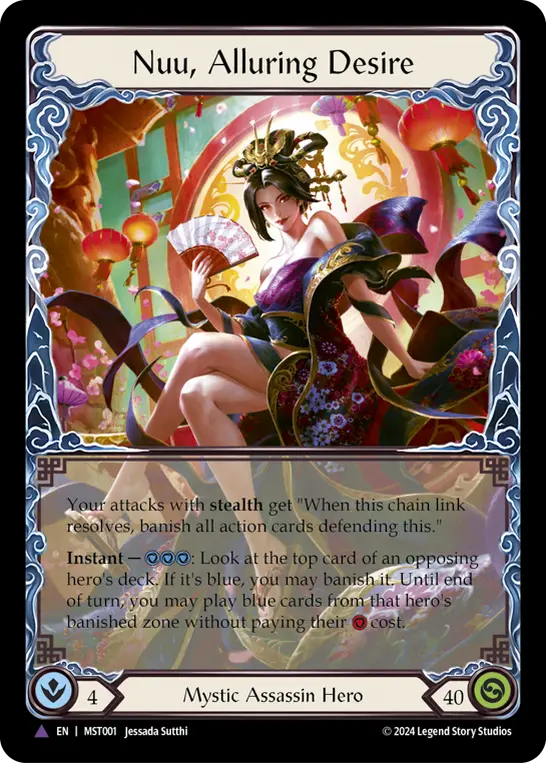 Nuu, Alluring DesireSee it on collecto.rs
Part the Mistveil arrived with plenty of booster boxes to open. You could walk into a local game store on release weekend, buy a display case, and peel open twenty-four packs without fighting for stock. Then you start looking for the Marvels. That is where the math turns cold.
Nuu, Alluring Desire exists as a standard cold foil hero, but her Marvel rarity printing is a different creature entirely. Legend Story Studios built Marvels to sit at the absolute fringe of a set's distribution curve. Opening a single case gives you a shot, but it offers zero promises. You are chasing a specific cold foil treatment applied to full-art, frame-shattering illustrations that appear once in hundreds of packs.
Modern Flesh and Blood sets do not suffer from the supply panics of the early days. Unlike the Springboard Somersault cards handed out in pre-launch demo decks before anyone knew the game existed, Nuu was printed in a fully established global era. The total volume of booster foil in the world for Part the Mistveil is massive. Yet this specific card remains brutally scarce because the odds inside every sealed box are engineered against you.
Collectors who chase Nuu are not fighting a lack of printed product. They are fighting the pull rates of modern set design. The card sits at the intersection of high-tier competitive play and gorgeous visual treatment. When someone opens one, it rarely stays in a trade binder for long. It moves directly into a double-sleeved tournament deck or behind a rigid acrylic display case. You can buy all the sealed boxes you want, but the market for the card itself stays tight.
1. Springboard Somersault (Ira Welcome Deck)#
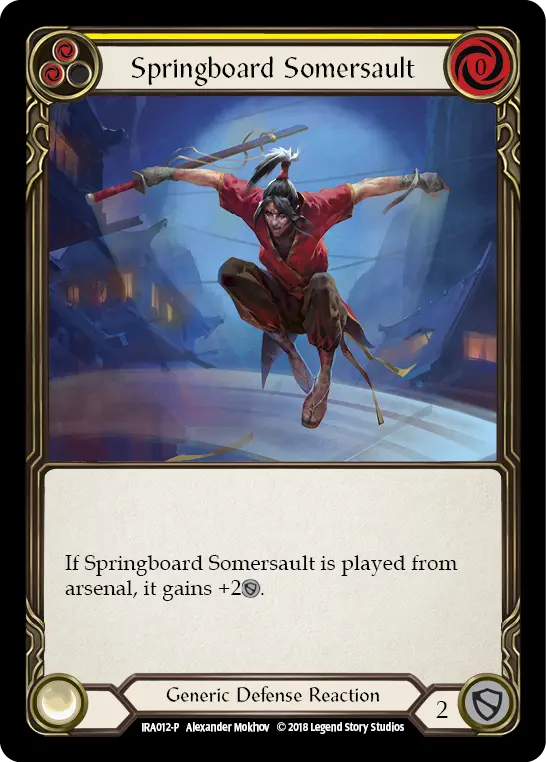 Springboard SomersaultSee it on collecto.rs
A local game store owner opens a cardboard box sent by a distributor in late 2019. Inside are dozens of small, half-size decks wrapped in thin cellophane. They are free samples, designed to be given away to anyone sitting down for a demo game of Flesh and Blood before the TCG becomes a global phenomenon. Most of those demo decks end up scattered across playing tables, shuffled without sleeves, or tossed into store trash bins at the end of the night. Inside those packages sat Springboard Somersault.
While modern cards like Nuu, Alluring Desire push pull rates to extreme limits within booster packs, Springboard Somersault owes its rarity to a completely different mechanical reality: it never appeared in a booster pack at all. Legend Story Studios produced this card specifically for the Ira Welcome Deck. It served as a teaching tool for basic defense mechanics during the game's earliest promotional push. Because players viewed these decks as disposable introductory materials rather than collectible assets, intact copies faced a brutal survival rate.
Finding one now means hunting down the surviving remnants of that initial launch era. The card itself carries a modest promo rarity tag, but that label hides the historical weight of its distribution. It represents the absolute entry point of the game's public history. Finding a clean copy requires searching through forgotten storage boxes from stores that took a chance on an unknown system before the first main set ever hit the shelves.
If you hold one today, it belongs in your permanent catalog. You can document the exact condition of your early promo pieces on collecto.rs, tag the Ira Welcome Deck release, and keep your full inventory exportable whenever you want to move your data.
A collection built around distribution oddities tells the story of the game itself. It preserves the early experiments, the localized events, and the structural quirks that defined how Flesh and Blood grew from a newcomer in New Zealand to a global TCG. These cards mark specific moments in that expansion, captured in cardstock and foil layer variations.
Finding them takes time, and keeping track of specific printings, promo stamps, and deck sources gets messy quickly. If you are hunting down obscure variants or trying to record exact print runs, you can catalog your cards on collecto.rs. It gives you a clean space to document your set variants, upload clear scans, and keep a precise record of your collection. Your data remains yours, and you can export it whenever you want.
The search for these quiet releases is what keeps collecting interesting. The market will always chase the loudest, most expensive legendary foils of the current season. Finding the pieces that slipped through the cracks takes a different kind of focus entirely.
Frequently asked questions#
What makes a Flesh and Blood card genuinely hard to find?#
Scarcity often stems from how a card was handed out. While main-set packs are opened in massive quantities, promos given only to tournament judges, organized play event winners, or early demonstration decks had very small distribution numbers. Early sets like Welcome to Rathe and limited-run promotional packs contain cards that simply do not exist in large quantities.
Are high-rarity cards always harder to find than promos?#
Not always. A high-rarity card from a widely printed booster set might have more physical copies in existence than a common or rare promotional card handed out at a single weekend event. Rarity dictates how often a card appears inside a specific box, while distribution defines how many total copies enter the world.
How should I store and catalog rare Flesh and Blood cards?#
Keep your cards in acid-free sleeves and rigid top-loaders or binder pages stored away from direct light and humidity. You can catalog your collection on collecto.rs to track your cards, document specific printings, and keep your data exportable at any time.