The short version#
Emperors in the New World captures the shift in the sea's balance of power, using distinct archetype engines and dramatic visual treatments to showcase the modern Yonko.
- Gol.D.Roger
- Donquixote Rosinante
- Marshall.D.Teach
- Monkey.D.Luffy
- Buggy
- Black Hole
- Sanji
- Crocodile
- Lim
- Shanks
The balance of power in the Grand Line does not collapse quietly. It snaps. By the time the dust settles around Wano, the old structure is gone, replaced by a volatile group of four who share almost nothing except their title: Shanks, Buggy, Luffy, and Blackbeard. Emperors in the New World leans entirely into this fracture. As the ninth main booster set in the One Piece Card Game, it does not treat the new Yonko as mere card faces. It translates their friction into distinct, uncompromising mechanical engines and deliberate visual choices.
Previous sets often mapped out single conflicts or isolated arcs. OP-09 takes a wider view. It looks at the modern sea after the fall of Big Mom and Kaido, framing the leaders not as static icons, but as heads of rival factions pulling the game in opposite directions. Red returns to Shanks with aggressive, tempo-driven board presence. Purple receives Luffy's high-risk ramp strategies, while Black introduces Marshall D. Teach and a complete denial of opponent effects. Then there is Buggy in Blue, running Cross Guild strategies that turn high-cost threats and field swarm into something that looks like an accident until it wins.
The art direction mirrors this thematic shift. The foil finishes, alternate arts, and textured treatments throughout OP-09 pull away from the standard composition formulas. Instead, they focus on scale and perspective: the low angle of a sword draw, the dense shadows of the Dark-Dark Fruit, the sheer chaos of a pirate coalition built on a misunderstanding. Whether you are building an engine for the table or curating a binder page around the modern Yonko, this set marks the moment the card game caught up to the story's newest era.
| # | Item | Set / Year | Rarity |
|---|---|---|---|
| 1 | Gol.D.Roger | -EMPERORS IN THE NEW WORLD- [OP-09] | SEC |
| 2 | Donquixote Rosinante | -EMPERORS IN THE NEW WORLD- [OP-09] | SP CARD |
| 3 | Marshall.D.Teach | -EMPERORS IN THE NEW WORLD- [OP-09] | L |
| 4 | Monkey.D.Luffy | -EMPERORS IN THE NEW WORLD- [OP-09] | L |
| 5 | Buggy | -EMPERORS IN THE NEW WORLD- [OP-09] | L |
| 6 | Black Hole | -EMPERORS IN THE NEW WORLD- [OP-09] | UC |
| 7 | Sanji | -EMPERORS IN THE NEW WORLD- [OP-09] | SR |
| 8 | Crocodile | -EMPERORS IN THE NEW WORLD- [OP-09] | SR |
| 9 | Lim | -EMPERORS IN THE NEW WORLD- [OP-09] | L |
| 10 | Shanks | -EMPERORS IN THE NEW WORLD- [OP-09] | SR |
10. Shanks (OP09-004)#
 ShanksSee it on collecto.rs
You slide the card out of the fresh booster pack and into a clean sleeve before it touches the desk mat. The foil catches the desk lamp, throwing a sudden cut of scarlet across the red border. Shanks stands dead center, looking precisely as unbothered as Oda always draws him when an entire sea is about to panic. In -EMPERORS IN THE NEW WORLD- [OP-09], this Super Rare copy of OP09-004 sets an immediate tone for how red operates right now.
Red Hair support has always functioned as the game's baseline for lean, aggressive sequencing. While Lim pulls the set into stranger, experimental territory by drafting video game canon into the card frame, Shanks does the opposite work. He anchors the release to core manga gravity. You run this card because you want your board to move quickly without tripping over complex triggers. It gives red decks a direct, functional spine, demanding answers from your opponent the second it hits the field.
That straightforward utility makes OP09-004 a card you keep near the front of a binder or tucked inside an active deck box. It does not rely on off-model novelty or crossover curiosity to earn its spot in this ranking. Instead, it relies on discipline. The card does its job cleanly, provides a template for Red Hair strategies, and reminds everyone why base red archetypes stay relevant across format shifts. Whether you track every print of the character or simply need the play piece ready for tournament nights, this copy belongs in your collection catalog with the rest of your core Four Emperors rotation.
9. Lim Alternate Art (OP09-022_p1)#
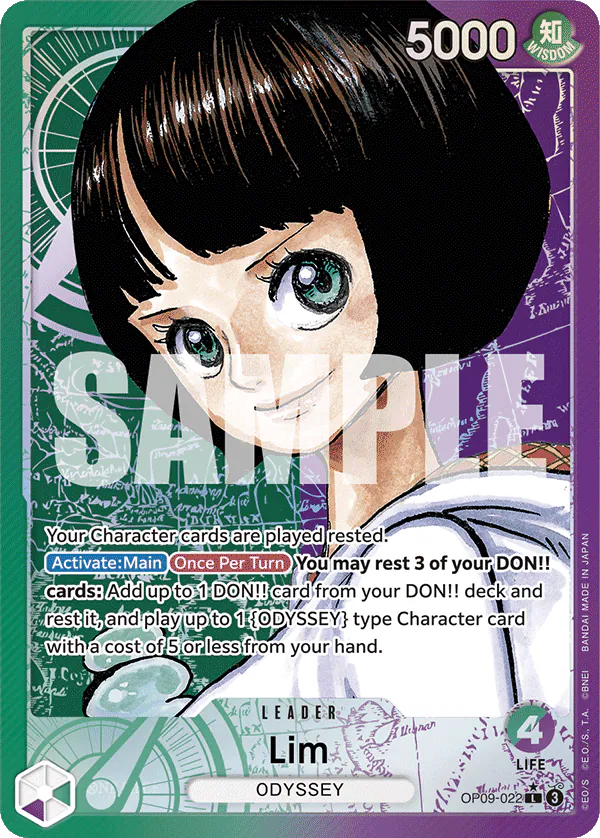 LimSee it on collecto.rs
Most cards in OP-09 pull their gravity straight from the manga page. Shanks commands the set through sheer historical weight, leaning on decades of Eiichiro Oda's ink to establish an aggressive baseline for red decks. Lim does the opposite. Originating in the video game One Piece Odyssey, she steps into the card game without thirty chapters of canon buildup behind her. Her presence here breaks the traditional paper aesthetic, giving this Leader alternate art a distinct visual identity that exists entirely outside standard serialization.
That separation gives the card its charm. Rather than freezing a famous panel in foil, the alternate art presents Lim with a soft, painterly palette rarely seen on high-tier leaders. It trades dramatic battle lines for deliberate stillness. The green frame wraps around clean composition, focusing on character design built specifically for a digital screen and translated onto cardboard. For anyone building around the Odyssey engine, playing this version changes the entire tone of your side of the table.
Mechanically, she brings a strange, puzzle-like tempo to green strategies. Where a traditional anchor like Crocodile stabilizes Buggy's circus with predictable control turns, Lim asks you to manage resources through an odd mix of events and stage interaction. It is not the most straightforward route to victory, but it rewards deliberate sequencing and patience.
Whether you catalog your leaders by competitive utility or simply keep them for the art shifts across different eras, this card marks a rare detour for the game. Bandai rarely lets outside media lead a flagship set release. When they do, the result feels refreshingly different from the usual sea of shouting pirates. If you track alternate arts in your collection, this one belongs in its own lane.
8. Crocodile (OP09-046)#
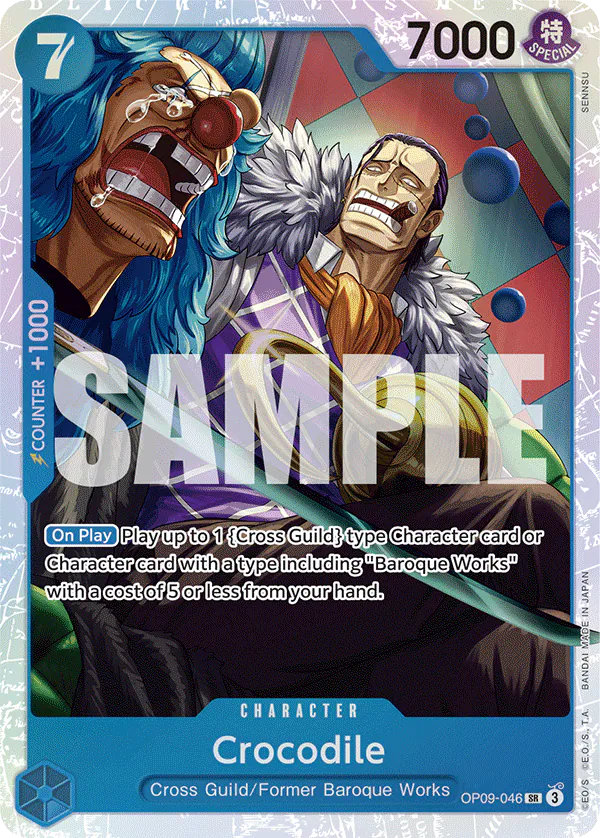 CrocodileSee it on collecto.rs
Eight cost, nine thousand power, and a clean slate of blue ink. Crocodile arrives in OP-09 as the operational spine of Cross Guild. While Buggy gets the clown-faced Emperor credit on the front page, the card stock itself tells the underworld truth. Blue decks built around the new engine need a stabilizer that can weather removal while establishing lethal swings. Crocodile delivers that stability without pretense. He gives the list an anchor, preventing the archetype from collapsing into pure circus tricks.
Where the purple Sanji at number nine functions as a mid-game hinge to swing initiative, Crocodile operates as the ceiling. Sanji sets the tempo on curve. Crocodile closes the door once you get there. His stat profile puts immediate pressure on the board, daring your opponent to exhaust counter events or let through nine-thousand-power swings every subsequent turn. It is a classic blue design pattern executed with minimal friction: big body, clear threat, and zero wasted text.
The artwork reflects that corporate, smoke-filled calm. Even within a booster set dominated by the loud visual spectacle of the Four Emperors, this card pulls back toward calculated patience. The foil treatment across the Super Rare finish catches the sand effects without burying the character behind excessive digital noise. If your binder tracks the shifting power structures of the Grand Line, this printing captures the exact moment the former warlord decided to let an idiot take the public fall while he ran the finances from the shadows. You can log your copy into collecto.rs alongside your other OP-09 pulls, track the variant finish, and export the file whenever you want to compare your Cross Guild core with the rest of your set run.
7. Sanji (OP09-065)#
 SanjiSee it on collecto.rs
At a local tournament last month, a purple deck pilot spent four turns quietly mathing out DON!! curves on a scrap piece of receipt paper. When turn five landed, they slapped down Sanji, corrected the board state in one clean stroke, and took back the tempo. That is the card doing its job.
Purple Straw Hat builds live or die on mid-game initiative. You spend the early turns taking minor hits or ramping your resource base. Then you need bodies that do more than occupy space. Sanji fits directly into that hinge turn. It does not demand the elaborate setup that Crocodile requires to hold Buggy’s circus together; instead, it enters the board, solves an immediate math problem, and demands an answer before your opponent can press their advantage.
Bandai gave this Super Rare a deliberate statline. In OP-09, the line between an aggressive push and a defensive misplay is razor thin. Cards at this cost tier have to balance offensive pressure against counter efficiency. Sanji carries enough presence to contest rested threats while keeping your DON!! recovery engine moving in rhythm. You feel the design intent the moment you sequence him into play.
For anyone archiving -EMPERORS IN THE NEW WORLD-, the card represents the mechanical shift toward leaner, higher-impact purple lines. It captures a specific moment in the game’s balance history, where mid-range stability matters just as much as end-game bombs. When you log OP09-065 in your collecto.rs binder, tag it alongside your other stage-five curve plays so you can track how purple engines evolve over successive releases. It stands out because it simply does what the text says without wasting a single resource.
6. Black Hole (OP09-098)#
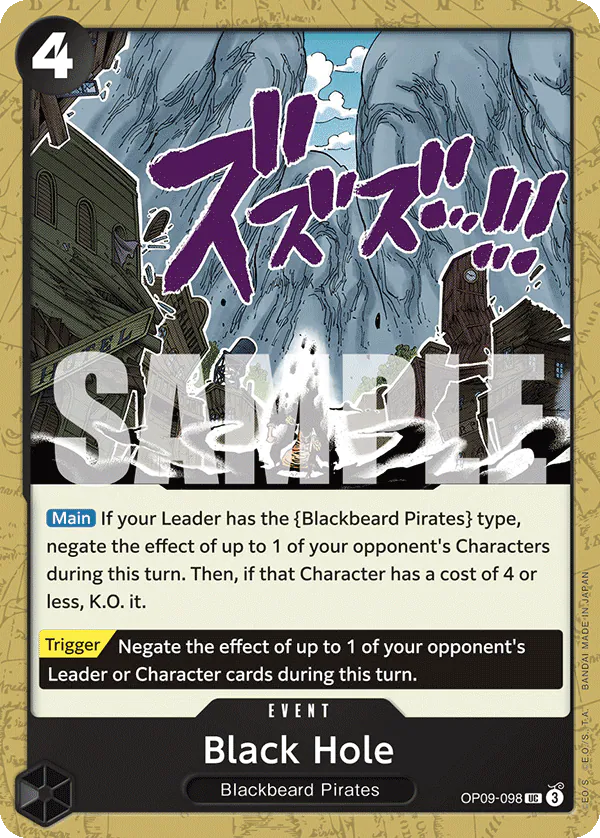 Black HoleSee it on collecto.rs
Why do some uncommon event cards linger in memory longer than the secret rares that share their box? Black Hole earns that stay through sheer presence. It is an uncommon card, slotted at OP09-098, but it carries the distinct narrative bite of Marshall D. Teach at his most disruptive. The art captures the darkness pooling across the floor, swallowing light and resources alike. In card games built around character tempo, an event card needs a direct point to make a binder entry feel complete. This one manages that simply by giving Blackbeard's specific, messy cruelty a physical footprint on cardboard.
Where Sanji handles purple board momentum with predictable mid-game curve math, Black Hole behaves like an unexpected sinkhole. It does not ask for permission. It strips away established board pieces and leaves behind an empty space that opponents have to answer immediately. That mechanical friction matches the character completely. Bandai often uses high-rarity slots to deliver clean spectacle, but they frequently hide their best thematic swings in the lower tiers. You open a pack hoping for foil textures and walk away studying the text box on an uncommon instead.
Whether you sleeve this copy for a Blackbeard deck list or store it next to the leaders in a set binder, it holds its own weight. The black border framing the dark art keeps it legible across a table. When you catalog cards like this on collecto.rs, you track how common and uncommon events often define an archetype far more than the flagship leaders do. It is an honest piece of game design that does exactly what the manga promised years ago, without needing extra foil stamps to make its point.
5. Buggy Alternate Art (OP09-042_p1)#
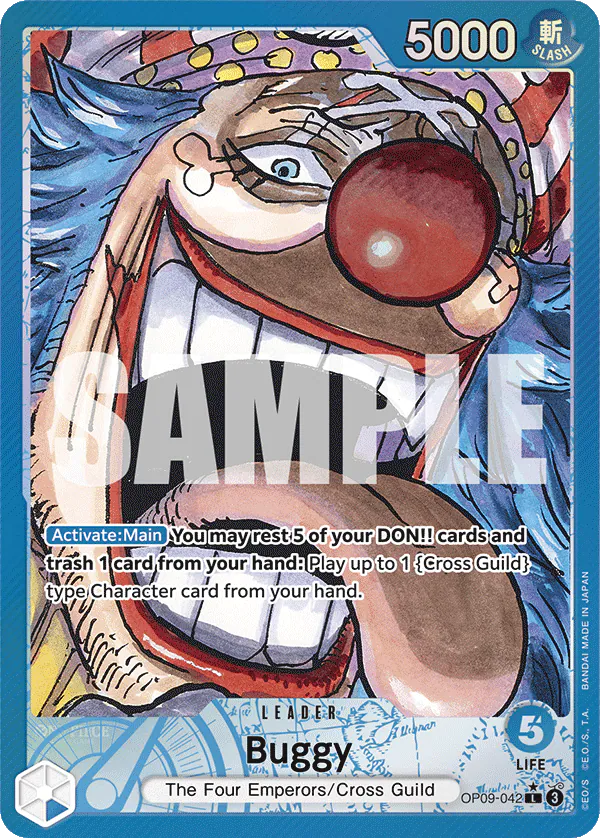 BuggySee it on collecto.rs
Nobody actually expected him to pull this off, which is the entire joke. Buggy did not earn his Emperor seat through sheer raw conqueror haki or meticulous tactical discipline. He stumbled uphill into legendary infamy, backed by a terrified crew and a very bewildered Cross Guild. Card OP09-042 captures that magnificent accident with absolute clarity. The alternate art version strips away standard leader borders to place his sweating, theatrical grin right in the middle of your playmat.
Where the Monkey.D.Luffy leader card across the table represents raw, imperial purple aggression, Buggy plays a completely different psychological game. He costs nothing to disrespect until the blue deck engine kicks into high gear. His leader ability turns cheap, weird utility characters into constant draw power and field presence. You flood the board with eccentric clowns and former Impel Down convicts, then force the table to treat them like genuine tactical threats. The card mechanically mimics the story: sheer confusion masquerading as sheer genius.
That balance between punchline and genuine threat makes the alternate art print particularly satisfying to sleeve up. The textured foil catches the gaudy red, white, and blue hues of his carnival outfit, framing him alongside Mihawk and Crocodile. They look furious to be there. He looks terrified to be in charge. It serves as an authentic counterweight to the stone-faced seriousness of the other Yonko in the set.
If you run blue in OP-09, you likely built around him the day your box arrived. When you add this copy to your collecto.rs binder, the catalog tool tracks the alternate art printing alongside your standard blue playsets. The clown prince of the New World gets his due, whether the rest of the Grand Line likes it or not.
4. Monkey.D.Luffy Alternate Art (OP09-061_p1)#
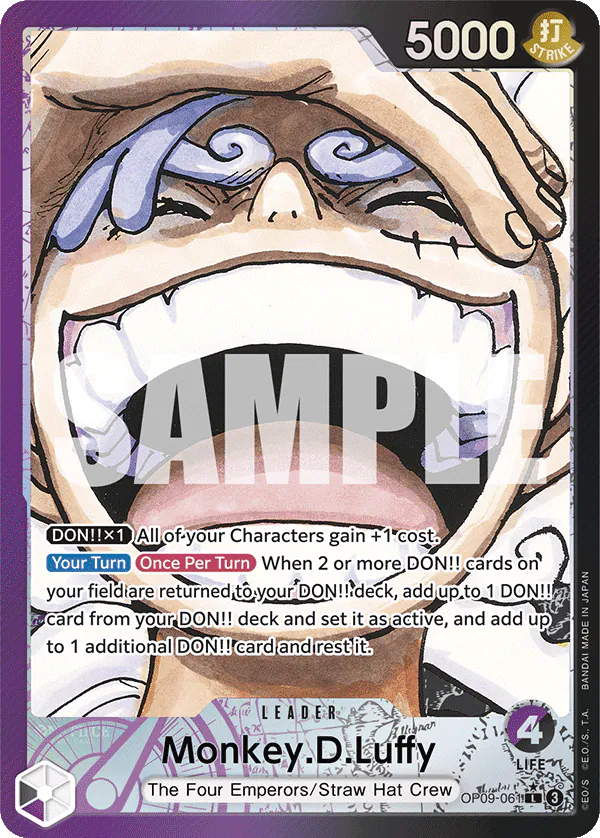 Monkey.D.LuffySee it on collecto.rs
Under the desk lamp, the white ink of Gear Five catches the glare before the foil underneath does. Eiichiro Oda drew this form loose and rubbery. This card translates that looseness into something heavy. It sits squarely in the purple slot for OP-09, carrying four life and five thousand power alongside an effect built entirely around DON!! acceleration. While Marshall.D.Teach locks out rival engines by shutting down triggers, this Luffy simply races past them. You return resources to gain resources, trading tempo now for overwhelming board states a turn earlier than your opponent planned for.
The alternate art strips away the standard tournament frame to let the transformation breathe. The cloud collar loops across the text box. The grin stretches almost ear to ear across the top third of the card face. Purple decks in the One Piece Card Game have always lived or died on exact mathematics, yet the presentation here leans directly into cartoon abandon. It captures the narrative turn of Wano: absolute freedom weaponised as raw political weight. He is not just an upstart rookie anymore. He is an Emperor, treated with the same mechanical gravitas as the veterans across the table.
Card OP09-061 marks that shift in tone clearly. If you track your cards in collecto.rs, logging this variant alongside the base leader gives you a tidy snapshot of how Bandai handles alternate rarities across OP-09. The textured foil layer picks out the lightning strikes behind him, separating the figure from the purple background ink without muddying the composition. It stands at the midpoint of this list because it does not attempt to break the fundamental engine of the game like Teach, nor does it play for comedic value like Buggy. It delivers on the premise of the set plainly. An imperial portrait, rendered in pure white and gold foil.
3. Marshall.D.Teach Alternate Art (OP09-081_p1)#
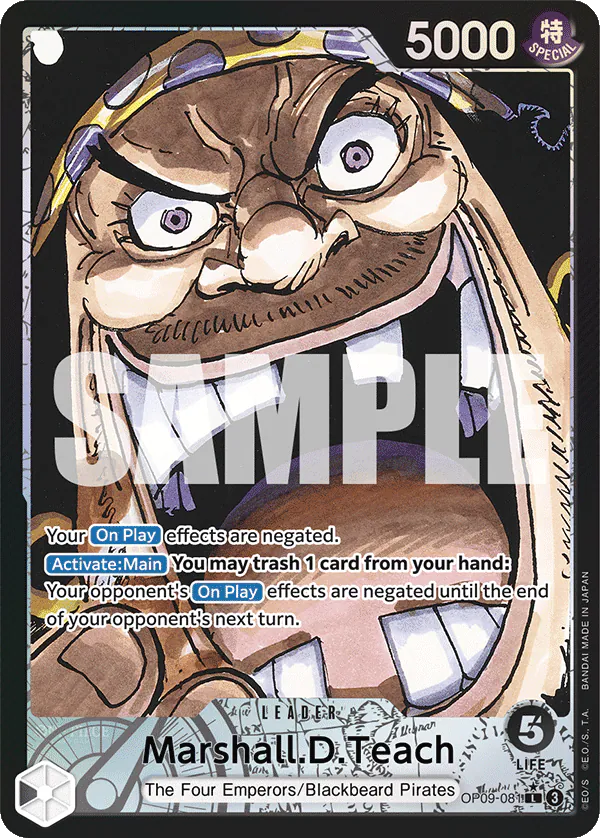 Marshall.D.TeachSee it on collecto.rs
Zero activated On Play effects across the opposing board for as long as Teach sits in the leader area. In a game built on immediate enter-the-field value, turning off those text boxes does not just slow down an opponent. It dismantles their engine entirely.
Marshall.D.Teach arrives in OP-09 as a mono-black leader carrying five life and zero counter power of his own. Where Monkey.D.Luffy pushes the purple strategy toward explosive DON!! ramps and imperial aggression, Teach plays the long grind. He denies the basic tools modern decks rely on to stabilize. Drop a searcher, drop a blocker, drop a board clear: if the card relies on an On Play trigger to justify its cost, Teach reduces it to an overcosted body with plain numbers. You force the table to play fair combat in a format designed around unfair tempo swings.
The alternate art framing gives that mechanical chokehold the presence it demands. Teach fills the space completely, grinning out through heavy black inks and jagged line work that ditch clean edges for raw weight. It looks oppressive because the card is oppressive. Black decks in the One Piece Card Game have always lived and died by trash management and cost reduction. Teach takes those familiar levers and adds total silence. Opponents have to look down at hands full of dead text and find a manual way through five life.
Slotting OP09-081 into your binder gives a physical record of the moment Bandai decided rules-suppression belonged in the command zone. If you catalog your playsets on collecto.rs, tag this print under both your black leader decks and your four-Emperors binder run. It stands as the set's clearest shift in how turns are calculated, right down to the quiet pause after an opponent reads the effect once more.
2. Donquixote Rosinante Special Card (OP04-119_p2)#
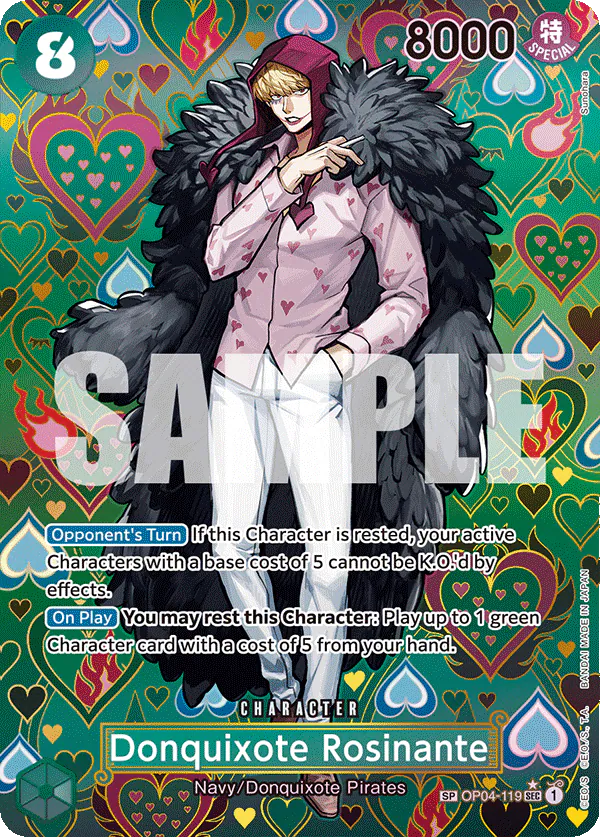 Donquixote RosinanteSee it on collecto.rs
While Teach bends the entire table to his presence through sheer suppression, Rosinante works by quietly absorbing whatever hit was meant for someone else. That division of labor defines this specific printing. OP-09 dedicates its rarest slots to towering Emperors, yet it saves one of its special reprint positions for a green character card first printed back in Kingdoms of Intrigue. The slot is not an afterthought. It is a visual recalibration for a defensive anchor that many players have carried through multiple deck iterations.
The original OP04 version leaned hard into quiet sorrow. This SP card treatment takes a different route, giving Rosinante room across the frame with stylized linework and textured foil that emphasizes the feather mantle rather than the tragedy. It treats him as a guardian rather than a casualty. Mechanically, the text remains identical to the original release: a five-cost, six-thousand-power blocker that can rest itself to protect another rested character from leaving the field. You already know how that timing works against aggressive red or black lines. What changes here is the weight of the card in hand.
Reprint slots in modern booster sets often feel like routine maintenance. They exist to cycle cardboard back into circulation. In OP-09, the special card treatments do something smarter by offering alternative art that reframes how a staple sits inside an existing binder. Rosinante bridges the gap between old deck builds and current pack openings without needing new rules or altered power stats. When you log this card into your collecto.rs account, you can keep the entry distinct from your earlier OP04 playset, tracking both versions under their proper set IDs while keeping your full variant history clean and exportable whenever you want to check it.
1. Gol.D.Roger (OP09-118_p1)#
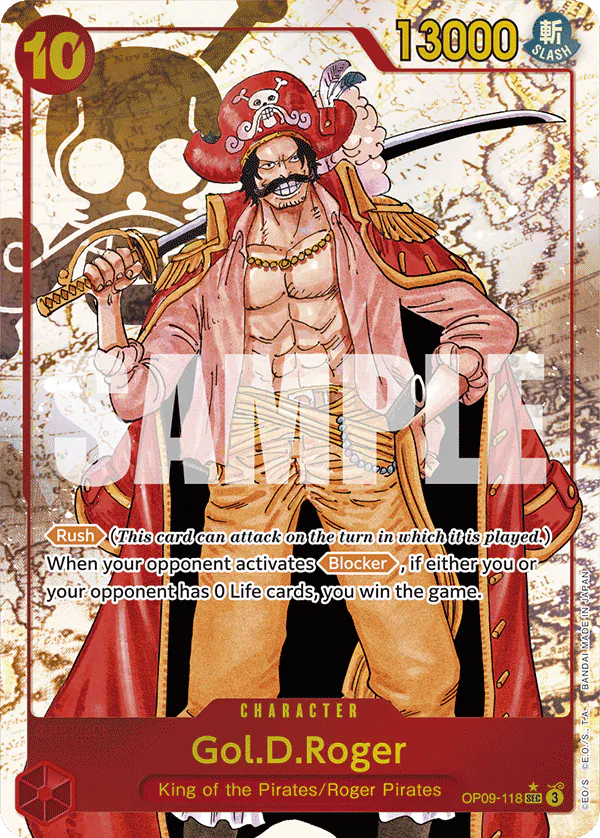 Gol.D.RogerSee it on collecto.rs
Where do you take a card set built around the four Emperors once every throne in the New World is already claimed?
You go back to the source. The Pirate King sits at the top of OP-09 because the entire setting exists in the wake of his execution. While Donquixote Rosinante earns his spot on this list by refining a familiar defensive line with fresh artwork, Gol.D.Roger operates on a different scale entirely. Rosinante protects your board from routine pressure. Roger simply ends the conversation. He enters play with ten cost and thirteen thousand power, towering over the standard stat curves that define modern constructed matches.
The Secret Rare printing carries that weight directly into the cardboard. Bandai chose to frame Roger not in the middle of a frantic sword clash, but in the deliberate stillness that preceded his legendary voyage. The line work is sharp. The gold foil accents stay restrained, outlining the coat trim and his broad grin rather than flooding the entire face of the card with generic shine. It looks like an artifact from the start of the story, which is precisely what it is meant to represent.
Running Roger in a deck requires total commitment to high-cost resource management. You do not drop him on curve by accident. You spend the preceding turns surviving, baiting counter cards, and watching your life total dwindle until you can finally tap out all ten DON!! cards in a single motion. That all-or-nothing cadence matches the character in the lore. If you pull this parallel art, catalog it under your primary binder on collecto.rs alongside your other high-rarity boss monsters, or set it apart in a magnetic display case on your shelf. It caps off the set by reminding everyone why the modern pirate era began.
Sets like Emperors in the New World show why the One Piece Card Game continues to hold attention. A set can print high-rarity foils and call it a day. It is harder to align the cardboard in front of you with the exact narrative stakes of the source material. OP-09 does that work. The archetypes feel like their captains: Blackbeard strips away what makes your deck function; Luffy bets everything on a single turn; Buggy stumbles into an overwhelming board state; Shanks waits for the exact moment to strike.
How you organize these cards depends entirely on what you value in the set. You might track the alternate arts for the print textures alone. You might separate the four modern emperors from the historical figures who preceded them, or keep the Cross Guild pieces grouped by crew rather than rarity. When you catalog your OP-09 cards on collecto.rs, you can organize them by leader, set code, or visual theme, and export your entire archive whenever you want. The power balance on the sea shifts constantly. Your record of it stays right where you put it.
Frequently asked questions#
What is the theme of One Piece Card Game OP-09?#
OP-09, titled Emperors in the New World, focuses directly on the Four Emperors of the modern era: Luffy, Blackbeard, Buggy, and Shanks. The set introduces dedicated Leader cards and supporting crew archetypes for each of them, spanning the Red Hair Pirates, Cross Guild, Blackbeard Pirates, and the Straw Hat crew.
Which Emperors are featured as Leaders in OP-09?#
The set introduces new Leader versions of Monkey D. Luffy, Marshall D. Teach, and Buggy, alongside Odyssean characters like Lim. These Leaders define specific color pairings and mechanics, such as Teach disabling opponent on-play abilities and Buggy building a Cross Guild engine.
What makes the Secret Rare cards in OP-09 distinct?#
Secret Rares in OP-09 feature major lore figures tied to the summit of piracy. The set includes Gol D. Roger, providing top-end power and distinctive full-art parallel foil options that anchor high-rarity slots for the expansion.