The short version#
True card scarcity is rarely about base rarity symbols; it is defined by distribution methods, short event windows, and regional tournament allocations.
- Urouge
- Donquixote Rosinante
- Nami
- Boa Hancock
- Koby
- Trafalgar Law
- Nami
- O-Nami
- Franky
- Hongo
Turn over a One Piece card and you will find a letter near the set code. C, UC, R, SR, SEC. The publisher prints those letters to tell you how often a card drops from a foil wrapper. They are helpful markers when you open a fresh booster box on your kitchen table, but they tell you very little about how hard a card is to actually hold in your hand.
True scarcity in Bandai’s card game has almost nothing to do with what is printed on the cardboard. It is born outside the booster box. It happens in local game stores during a two-week window, in tournament halls where only eight people leave with a specific envelope, and at regional events where the prize pool shifts before the next season begins.
When a card is sold in a booster pack, thousands of copies enter the market at once. When a card is handed to someone who placed top four at an offline regional, the supply is capped by the number of tables in the room. Some of these cards were printed for a single weekend. Others required winning a match against someone who flew across three state lines just to play their turn.
If you collect this game long enough, your focus shifts from the chase rares in the main sets to the cards that never saw a retail shelf. You start tracking distribution sheets, store championship kits, and event packs. You realize that finding a card has less to do with luck at a checkout counter and more to do with where the card was handed out, who was standing there to receive it, and how many of them kept it in a sleeve.
Here are ten cards where the printed rarity symbol is only a small part of the story.
| # | Item | Set / Year | Rarity |
|---|---|---|---|
| 1 | Urouge | Offline Regional Champion Card Set 25-26 Season 1 | R |
| 2 | Donquixote Rosinante | -LEGACY OF THE MASTER- [OP-12] | L |
| 3 | Nami | -EMPERORS IN THE NEW WORLD- [OP-09] | SP CARD |
| 4 | Boa Hancock | -Anime 25th Collection- [EB-02] | L |
| 5 | Koby | Event Pack vol.7 | P |
| 6 | Trafalgar Law | Event Pack vol.7 | P |
| 7 | Nami | 2025 NEW YEAR EVENT | C |
| 8 | O-Nami | Event Pack Vol.5 | R |
| 9 | Franky | Premium Card Collection -FILM RED Edition- | UC |
| 10 | Hongo | Winner Pack 2025 Vol.2 | UC |
10. Hongo (Winner Pack 2025 Vol.2)#
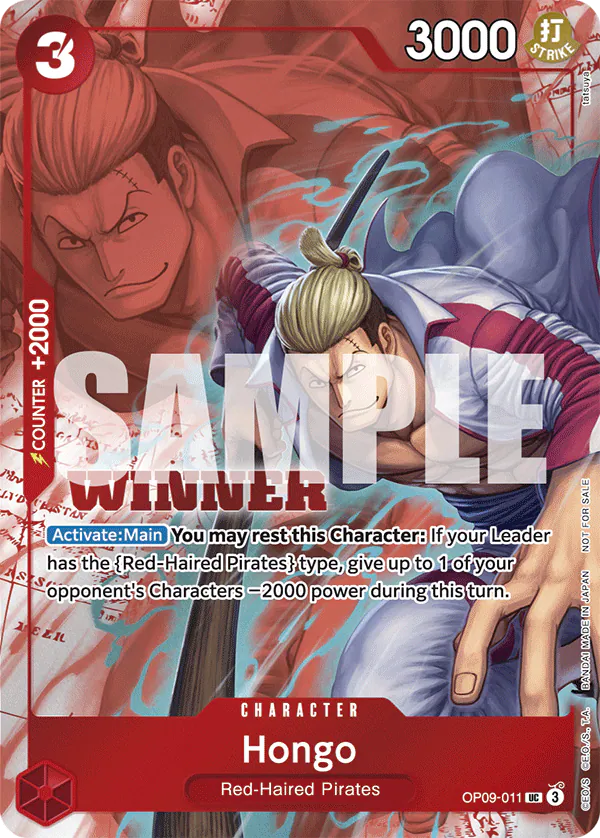 HongoSee it on collecto.rs
One entry ticket. One tournament. One stamped card for the person who wins the whole thing. The standard uncommon Hongo from the standard OP09 booster box is a card you will pull while looking for something else. The Winner Pack 2025 Vol.2 variant is a different proposition entirely. It sits at number ten on this list because it introduces a barrier that money alone cannot immediately clear: you had to sit at a table, play the match, and walk away undefeated.
Bandai uses Winner Pack promos to reward local tournament play. They do not sell these packs at retail. They do not include them in standard booster boxes. To get a sealed Vol.2 pack, a local game store has to host an official event, and to get the Hongo inside it with that gold foil stamp across the art, you have to win. That tight distribution bottleneck shrinks the available supply instantly, long before the card ever reaches the secondary market.
That local, victory-gated supply is what sets this card apart from the Franky at number nine. Where Franky relies on event binders and theatrical windows—restricting access by geography and calendar dates—Hongo restricts access by outcome. You could be in the right room on the right weekend for Hongo and still walk out empty-handed if your matchups go sideways.
For collectors chasing the complete OP09 red character set, this specific UC card code turns into a wall. The art features the Red Hair Pirates surgeon in mid-action, but the real draw is that small, printed text near the border that proves where the card came from. If you are cataloging your Red Hair Pirates binder on collecto.rs, this is the slot that usually stays empty the longest.
9. Franky (Premium Card Collection -FILM RED Edition-)#
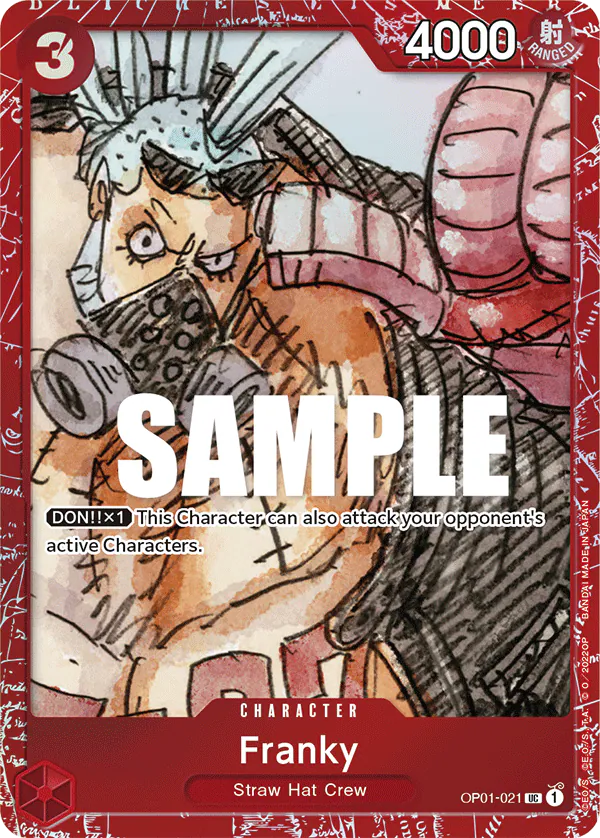 FrankySee it on collecto.rs
You are sitting in a packed Tokyo cinema in the late summer of 2022. The house lights stay down just long enough after the credits for the theater staff to hand you a small black paper envelope. Inside is a glossy booklet containing thirteen cards. You open it to the fourth page, and there is Franky, striking a pose in his oversized crimson leather jacket. If you missed that screening, or failed to secure a ticket to the specific pop-up venues hosting the promotion, your window closed before the movie even finished its theatrical run.
This unrefined card carries the code OP01-021. In the standard Romance Dawn set, it is an Uncommon card that rarely commands a second glance during a draft. Put that exact same card design into the Premium Card Collection FILM RED Edition folder, however, and the math changes completely. Bandai did not print this binder for standard retail shelves. They distributed it through limited theatrical runs and specific event venues, tying its availability to a strict geographic and temporal window.
While cards like O-Nami bottleneck a collection through competitive store events, this Franky card creates a different kind of scarcity. It relies entirely on presence. You had to be in the right room in the right city during a very short calendar week. Because the card itself shares its artwork and text with a common set filler piece, many fans overlooked the folder entirely, letting it sit unopened or tossing it into tote bags where the corners dinged against water bottles.
Finding a copy today means tracking down a collector who preserved that original venue booklet intact. It remains a quiet hurdle for anyone trying to assemble every unique physical release of the Straw Hat crew.
8. O-Nami (Event Pack Vol.5)#
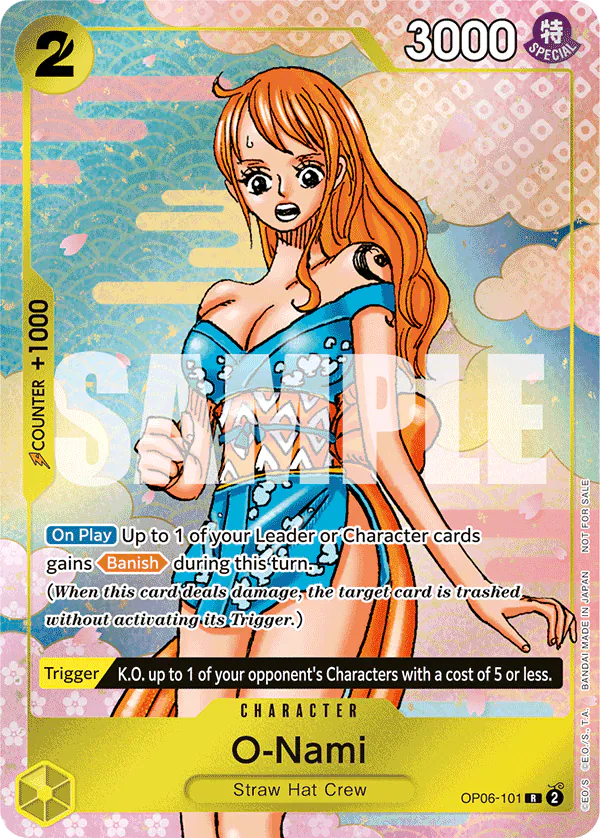 O-NamiSee it on collecto.rs
Rare cards are usually easy to spot because they shine. Super Rares and Secret Rares pull the eye with textured foil and full-art treatments, leaving standard Rarity cards to blend into the background of a binder page. The Event Pack Vol.5 version of O-Nami breaks that pattern. The card itself carries a simple R rarity stamp, but the distribution method separates it from every standard pull in Wings of the Captain packs.
Bandai did not put this print into booster boxes. You earned it by sitting down across from another player at an official store tournament. Players received a pack containing one random card from a curated pool of six for participating. That single-card format creates a specific kind of scarcity. Even if you attended every weekly event during the season, you were never guaranteed to pull the exact yellow card your deck or set required.
This distribution model creates a different supply barrier than the one keeping Nami out of reach. While holiday promos rely on a narrow calendar window that disappears after a single weekend, pack-in promos like O-Nami squeeze supply through probability and local access. You had to have an active tournament store nearby, and you needed the odds to land in your favour when opening a foil wrapper that contained a single card.
Collectors building complete playsets or master sets of the OP06 era run straight into this bottleneck. The art features Nami in her Wano country outfit, making it a key piece for character collectors alongside tournament players running yellow decks. Because these cards entered circulation one paper pack at a time through local game shops, finding clean copies requires looking past the usual secondary market channels.
7. Nami (2025 New Year Event)#
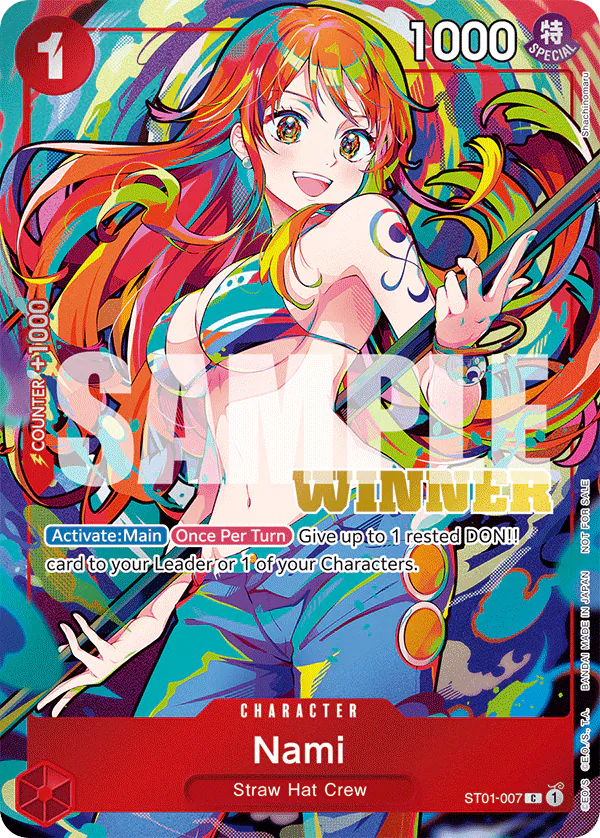 NamiSee it on collecto.rs
A friend waited three hours in a line that wrapped twice around an Osaka department store just to walk away with one sealed envelope. Inside was a single event pack, given out exclusively during a short holiday window. He did not open it on the train ride home. He put it straight into a hard sleeve, acknowledging the reality of holiday event promos: when the event calendar turns, the supply stops completely.
This specific Nami card carries the ST01-007 card code and holds a Common rarity stamp, but those markings hide its actual availability. Standard set cards flow through traditional booster boxes and retail shelves for months. Holiday event promos operate on a brief, rigid timer. Once the venue closes its doors for the New Year celebration, no more copies enter circulation. The secondary market becomes the only source overnight.
That window creates a different kind of scarcity than retail promos like O-Nami. While store event cards linger across multi-week tournament schedules, a holiday card relies on a single weekend crowd. If you were not in that specific room during those specific days, you missed the entire primary distribution.
Collectors aiming for complete sets run into this wall quickly. The card itself uses a familiar character code, but the 2025 New Year Event stamp separates it from its starter deck sibling. The raw number of surviving, mint-condition copies remains low simply because event attendees treat them as casual souvenirs rather than preservation targets. Finding one today means tracking down someone who knew what they had the moment it handed over the counter.
6. Trafalgar Law (Event Pack Vol.7)#
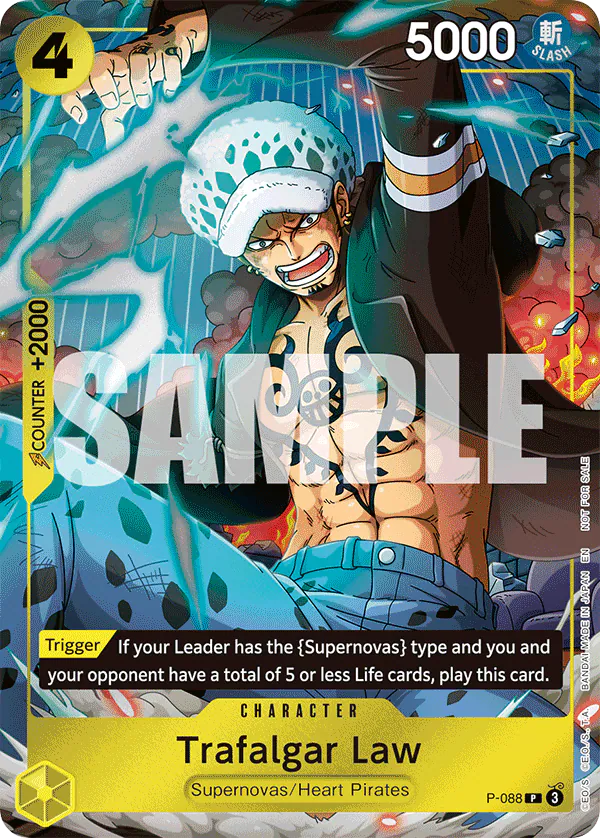 Trafalgar LawSee it on collecto.rs
How do you track down a card that never spent a single second on a store shelf?
Trafalgar Law (P-088) belongs to Event Pack Vol.7, a promotional run given out exclusively to participants at sanctioned organized play events. You could not buy a booster box to chase it. You could not order a case online and hope for a lucky hit. To get one at release, you had to register, show up, and play.
That distribution model changes the math for collectors completely. Standard set cards, even the rarest alternate arts, enter the world through thousands of retail locations simultaneously. Promo cards tied to event packs filter through a much smaller funnel. They rely on local game store attendance, regional tournament capacities, and strict per-player caps during a specific competitive window.
While the holiday event Nami card built its scarcity through a short calendar window, this Law promo adds a competitive hurdle to the calendar constraint. When the event season ends, the supply stops instantly. The cards that made it into deck boxes often stayed there, getting shuffled and handled in competitive play. Finding a copy that escaped tournament wear without ever seeing a shop counter requires patience.
For catalogers working through the P-numbered promo series, P-088 represents a specific kind of headache. It sits at the intersection of restricted distribution and high-demand character cataloging. If you missed the tournament season where Event Pack Vol.7 was handed out, you are entirely reliant on the secondary market, where copies surface far less frequently than standard set parallels.
When you add this one to your collecto.rs catalog, you are documenting an entry that bypassed retail supply chains entirely. It is a record of an event that happened in a room full of players, not a transaction at a checkout counter.
5. Koby (Event Pack Vol.7)#
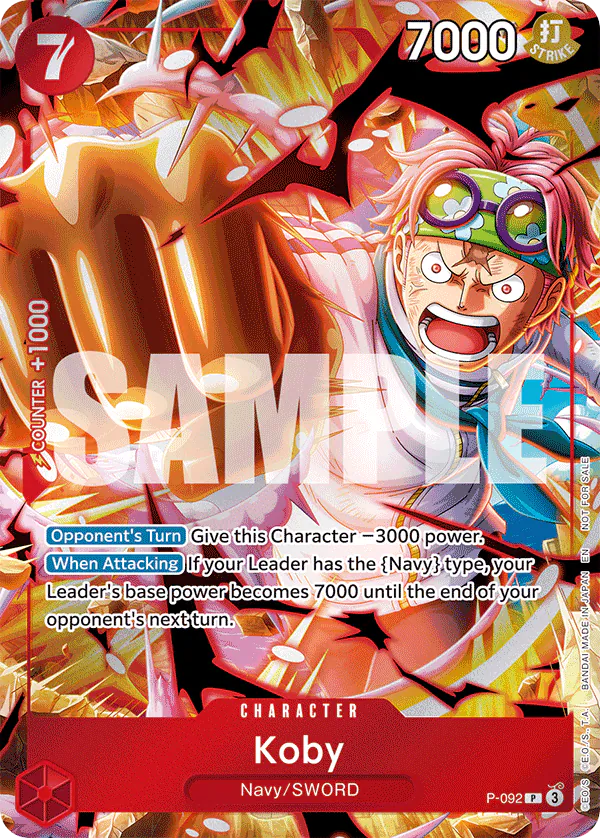 KobySee it on collecto.rs
You probably expected a Yonko here. It makes sense to assume the hardest finds feature captains with nine-figure bounties or scenes from peak arc climaxes. Koby breaks that logic. He spends most of the story trying to get his boots tied straight, yet his Event Pack Vol.7 printing stays firmly out of reach.
Promotional cards exist in their own supply reality. Regular set hits like the Boa Hancock anniversary printings rely on tight retail runs and special foil treatments to create scarcity. You can still buy those boxes online if your budget allows it. Koby, carrying the code P-092, never saw a shop shelf. Bandai distributed Event Pack Vol.7 exclusively through official competitive gatherings. You had to show up, register, and play to receive the sealed wrapper containing it.
That distribution model hits character catalogers hardest. If you build your collection around every official printing of a single marine, your checklist depends on tournament logistics rather than booster box odds. When an event pack run ends, the remaining inventory does not slide into secondary retail distribution. It simply stops moving.
The card itself keeps things simple. It carries a standard P rarity stamp and clean art that looks right at home beside main-set navy lists. There is no exaggerated parallel foil or alternative art treatment signaling its status from across a table. The difficulty is entirely in the paper trail. Finding one today means locating a player who sat through those specific tournament rounds, kept the promo in a sleeve, and decided to let it go. When you track your master sets on collecto.rs, it is usually cards like this P-092 that leave the last open slot.
4. Boa Hancock (Anime 25th Collection)#
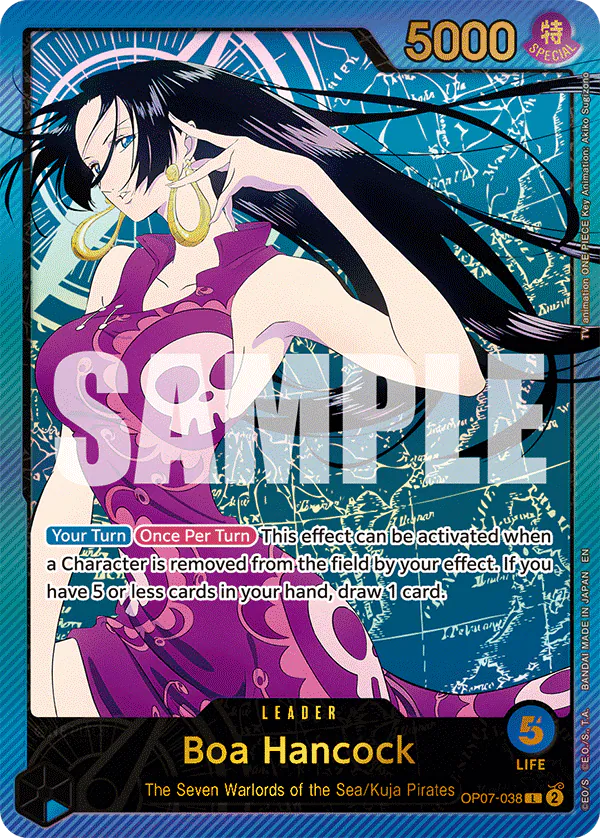 Boa HancockSee it on collecto.rs
One print run. The Anime 25th Collection subset EB-02 landed with a distribution footprint far smaller than standard expansion sets, creating an immediate choke point for complete set builders. The Boa Hancock leader card, coded OP07-038, sits right at the centre of that squeeze. Extra Booster sets operate on tighter allocation math than regular releases like OP-07. You pull fewer packs per box, and the parallel slots shrink accordingly.
Anniversary releases do not follow the standard rarity distribution rules. Bandai applied a distinct foil pattern to this run, using a textured coating that separates it from standard main-set Super Rares and Secret Rares. The visual difference is obvious the moment you tilt the card under a lamp, but the real barrier is the distribution math. In standard sets, hit rates are predictable across a case. In EB-02, the pool of alternate treatments is compressed, meaning any specific leader card requires opening exponentially more sealed product to surface naturally.
While the Nami insert relies on brutal per-case odds inside a massive print run, Boa Hancock presents a different hurdle altogether: there is simply less of the underlying product in circulation. You are not just fighting the pulled-card odds inside a box; you are fighting the initial volume of boxes shipped to stores. That structural limitation turns a set-specific Leader into a long-term bottleneck.
For catalogers tracking the OP07-038 slot, keeping precise notes on foil variants and set codes keeps your collection accurate. You can log the card code, tag the subset, and back up your records directly on collecto.rs whenever you update your binder.
3. Nami (Special Card - OP-09)#
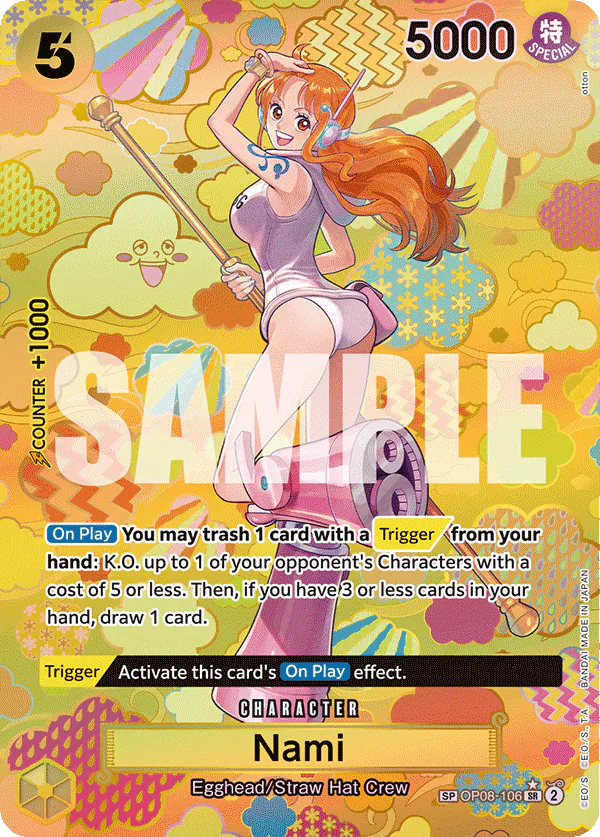 NamiSee it on collecto.rs
A card can sit at the top of a set list without looking like a prize. The OP-09 Nami Special Card skips the loud gold foil and crowded battle art for a clean, painterly portrait that feels almost quiet on a table. But finding one in a sealed pack is a math problem that works against you from the first box.
Main set releases distribute their rarest hits across every case, yet the math shifts once you target a specific Special Card. Pulling an SP Card from an EMPERORS IN THE NEW WORLD box is already a rare event. Pulling Nami requires beating the odds twice: first to hit the rarity tier, then to roll her specific card code over the other parallel options in the same print run. Where the Boa Hancock anniversary print relies on a tight, limited sub-set distribution to stay out of reach, this Nami relies on the pure volume of a standard set to hide in plain sight.
That difference changes how you look at a sealed case. With limited promos, you know the count before you open the box. With an main-set insert carrying the OP08-106 print code inside the OP-09 master lineup, the card stays elusive because no single case guarantees her spot. You can open a dozen display boxes and see every other parallel hit twice before this specific layout appears on your mat.
Cataloging your hits by set code makes those pull ratios clear over time. You can record the card code, tag the SP print variation, and back up your binder data whenever you want to export your list.
2. Donquixote Rosinante (Legacy of the Master Leader)#
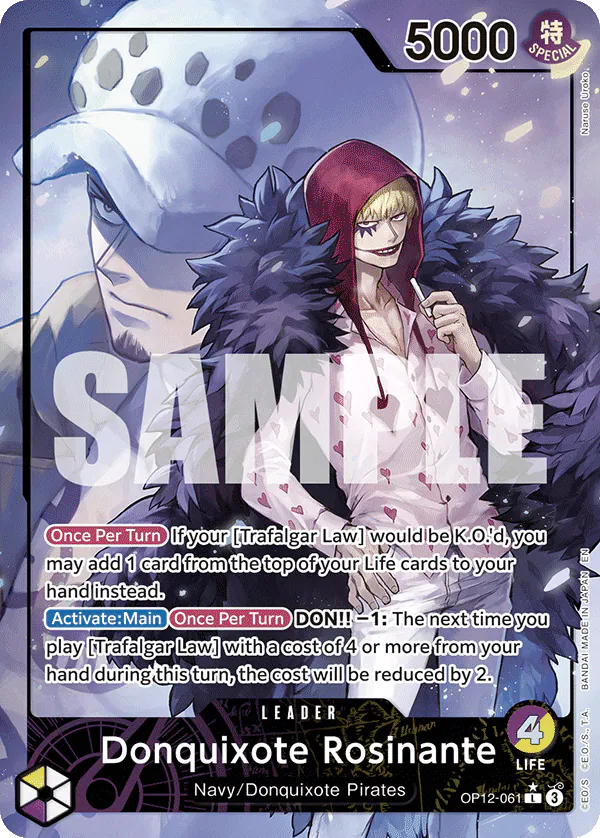 Donquixote RosinanteSee it on collecto.rs
You crack a fresh booster box, pull the leader card you need for your deck, and realize the art looks entirely wrong. In the best way possible. Instead of the standard frame, Rosinante stares back at you from an alternate full-bleed illustration that only drops once every few cases. It is the kind of pull that halts a draft night cold.
Alternate art leaders occupy a distinct tier of scarcity in the One Piece Card Game. While special inserts like the Nami card rely on sheer lottery luck across massive print runs, a card like Donquixote Rosinante from Legacy of the Master sits right at the intersection of mechanical necessity and low pull rates. Every navy deck player needs a leader card on the table to function. Very few get to play with this one.
Cataloguing these variants comes down to the details that set them apart from their main-set siblings. This specific printing carries the OP12-061 code, locked to the L rarity slot, but the physical card in hand feels entirely distinct from the standard issue version you find in regular pack slots. The textured foil treatment and altered composition make it instantly recognizable from across a table before the first turn even begins.
Keeping track of leader variants alongside your standard deck pieces gets messy fast when you are managing multiple sets across different release waves. That is why we built collecto.rs to give your collection a clear home. You can log the exact code, tag the print variant, and export your entire binder file whenever you want. No clutter, just the data on what you actually own.
1. Urouge (Offline Regional Champion Card Set 25-26 Season 1)#
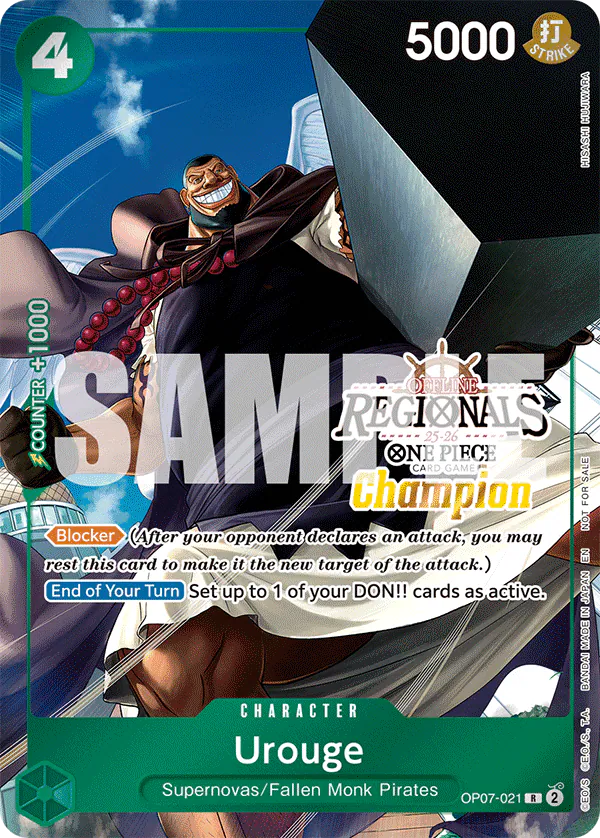 UrougeSee it on collecto.rs
You play nine rounds of Swiss, lose three years of sleep, and win the whole thing. The organizers hand you an envelope. Inside is a single copy of a red Rare card depicting a monk who fights with a giant iron pillar. There are no booster packs to open for another one. There is no second place prize that looks like this. You either won that specific tournament, or you bought the card from the person who did.
Top-tier competitive prize cards sit at the absolute ceiling of physical scarcity in the One Piece TCG. Set OP07-021 belongs to the Offline Regional Champion Card Set for the 25-26 Season 1. While a card like Donquixote Rosinante commands attention because alternate leader prints are notoriously tough hits in standard booster boxes, Rosinante still exists inside a retail distribution chain. Thousands of boxes were sealed, shipped, and opened. Urouge never saw a store shelf, a blister pack, or a retail display. Its supply was capped the moment the tournament bracket closed.
That difference changes how a card lives in the real world. Set-level hits rely on low pull rates spread across massive print runs. Tournament champion cards rely on strict headcount limits. The artwork on this specific R-rarity printing does not just mark a character from the Worst Generation; it records a specific weekend where one player went undefeated. When a card can only enter the market through the hands of a regional winner, finding a copy in clean condition becomes a exercise in tracking down individual people rather than refreshing marketplace listings. We built collecto.rs so you can document rare tournament promos alongside your main set pulls, with full data export whenever you want it. This Urouge remains the hardest card to pull out of another collector's hands.
The secondary market often treats scarcity as a temporary state, waiting for the next print run to balance the scale. Promo cards, regional prizes, and event packs do not work that way. Once an event window closes, the supply stops moving. The cards that exist are the only cards that will ever exist.
That reality changes how you look at a binder. A set of main-expansion Secret Rares represents patience and a budget. A collection of event promos represents geography, timing, and the specific history of a game played in real rooms by real people. Every copy in circulation has a paper trail that leads back to a specific room on a specific weekend.
Whether you track these down through trades, keep them in top loaders, or watch them from a distance, they anchor the physical history of the game. If you are cataloging your own promos or building out a complete set record, you can log every variation, print run, and event promo on collecto.rs. It keeps your card data structured, clean, and entirely yours, wherever your collection takes you next.
Frequently asked questions#
What makes a One Piece card genuinely scarce?#
Scarcity comes down to how a card was distributed. While set secret rares are pulled from standard booster boxes, event promos, stamped winner cards, and regional championship prize cards are capped at fixed quantities. Once those competitive events end or promotional packs run out, no additional copies enter circulation regardless of market demand.
Are alternate art cards harder to find than tournament promos?#
Set-based alternate arts are rare per box, but their total print run scales with global booster production. Tournament promos and stamped event cards have hard caps tied strictly to player attendance and prize structures. Over time, physical distribution limits make competitive promos much harder to acquire raw.
How can I keep track of promotional card variants?#
Tracking specific card codes and set prefixes is essential because variant stamps share base numbers with common prints. Documenting exact foil finishes, event stamps, and release origins in a dedicated catalog helps separate standard set cards from restricted promo distributions.