The short version#
Ascended Heroes works because it commits to pairing specific trainers and distinct mechanical eras, balancing nostalgic character ownership with bold design.
- Steven's Metagross ex
- Marnie's Grimmsnarl ex
- Iris's Fighting Spirit
- Pikachu ex
- Erika's Tangela
- Mega Hawlucha ex
- Iono's Bellibolt ex
- Drakloak
- Team Rocket's Dugtrio
- Erika's Oddish
Every Pokémon set makes a promise. Most of the time, the promise is simple: open the pack, find the monster, sleeve the card. Ascended Heroes does something harder. It ties the monster back to the person standing behind it, then mashes that bond against mechanical eras that rarely share a binder page.
Trainer-owned Pokémon are not new. Gym Heroes and Gym Challenge proved decades ago that putting a name in a prefix changes how the cardboard feels in your hand. An Oddish is nature on two roots. Erika's Oddish is an afternoon in a Celadon greenhouse with trimmed bonsai and filtered sunlight. That naming convention gives identity to cards that might otherwise blur into common bins.
Ascended Heroes works because it commits to this lineage without treating it like museum glass. It refuses to stay locked in 1999. It pulls gym leaders from Kanto and champions from Unova, then drops modern rule-box designs right beside classic pencil sketches. You get vintage posture alongside modern foil treatments. The set does not ask you to choose between the way the game felt when you learned it and the way the game looks on a kitchen table tonight.
That balance is tricky. Lean too hard into character ownership, and the set turns into hollow fan service. Lean too far into modern battle mechanics, and the card art gets swallowed by text boxes and damage counters. Ascended Heroes threads the needle by anchoring the art in the specific habit of each partner. You see the personality of the human reflected in the posture of the Pokémon. The result is a set that gives both vintage specialists and modern collectors something concrete to study. Here are ten cards that show exactly how that balance works.
| # | Item | Set / Year | Rarity |
|---|---|---|---|
| 1 | Steven's Metagross ex | Ascended Heroes | ultra-rare |
| 2 | Marnie's Grimmsnarl ex | Ascended Heroes | ultra-rare |
| 3 | Iris's Fighting Spirit | Ascended Heroes | ultra-rare |
| 4 | Pikachu ex | Ascended Heroes | ultra-rare |
| 5 | Erika's Tangela | Ascended Heroes | ultra-rare |
| 6 | Mega Hawlucha ex | Ascended Heroes | ultra-rare |
| 7 | Iono's Bellibolt ex | Ascended Heroes | holo-rare |
| 8 | Drakloak | Ascended Heroes | ultra-rare |
| 9 | Team Rocket's Dugtrio | Ascended Heroes | uncommon |
| 10 | Erika's Oddish | Ascended Heroes | common |
10. Erika's Oddish#
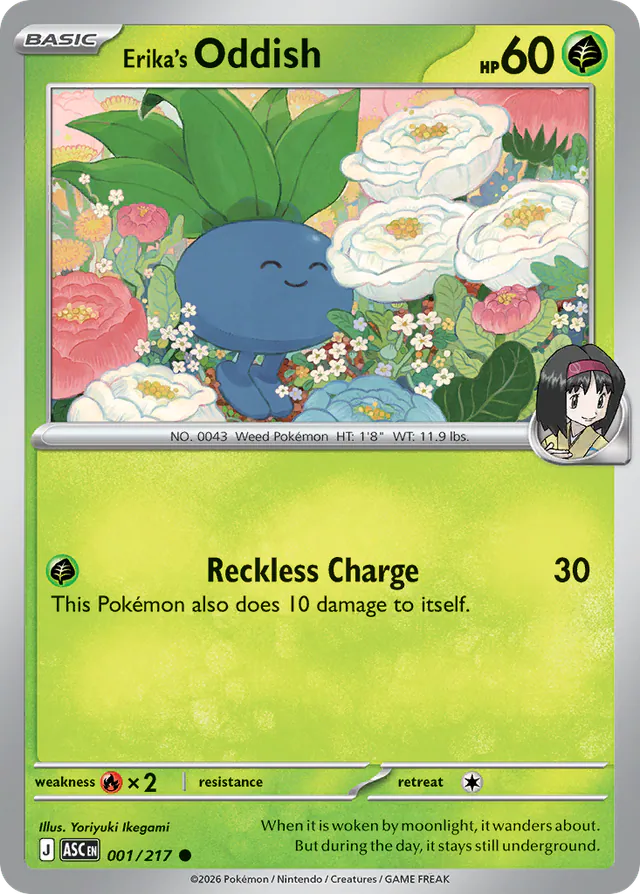 Erika's OddishSee it on collecto.rs
A draft slips under the door while you sort through fresh bulk on the kitchen table. Foils go into soft sleeves on the left. The rest lands in a low stack on the right, cardstock sliding against cardstock until a familiar Gym Leader badge catches the overhead bulb. This is Erika's Oddish, printed as a simple common, sitting quietly at the base of our list.
Ascended Heroes makes its point here. A set proves its identity not just through high-end pulls, but through the cards meant to fill booster pack floors. The flavor text tells us the little weed wakes only by moonlight and spends its daylight buried underground. That quiet stillness carries through the entire presentation. Owner cards defined an era decades ago by tying a creature to a person, lending context to what could have been generic card art. Seeing that convention return on a common card gives the set its backbone.
Compare this card to Team Rocket's Dugtrio a little further up the list. That Dugtrio brings the sharp, industrial menace of a villain faction to an uncommon slot, full of jagged outlines and bad intentions. Erika's Oddish works in reverse. It leans into pastel serenity and domestic calm, grounding the set before things get loud.
Many binders treat commons as packing material, filed away in bulk boxes under beds or sold off by the kilo. When you catalog a set run like Ascended Heroes on collecto.rs, you see how much character sits in the bottom third of the checklist. The card does not try to overpower the page. It sits among your Grass types or alongside Celadon Gym memorabilia, holding its space with quiet confidence. That kind of restraint makes a set worth building from the ground up.
9. Team Rocket's Dugtrio#
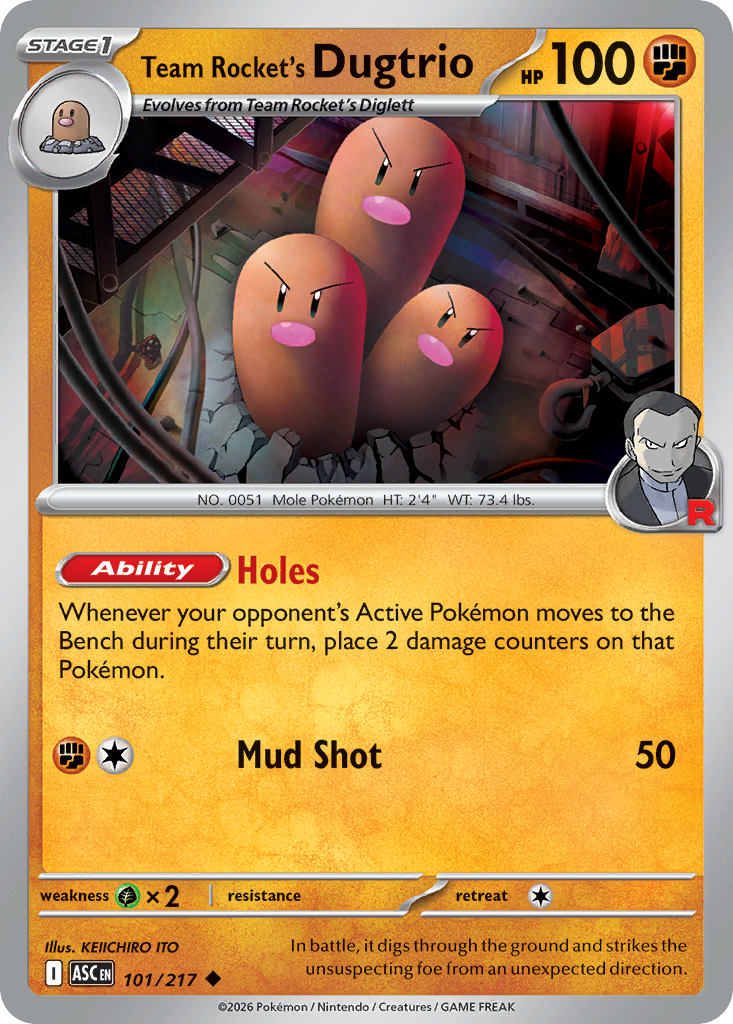 Team Rocket's DugtrioSee it on collecto.rs
Most modern expansions save their narrative punch for secret rares, burying lower rarities under generic stadium backgrounds and neutral poses. Ascended Heroes takes the opposite route. It hands uncommon slots back to vintage villainy, letting classic factions set the tone long before you reach the back of the pack. Team Rocket's Dugtrio is proof that a silver foil symbol is not required to build atmosphere.
The card leans straight into the mean streak that defined early Rocket sets. Its flavor text sets the scene without wasted motion: in battle, it digs through the ground and strikes the unsuspecting foe from an unexpected direction. Three scowling faces emerge from churned dirt under the unmistakable Rocket insignia, trading pastoral charm for tactical ambush. Erika's Oddish uses its common slot to showcase quiet Gym Leader domesticity earlier in this list. Dugtrio does the inverse, bringing sharp edges and organized crime aesthetics to the middle of the binder.
That balance gives Ascended Heroes its specific weight. Owner-based cards work best when the identity alters the creature's demeanor, not just its name header. Dugtrio does not look like a wild encounter. It looks trained to take an ankle out on command. You feel the trainer behind the glass. Collectors who build along thematic lines get plenty to work with here, especially anyone tracking the long history of Team Rocket prints across eras.
When you log this print on collecto.rs, you can group it alongside vintage Rocket variants or file it straight into your Ascended Heroes master set. The core tools keep both sorts of organization intact, and your data stays exportable whenever you want to move it elsewhere. That utility matters because cards like this uncommon hold an expansion together between the showcase hits.
8. Drakloak#
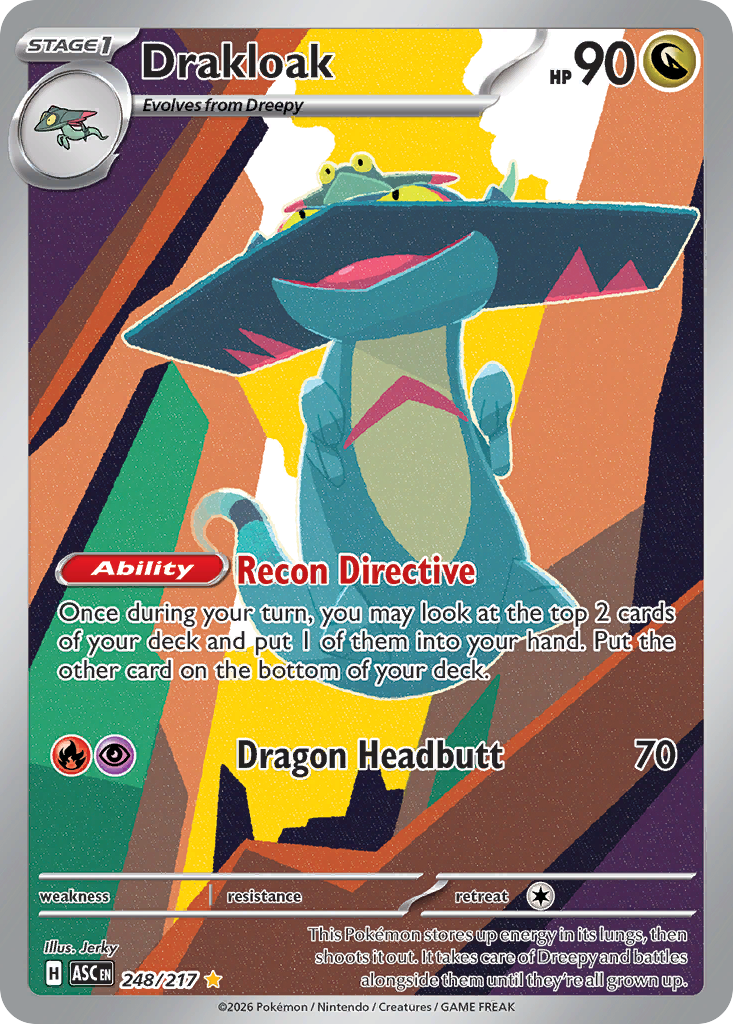 DrakloakSee it on collecto.rs
When was the last time you stopped to study a Stage 1 Pokémon card? Usually, the middle form gets skipped. You open a pack, pull an ultra-rare, and expect the final stage taking up the entire frame with claws out. Drakloak rarely gets that kind of spotlight. Most sets rush past it to print Dragapult on textured foil, treating the middle evolution as cardboard you burn through on your way to playing the big hitter. Ascended Heroes does the opposite here. Giving Drakloak an ultra-rare slot forces a slower look at a design that typically spends its life tucked inside the deck box.
The card leans entirely into the quiet oddity of the creature. Drakloak carries Dreepy on its head, babysitting while it fights. The flavor text notes that it stores energy in its lungs, shoots it out, and battles alongside those smaller dragons until they grow up. Translating that dynamic onto a full-art ultra-rare changes the tone of the set. While Iono's Bellibolt ex demands attention with raw Paldean power and bright arena lighting, Drakloak operates on gentle, domestic caretaking. It feels less like an attack piece and more like a captured habit.
That choice rewards anyone cataloging Ascended Heroes by art style rather than pure board presence. Middle evolutions hold an awkward place in binder pages. They exist between the familiar cuteness of the basic form and the heavy impact of the final stage. When an expansion commits top-tier print real estate to a middle form, it creates an unusual anchor in a binder row. You can log it in your collecto.rs account under full-arts or by evolution line, and export the list when you want to compare how artists approach caretakers versus heavy attackers across modern sets.
7. Iono's Bellibolt ex#
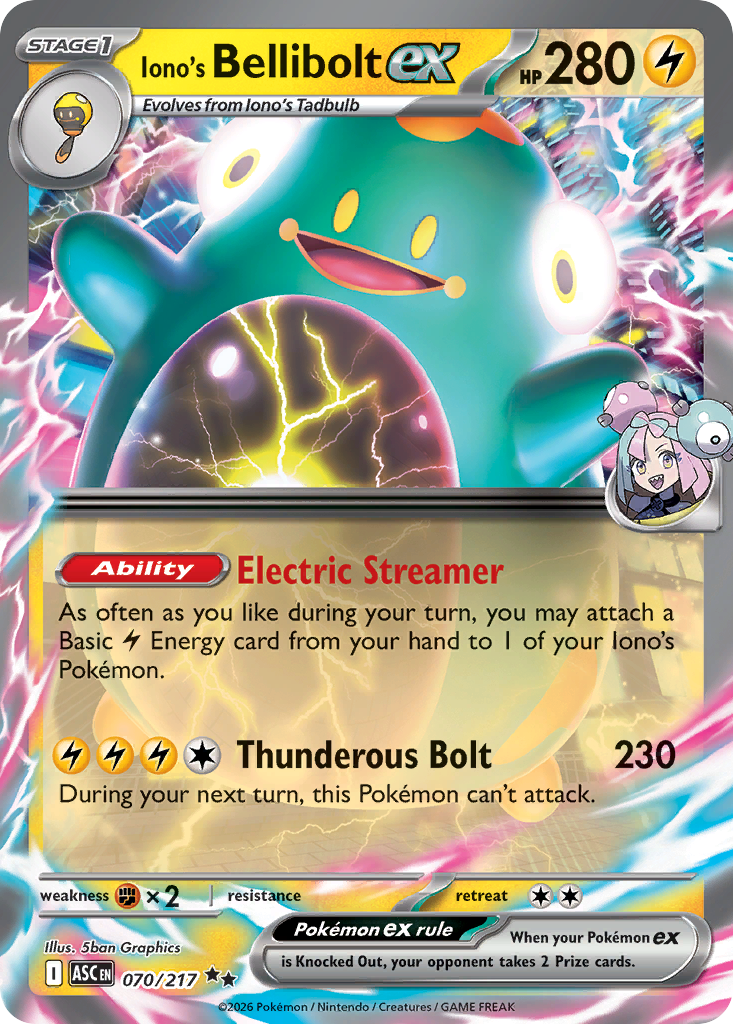 Iono's Bellibolt exSee it on collecto.rs
Zero trainer names appeared in the card titles of the original base set, but owner-affixed cards have anchored specific eras of the hobby ever since Gym Heroes landed in 2000. Ascended Heroes brings that lineage into modern Paldea, placing the streamer-influencer Gym Leader right on the card banner alongside her partner.
Iono's Bellibolt ex sits at holo-rare, carrying the weight of character-driven mechanics without leaning into secret-rare inflation. The card prioritises bold staging over abstract textures. It presents Bellibolt as a deliberate team anchor rather than a wandering wild encounter. That distinction matters for the binder layout. Where Drakloak demands attention by rescuing an overlooked stage-one middle slot, Bellibolt commands its spot through pure personal branding. It pulls the personality of Levincia into the game space, leaning on the bright electric framing that defines Paldean competitive play.
Owner cards operate on a different rhythm than standard ex printings. The collector is tracking the bond between character and creature, not just the raw species index. bellibolt itself has a squat, static silhouette, but attaching Iono immediately alters how that silhouette reads on foil. It turns a round, neon frog into a broadcast centerpiece.
In Ascended Heroes, these designated pairings bridge the gap between traditional Gym sets and current Scarlet & Violet aesthetics. The finish gives the card an immediate table presence. If you catalog by trainer rosters or Paldean regional entries, this is one of those pieces that settles cleanly into place, holding its own beside legacy Gym Leader cards without needing an alternate art slot to make its case.
6. Mega Hawlucha ex#
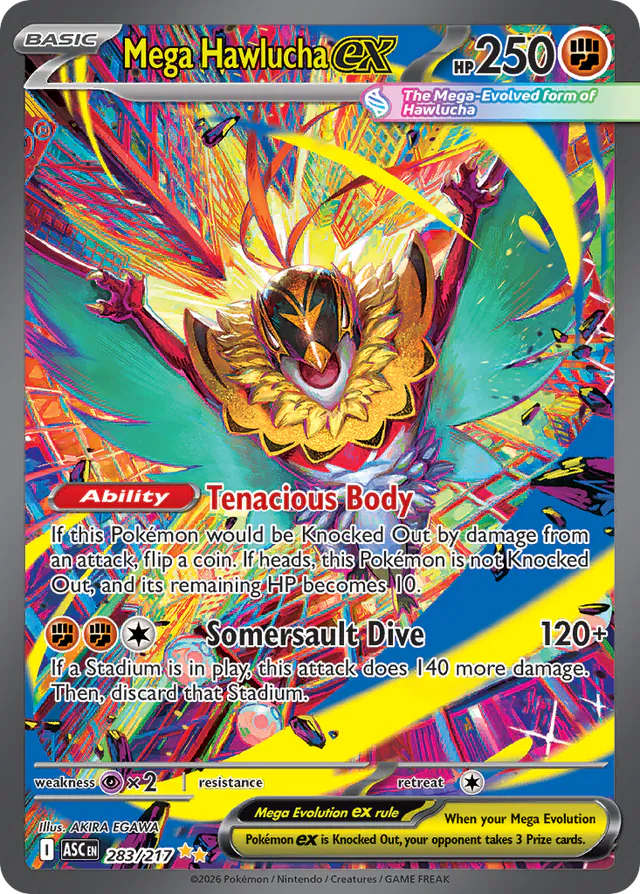 Mega Hawlucha exSee it on collecto.rs
You probably expected another Charizard or Rayquaza to carry the Mega Evolution banner here. That assumption is fair enough, given the history of the mechanic, but Hawlucha takes the slot instead. The Kalos wrestler never received an official Mega form in the mainline video games. Ascended Heroes grants that distinction on cardboard, framing the creature in full luchador splendour across an ultra-rare layout.
The artwork leans into the theatre of the ring. Sharp foil accents cut across the wings, and the framing breaks standard border constraints to give the posture physical presence. Where Erika's Tangela relies on nostalgic restraint and quiet foil patterns to honor Kanto history, Mega Hawlucha ex opts for kinetic force. It demands your eye through saturated contrast and sheer bravado. You get an exaggerated silhouette that celebrates a quirky Gen 6 bird rather than defaulting to the usual dragons.
That choice matters for the texture of an expansion. When modern sets spread their top-tier printing treatments among regional standouts instead of leaning exclusively on the obvious heavy hitters, the binder page gains personality. A collection built entirely on predictable headliners tends to flatten out over time. Cards like this break the rhythm. You can catalog it under Mega Evolutions, sort it by regional dex, or file it under fighting types; collecto.rs lets you tag and group your binder rows however your brain organizes the hobby, with every field ready to export when you want your raw data back.
It earned its spot on this list because it rewards a closer look. Hawlucha carries itself like an undisputed champion, and the print run gives that attitude the heavy ink treatment it deserves.
5. Erika's Tangela#
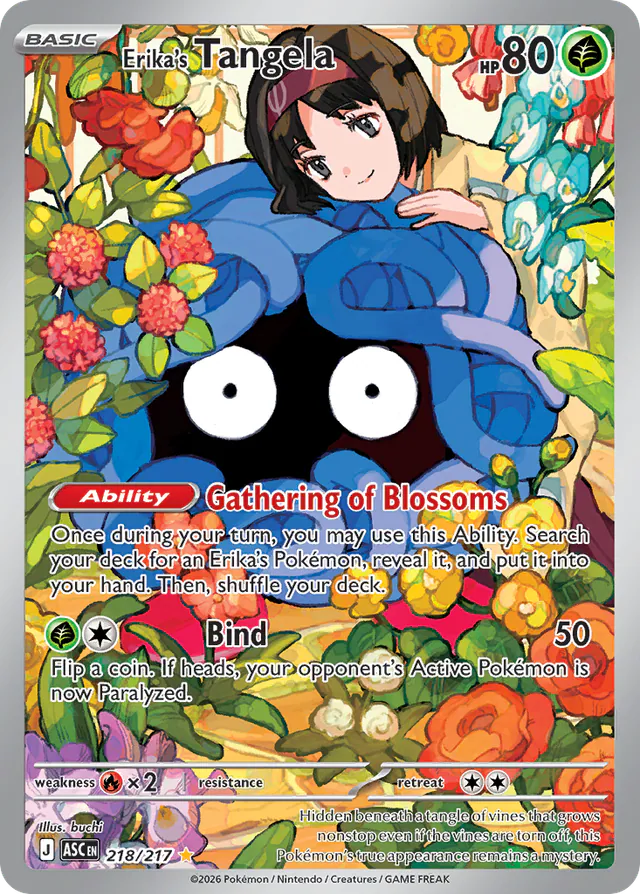 Erika's TangelaSee it on collecto.rs
A late-afternoon sun catches the top edge of your binder sleeve, hitting a swatch of dense green foil that looks less like ink and more like overgrown moss. Erika’s Tangela belongs to the ultra-rare trainer bracket in Ascended Heroes, a lane designed to reconnect original Kanto personalities with contemporary surface craft. Modern card stock often handles foliage poorly, reducing leaves and thickets to flat digital gradients. Here, the etched foil follows the grain of each vine individually, giving the tangle physical depth that matches the flavor text on the lower border: vines that regenerate constantly, concealing whatever face sits underneath.
Where the Pikachu ex in this set commands attention through bright yellow contrast and franchise weight, this card works through quiet texture. Pikachu sets the ceiling for the set’s boldest foil stamping, yet Tangela takes those same production tolerances and applies them to shadows. The card frames Erika’s quiet discipline by keeping the subject understated. The vines curl forward into the foreground frame, overlapping the text box just enough to break the grid without turning the card into a messy full-bleed splash.
Gym Leader signatures always run the risk of relying purely on nostalgia from the early 2000s. Ascended Heroes sidesteps that by treating Erika not as a retro sticker, but as an aesthetic choice for the palette. The card uses muted teals, soft celadon, and deliberate negative space behind the central tangle. It feels deliberate in a binder row next to louder battle poses. If you catalog this copy on collecto.rs, you can log the exact surface finish alongside the card number. The print run handles these darker, organic tones with surprising clarity, making it a distinct study in modern foil execution.
4. Pikachu ex#
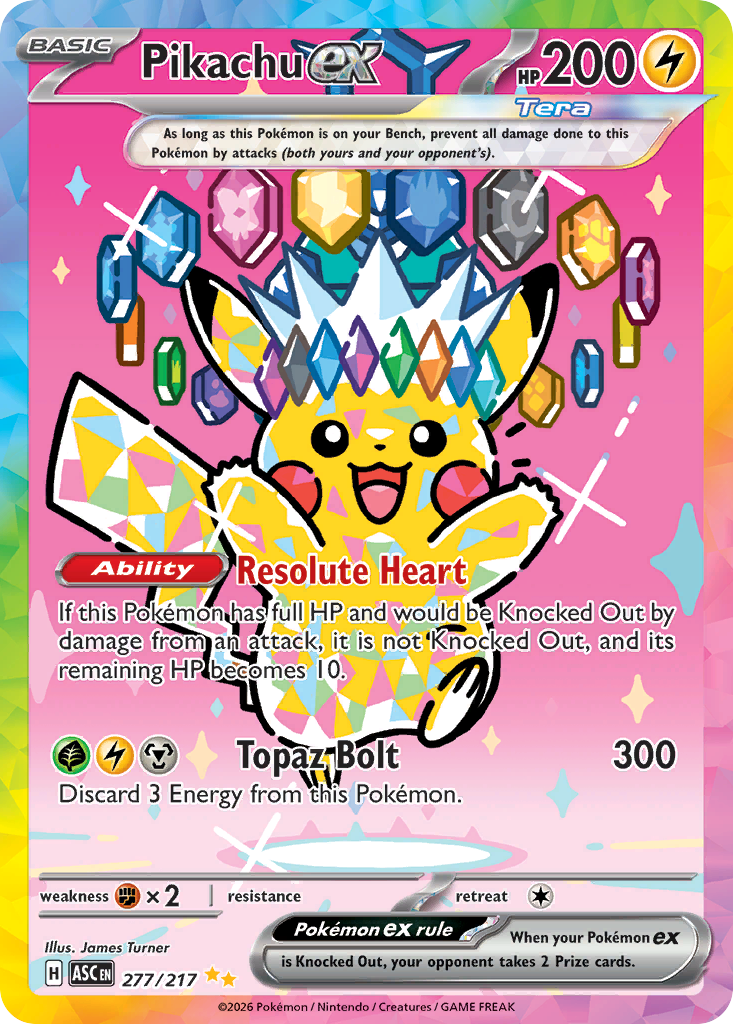 Pikachu exSee it on collecto.rs
Pikachu cards tend to project pure warmth, but this ultra-rare framing cuts the sweet act entirely. While Erika's Tangela leans on textured foil to summon soft Gen 1 nostalgia, this sheet of cardstock relies on sharp edges and deliberate scale. The electric mouse steps out as an ex piece with heavy linework and saturated yellow tones that demand the center of the pocket page. It reminds you that the franchise mascot can still carry a high-tier slot without relying on gimmick hats or festival costumes.
Ascended Heroes uses this printing to plant a distinct flag. Modern expansions often struggle to balance nostalgia against clean gameplay design. Here, the layout gives the lightning bolt mechanics room to breathe. The holographic sheen runs corner to corner, catching the overhead lamp with a tight luster that feels substantial rather than busy. You see the energy costs clearly. You see the HP total sitting heavy at the top right. It looks less like a promotional handout and more like an anchor card built to anchor competitive play mats and binder rows side by side.
Slotting it into your collection brings a tidy satisfaction. It matches the visual weight of the set's heavier hitters while keeping its identity locked to standard set numbering. If you track your cards on collecto.rs, you can mark the exact variant and condition right from your desk, then export the full sheet whenever you reorganize your trade box. It stands out because it treats Pikachu as a formidable competitor first and a brand icon second, which is a rare balance in current sets.
3. Iris's Fighting Spirit#
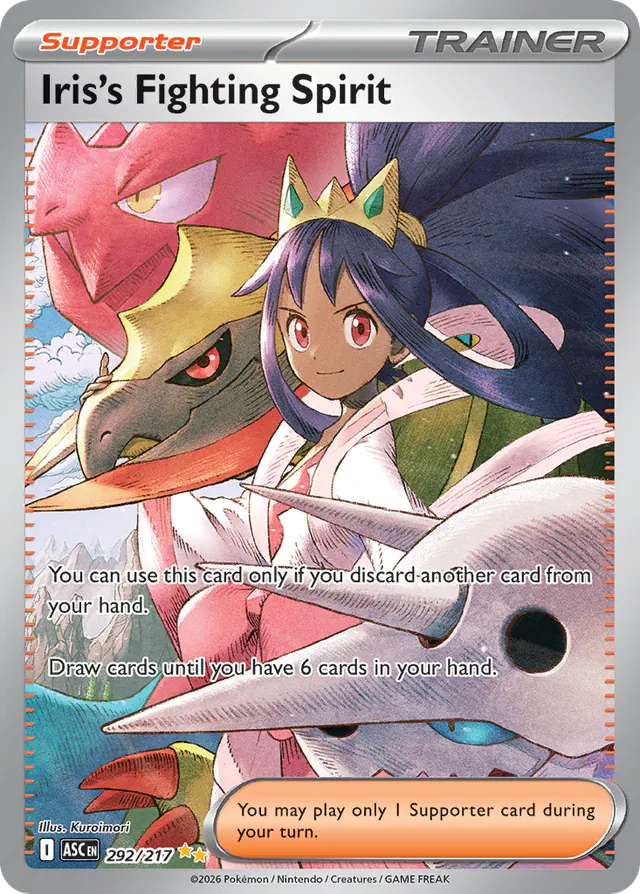 Iris's Fighting SpiritSee it on collecto.rs
Forty-seven words of effect text sit across the bottom half of the card, but the art does the heavy lifting before you read a single syllable. Iris’s Fighting Spirit claims the ultra-rare slot in Ascended Heroes with direct momentum. Trainer Supporters often end up frozen in administrative poses, pointing forward or clutching a Poké Ball like a badge of office. This print skips that formality entirely. Iris leans straight into the frame, arms up, hair sweeping across the upper border with the kind of kinetic energy usually reserved for fully evolved Dragon types.
That presence gives the card a different gravity than its neighbour on this list, Marnie’s Grimmsnarl ex. Where Marnie’s card splits your focus between trainer and partner to establish scale, Iris commands the entire composition alone. The design treats the human character as the event itself. For an owner-driven binder page, that distinction matters. You get the full weight of the character’s champion arc rendered without the visual buffer of a flanking Pokémon.
The ultra-rare foil treatment catches the line work cleanly, running texture along the diagonal cuts of the background rather than flattening everything under uniform sheen. It keeps the card readable across a table while rewarding close inspection under a desk lamp. You see the deliberate weight in the line art, especially around the wraps on her wrists and the wind-whipped collar of her top. Ascended Heroes uses cards like this to bridge competitive utility and binder aesthetics without shortchanging either side.
Drop it into a nine-pocket page next to classic Black and White era supporters, and the lineage shows immediately. It feels earned rather than ornamental. Log the card into your collecto.rs account under Ascended Heroes, tag the foil pattern, and see how the palette balances against your existing trainer inventory.
2. Marnie's Grimmsnarl ex#
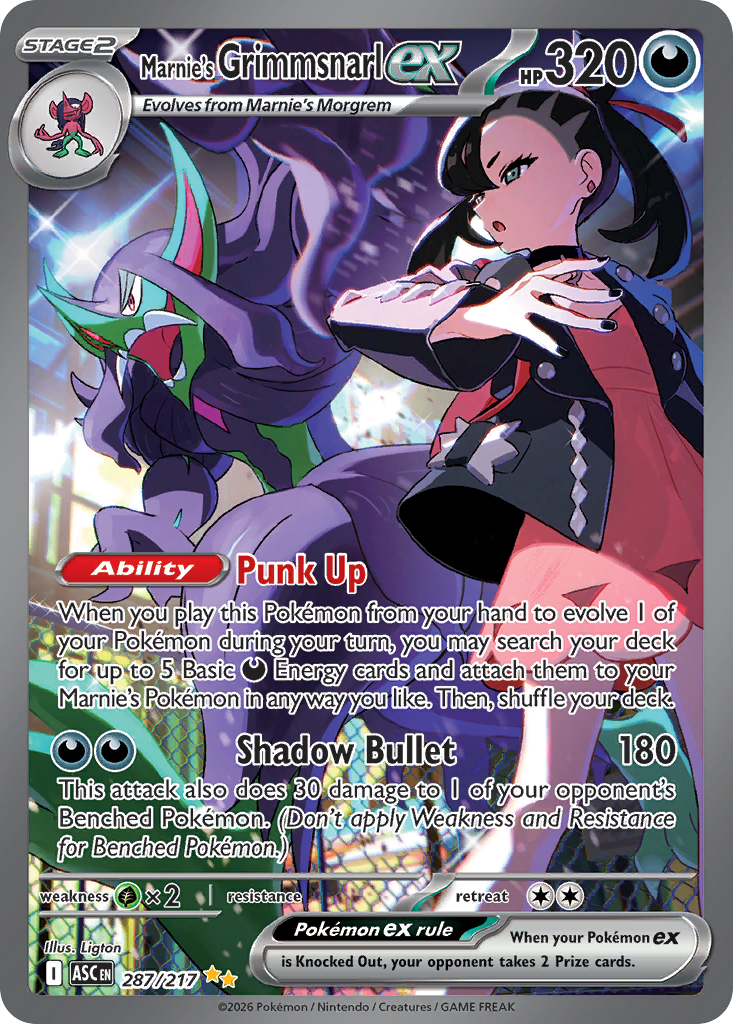 Marnie's Grimmsnarl exSee it on collecto.rs
Someone at a regional tournament once set a deck box down beside mine, unzipped a worn velvet playmat, and laid out sixty cards face down without saying hello. When the opening flip revealed an imposing Dark-type bruiser paired to Galar’s quietest gym leader, the mood shifted. That confrontation belongs to this card. Marnie’s Grimmsnarl ex brings that specific tension into the modern ultra-rare layout, where heavy line work and deep violet saturation give the creature room to loom.
Owner-driven cards carry history by definition. They require an illustrator to solve two visual problems at once: give the Pokémon its full physical presence, and remind you whose discipline keeps it in check. The modern ex template can easily swallow quieter partnerships, but here the scale works in its favor. Thick, jagged limbs push against the border foil, balanced by the stark spiked collar and silhouette cues that tie straight back to Marnie’s leather jacket. Where Steven’s Metagross ex channels clean, polished steel and cold tactical geometry, this card relies on sheer bulk and tangled shadow. It feels heavier on the cardboard.
That friction between trainer and partner makes the card work across a binder spread. It is an ultra-rare that does not rely on soft pastel gradients or clean symmetry to justify its slot in Ascended Heroes. Instead, it leans into high-contrast inks that hold their density even under flat overhead lighting. When you log this entry into collecto.rs alongside your other owner-marked Ultra Rares, the card stands out for its sheer visual mass. It reminds you that some partnerships are built on raw weight rather than polite cooperation, giving the expansion a grounded, physical edge that sets it apart from earlier eras.
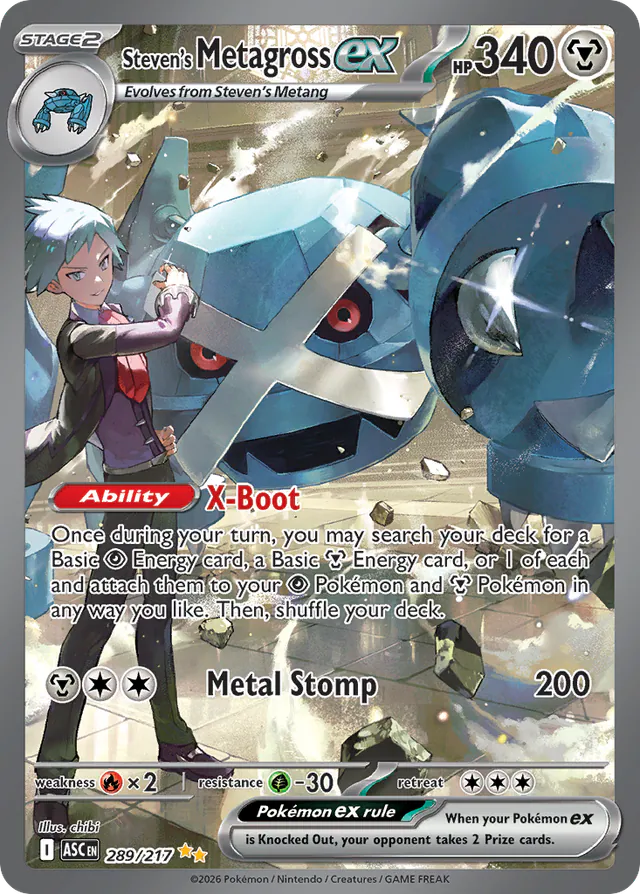
1. Steven's Metagross ex#
 Steven's Metagross exSee it on collecto.rs
A desk lamp hums over three penny sleeves, casting cold white light across steel-blue plating and polished chrome edges. You pause your sorting stack right here. Steven's Metagross ex earns the top spot because it solves the central creative problem of modern owner cards: how to show human partnership without shrinking the monster to fit in the frame. The card gives Metagross the entire physical arena, framing the massive iron hull so low and wide that Steven’s presence feels like an atmosphere rather than a cameo.
That balance is where it pulls ahead of Marnie's Grimmsnarl ex earlier in this list. Where Marnie’s card leans into neon contrast and personal punk swagger, this piece trades on absolute mass and tactical composure. The ultra-rare foil treatment catches the beveled cross on Metagross’s face, turning flat cardstock into heavy industrial armor. It honors the Hoenn Champion’s signature partner by making the Pokémon feel genuinely unmovable, the way it felt when you first walked into that final chamber in Ever Grande City with an underleveled team.
Ascended Heroes uses the ex mechanic to restore sheer weight to the tabletop. Ultra-rare prints can sometimes dissolve into glittery noise, but the layout here protects the linework. Every plate seam and hydraulic joint remains legible under the texture stamp. It acts as a masterclass in how to modernize an old battle pairing without leaning on nostalgic gimmicks or soft-focus backgrounds. If you track your master set on collecto.rs, this is the card that anchors the entire Ascended Heroes binder page, pulling the eye away from surrounding secret rares through sheer compositional gravity. It is patient, deliberate, and built like an anvil.
Sets that attempt to bridge eras usually stumble over their own ambition. They pick a single vintage mechanic, dress it in modern gloss, and hope the visual contrast carries the weight. Ascended Heroes succeeds because it treats trainer ownership as a design language rather than a nostalgic novelty.
When you see these cards laid out together, the timeline collapses. A Grass-type staple from Celadon City sits naturally alongside a Paldean partner built for modern prize-card math. The layout respects the visual history of the game while letting new artists take real risks with negative space, texture, and character interaction. It gives you a reason to pause on a stage-one evolution, not just the top-rarity chase.
Whether you sleeve these for a binder run, file them into a master set, or leave a few on your desk under proper light, they hold up to inspection. If you are tracking this set, collecto.rs lets you catalog every variant, note the print details, and export your data whenever you need it. A strong collection is built on intent, and Ascended Heroes gives you plenty of reasons to be deliberate about what goes into your sleeves.
Frequently asked questions#
What is the focus of the Ascended Heroes Pokémon card set?#
Ascended Heroes highlights specific trainer-owned Pokémon alongside modern Mega Evolution cards. Instead of focusing on a single generation, it pulls characters and mechanics across various regions to create a cohesive expansion.
Are owner's Pokémon back in Ascended Heroes?#
Yes. The set integrates trainer-named cards throughout common, uncommon, and ultra-rare slots, featuring names like Team Rocket, Erika, Steven, Marnie, and Iono right on the card face.
What makes Mega Evolution ex cards distinct in this set?#
Mega Evolution cards appear as powerful ex stages that push high damage profiles and unique card art layouts, reviving an older era mechanic within a modern frame.