The short version#
Fusion Strike earned a reputation for its sheer scale, but these ten cards show how its new battle style mechanic, textured full arts, and distinct character choices gave the massive checklist its real identity.
- Mew V
- Gengar VMAX
- Celebi V
- Greedent V
- Boltund VMAX
- Chandelure V
- Deoxys
- Power Tablet
- Meloetta
- Fusion Strike Energy
Fusion Strike arrived late in 2021 as a physical endurance test. The main set spans 264 cards before counting secret rares. With the alternate arts and gold cards layered on top, the total checklist stretches to 284. It remains the largest single expansion in the history of the Pokémon Trading Card Game.
Scale alone gave the set an early, slightly exhausted reputation. Opening a booster box meant confronting hundreds of commons and uncommons designed to dilute pull rates. When people talked about the set, they talked about the sheer mathematics of finishing a master binder. They talked about the stack height.
Looking past the sheer footprint reveals a remarkably coherent design philosophy. Fusion Strike wrapped up the mechanical ideas introduced across the Sword & Shield era. Single Strike brought brute force. Rapid Strike focused on fluid repositioning. Fusion Strike arrived to synthesize the two, rewarding players and deck builders for assembling cooperative benches where specific Pokémon feed off each other's attacks.
That mechanical identity spilled over into the cardboard itself. The artwork here feels distinct from the expansions immediately flanking it. The set brought hyper-specific color palettes dominated by electric magenta, deep teal, and graphic purple accents. It also handed premier illustration slots to Pokémon that rarely anchor modern sets, balancing canonical favorites against offbeat choices with striking narrative scenes.
Whether you opened three booster packs or tracked down three sealed cases, the set holds specific cards that define what Pokémon was doing at this exact pivot in the eighth generation. The ten cards here highlight how texture, gameplay utility, and bold illustration choices turned an overwhelming checklist into a collection with its own distinct point of view.
| # | Item | Set / Year | Rarity |
|---|---|---|---|
| 1 | Mew V | Fusion Strike | ultra-rare |
| 2 | Gengar VMAX | Fusion Strike | ultra-rare |
| 3 | Celebi V | Fusion Strike | ultra-rare |
| 4 | Greedent V | Fusion Strike | ultra-rare |
| 5 | Boltund VMAX | Fusion Strike | — |
| 6 | Chandelure V | Fusion Strike | ultra-rare |
| 7 | Deoxys | Fusion Strike | holo-rare |
| 8 | Power Tablet | Fusion Strike | secret-rare |
| 9 | Meloetta | Fusion Strike | rare |
| 10 | Fusion Strike Energy | Fusion Strike | uncommon |
10. Fusion Strike Energy#
 Fusion Strike EnergySee it on collecto.rs
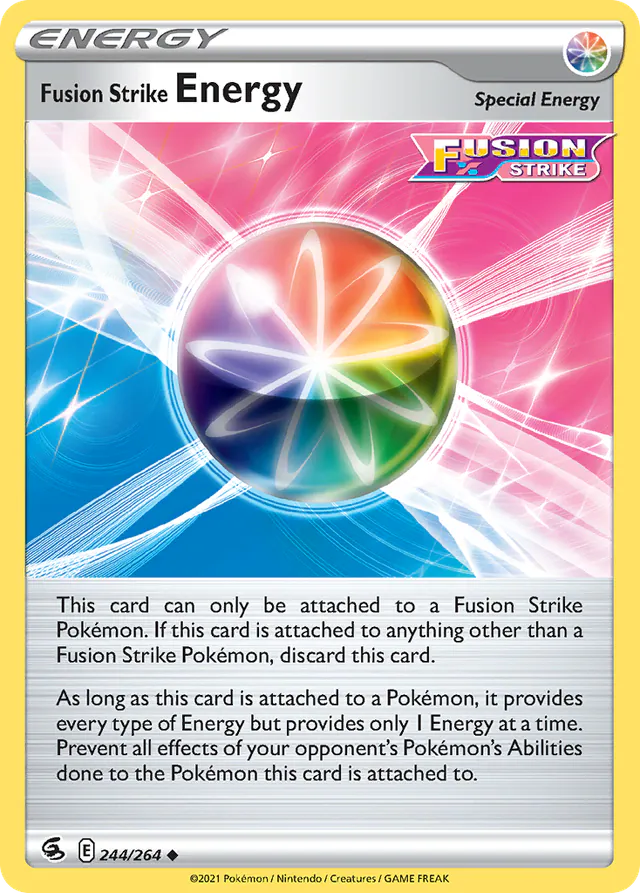
Two hundred and eighty-four cards make up the main numbering of Fusion Strike, the largest standard expansion in the game's history. It is easy for an uncommon Special Energy card to disappear into that sheer volume of cardboard. Yet without this single piece of utility, the expansion's titular battle style falls flat on its face.
Fusion Strike Energy provides one Energy of every type, but only while attached to a Fusion Strike Pokémon. More importantly, it prevents all effects of an opponent's Pokémon's Abilities done to the attached card. That secondary clause quietly solved one of the era's biggest hurdles, shielding your setup from passive disruption while fueling multi-type attack costs. The design reflects the set's identity at its most literal. Instead of raw standalone power, the card exists purely to connect other moving pieces.
Look at how it enables Meloetta, which sits just above it on this list. Meloetta's Melodious Echo attack relies on counting every Fusion Strike Energy attached to your entire team to scale its damage upward. Meloetta provides the immediate, single-prize pressure, but that pressure is entirely theoretical until these Energy cards hit the felt. Ranking the Energy at number ten acknowledges the engine room before we get to the showpieces.
For binder collectors, this card serves as the anchor point for the mechanic's visual language. The vivid pink-and-purple identity stamped across the frame defines how the era organized its themes. When you sort an expansion by its play patterns rather than raw rarity symbols, cards like this explain why the set was built the way it was. You can log it in your collecto.rs account alongside the heavy hitters, keeping the utility pieces intact right next to the secret rares that relied on them.
9. Meloetta#
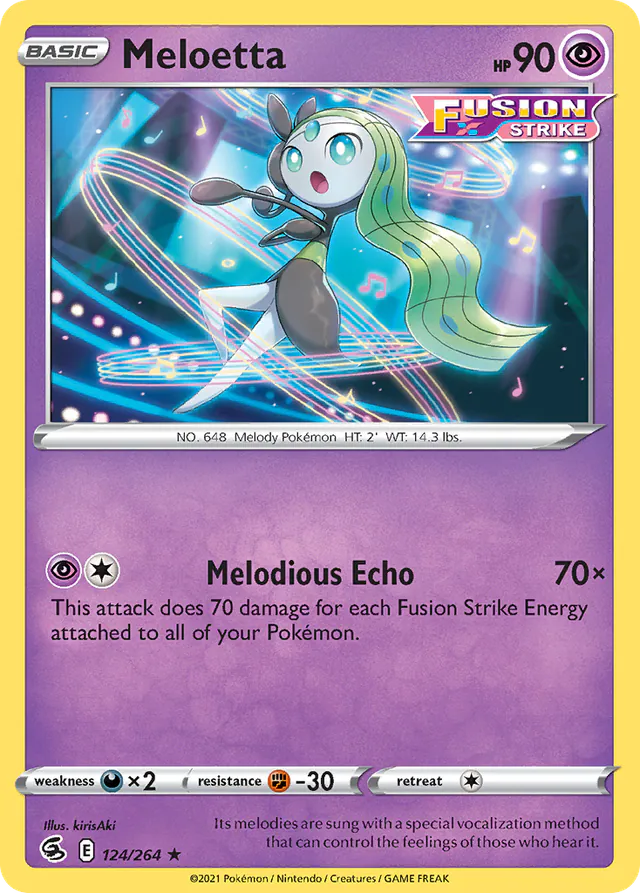 MeloettaSee it on collecto.rs
You expect a set with 284 cards to put all its weight behind massive VMAX giants. Instead, Fusion Strike gave one of its sharpest teeth to a regular rare sitting at single-prize vulnerability. Meloetta does not demand three turns of setup or hand away half the game when it leaves the board. It slides into the active spot, asks you how many specialized energy cards you managed to scatter across your bench, and hits with Melodious Echo for numbers that rival Pokémon four times its size.
That balance between cost and output is what makes this card fascinating inside the wider expansion. While Fusion Strike Energy gave the mechanic its quiet structural foundation, Meloetta converted that raw infrastructure directly into speed. The energy card solved the problem of keeping pieces moving; Meloetta gave you a reason to move them immediately. In a format where trading multiple prize cards defined every turn, dropping ninety damage per attached Fusion Strike Energy forced opponents to answer a regular rare with their best resources.
The card itself keeps things simple. It carries 90 HP, psychic typing, and flavor text about melodies sung to control feelings. In practice, the mood it created across the table was purely defensive panic. Because it hit so hard on turn one going second, it completely redefined how players approached their opening setup. You were never just bracing for a giant psychic cat; you were calculating whether this ninety-HP singer was about to knock out your primary attacker before you even evolved it. It stands out because it proved the Fusion Strike mechanic was not just about bulky centerpieces absorbing hits. It was built around mutual leverage, where smaller pieces punched well above their weight class simply by existing next to each other.
8. Power Tablet#
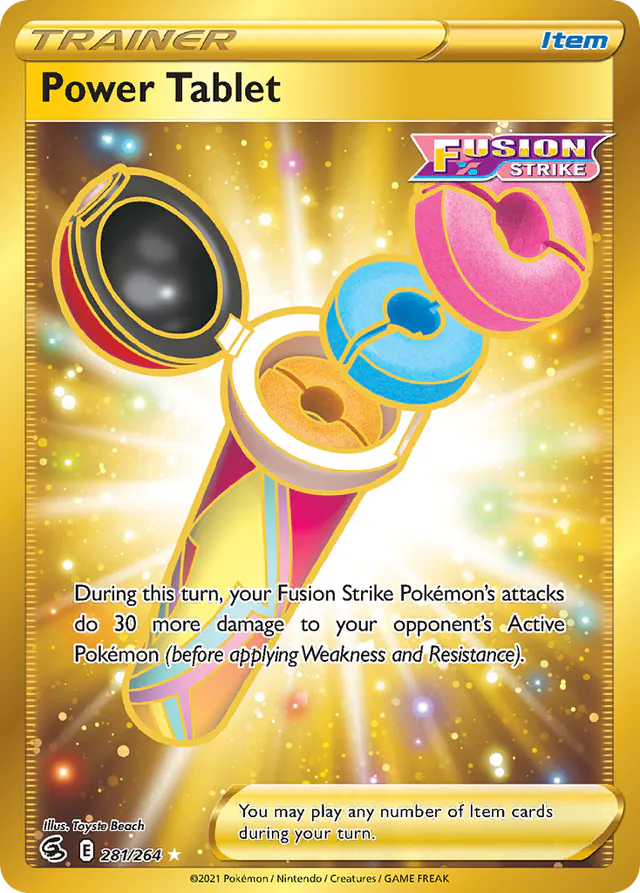 Power TabletSee it on collecto.rs
A player drops four damage counters onto their board, checks their hand, and slides a gold-bordered Trainer into the discard pile. The math changes instantly. In the Sword & Shield era, secret rare gold cards usually belonged to staples with universal appeal, like Level Ball or Quick Ball. Then Fusion Strike printed this one. It ignored the rest of your deck completely. It cared only about a single printed tag.
Power Tablet does one job. It adds thirty damage to attacks from your Fusion Strike Pokémon for the turn, and you can burn all four copies in a single sequence if you have them. Where Meloetta took the set's synergy-first philosophy and turned it into an efficient, single-prize attacker, Power Tablet lived entirely behind the curtain. It was the mechanical accelerant. You did not play it to solve a varied board state. You played it because the core Fusion engine wanted to turn math into a formality on turn two.
That narrow focus makes the card an interesting artifact of how Creatures, Inc. designed this expansion. Most sets let their high-rarity items breathe across different archetypes. Here, the secret rare slot committed fully to the set's insular identity. The textured gold foil covers a simple piece of tech: a handheld device glowing with pink energy, framed against deep metallic linework. It looks less like a mythic relic and more like a very expensive spare part.
If you keep this card in your binder, it marks the exact moment the battle style mechanic stopped pretending to be subtle. It told you how to build, what to attack with, and how fast the game was supposed to end. You can log it in your collecto.rs account under secret rares, where the data stays yours.
7. Deoxys#
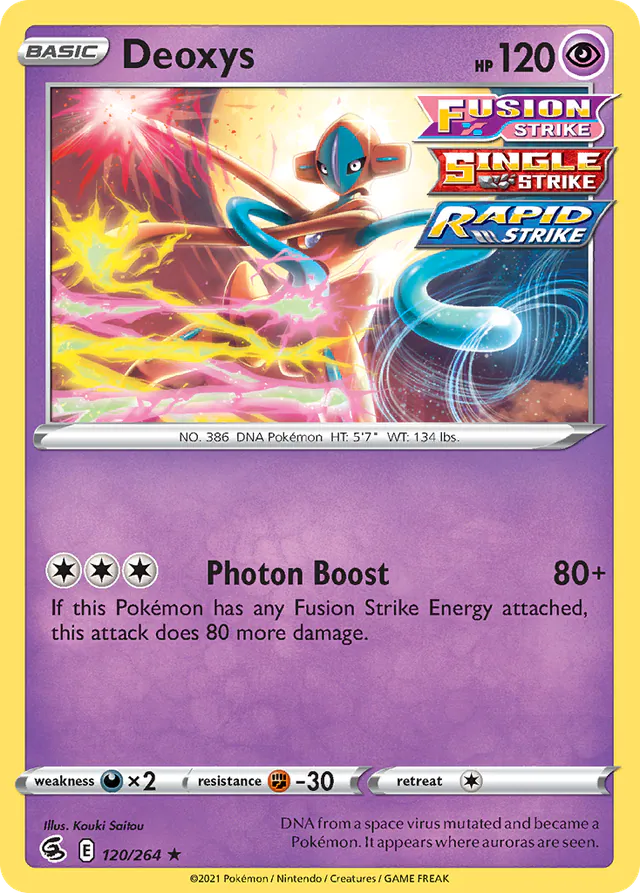 DeoxysSee it on collecto.rs
What happens when a single card is asked to carry the weight of an entire era's mechanics? In Fusion Strike, Deoxys answers that by refusing to pick a lane. Most cards in the set lean hard into their assigned identity. Power Tablet exists purely to grease the gears of the Fusion Strike engine, narrowing its focus to do one job with ruthless efficiency. Deoxys goes the opposite direction. It sits at the crossroads of Single Strike, Rapid Strike, and Fusion Strike all at once, acting as a functional bridge across the trio of battle styles that defined the middle of the Sword & Shield series.
Mechanically, that versatility gave deck builders a rare toolbox piece. Visually, the holo-rare print keeps things grounded in its extraterrestrial roots. The card text reminds us that DNA from a space virus mutated to form this creature, appearing alongside auroras. That bit of cosmic weirdness fits neatly against the geometric style stamps crowding the card's border. The card face has a lot of structural work to do. Juggling three distinct mechanic banners on one card could easily look like graphic clutter, yet the layout gives each style room to breathe without choking the illustration.
That balance makes it an intriguing card to document. When you log this era in collecto.rs, sets like Fusion Strike can easily feel like isolated experiments. Cards like Deoxys connect those experiments back to the sets that came before them. It captures a specific design window where the rules were expanding in multiple directions at the same moment. It might not carry the immediate visual punch of an alternate art secret rare, but it preserves a distinct design philosophy. For anyone tracking how modern mechanics evolved across the era, it earns its place in the binder.
6. Chandelure V#
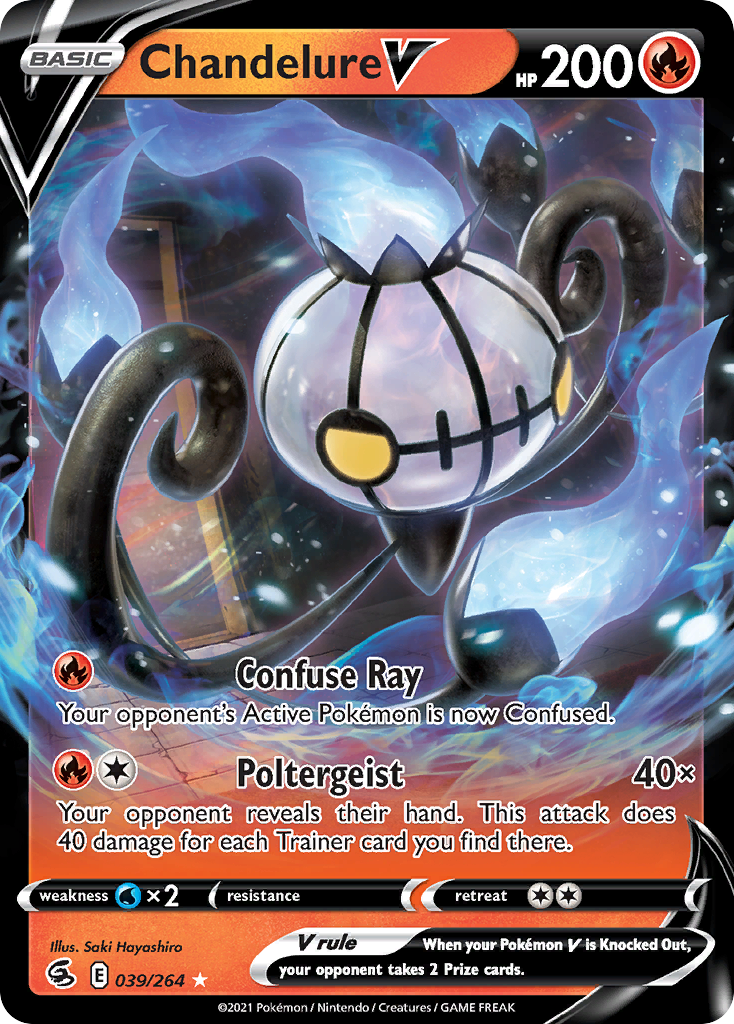 Chandelure VSee it on collecto.rs
Late on a Friday night, someone cracked a fresh booster box on a folding table, sorting each pull by color. Fusion Strike piles run aggressively pink, cyan, and electric yellow, reflecting the cheerful, candy-coated energy the designers chased throughout the expansion. Then Chandelure V slipped out of a pack, and the entire palette broke. Deep purples, murky blacks, and ghostly teal flames replaced the cotton-candy backdrop, dropping the temperature of the room by ten degrees.
That jarring tonal shift gives Chandelure V its standing here. Fusion Strike sprawls across hundreds of cards, leaning heavily into vibrant, buoyant artwork that fits Mew and Genesect. Boltund VMAX sits right next to this slot on the list, flaunting the set's signature hyper-stylized brightness with loud lightning effects and saturated textures. Chandelure V cuts clean against that grain. It offers an eerie, self-contained pocket of classic ghost-type menace. The art frames the Luring Pokémon with quiet intensity, letting the dark negative space do the heavy lifting rather than crowding the border with neon effects.
Mechanically, it carries the Ultra Rare designation in a set packed with towering threats. While casual binders often fill up with the biggest marquee names from Sword and Shield, pieces like this anchor the visual pacing of a binder page. The contrast matters. Flipping through rows of bubbly, neon attackers only works if the set occasionally reminds you that darker corners exist in the Pokédex. Chandelure does that without fuss, trading high-key dazzle for crisp, moody atmospheric weight.
5. Boltund VMAX#
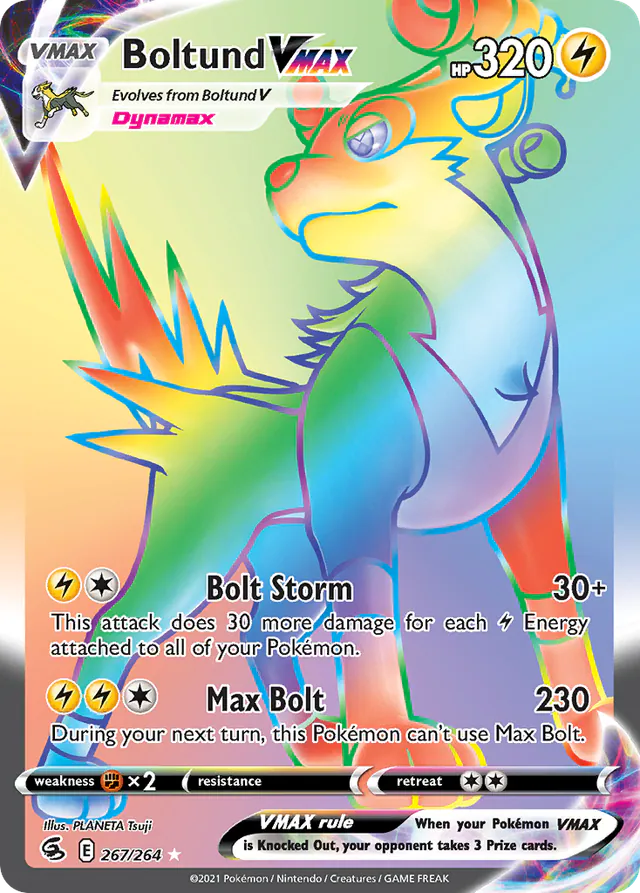 Boltund VMAXSee it on collecto.rs
Where Chandelure V pulls the eye down into soot and violet shadows, Boltund VMAX pushes everything straight toward the light. The Rainbow Rare treatment has plenty of critics. Many feel the silver foil wash flattens the distinct lines of the original art, and in weaker prints, that criticism holds up. On this card, the treatment does something different. The yellow sparks that define the character run directly against the diagonal prism foil, turning an otherwise standard attack pose into pure kinetic energy.
Fusion Strike arrived right in the thick of Sword & Shield, an era obsessed with scale. VMAX cards had a simple brief: take a creature you know, expand it until it breaks through cloud cover, and surround it with swirling energy clouds. Boltund does not have the sprawling lore of the set's headlining psychic types, but it has clarity. The illustration leans hard into angular motion, cutting across the frame from corner to corner. When that layout hits the textured surface of card number 267, the line work remains sharp rather than washing out into uniform pastels.
That balance is tricky with Secret Rares. Sometimes the extra layer of foil suffocates the illustration; other times, it carries the weight of the entire piece. Here, the electric styling thrives under that metallic wash. You see every ridge stamped into the cardboard, every gradient shift from lemon yellow to electric blue across the dog's paws. It acts as an anchor for the set's experimental edge. It shows how the era could take a mid-tier battler, scale it up to stadium size, and make the hyper-stylized foil finish feel completely earned rather than tacked on at the end.
4. Greedent V#
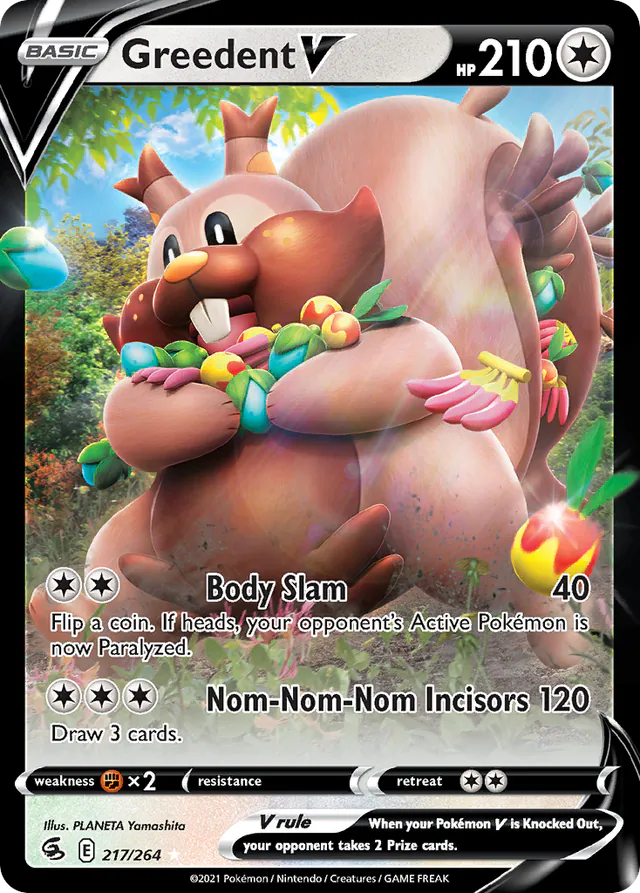 Greedent VSee it on collecto.rs
Most people assume a massive modern set earns its reputation through towering dragons and psychic deities, but that assumption misses what actually anchors the set. Greedent V does not care about your grand expectations. It sits in a pile of hoarded Berries, thoroughly pleased with itself, daring anyone to take it seriously. It is a necessary counterbalance in an expansion packed with catastrophic showdowns.
Fusion Strike arrived with an unprecedented card count and an intense mechanical mandate. It demanded focus from players and collectors alike. Where Celebi V used delicate linework and soft composition to create a quiet visual breather, Greedent V takes the opposite path to relieve that same tension. It leans directly into comedy. The alternate art version shows the chubby rodent caught mid-feast, surrounded by crumbs, wild berries, and absolute domestic chaos. It reminds you that the Pokémon world is also an absurd ecosystem where a squirrel can demand top billing alongside legendary psychic titans.
That balance matters when a set stretches past two hundred and eighty cards. Without entries like Greedent, the visual identity of Fusion Strike would risk flattening under its own self-importance. The ultra-rare treatment elevates a creature that is fundamentally ordinary into something that stops a binder page cold. You turn the pocket page past disciplined battle stances and find a greedy cheeks Pokémon having the absolute time of its life.
When you log your Fusion Strike checklist into your collecto.rs account, notice how Greedent changes the rhythm of your display. It punctures the seriousness of the Sword & Shield era with sheer personality. That contrast is precisely why it holds this spot on our list.
3. Celebi V#
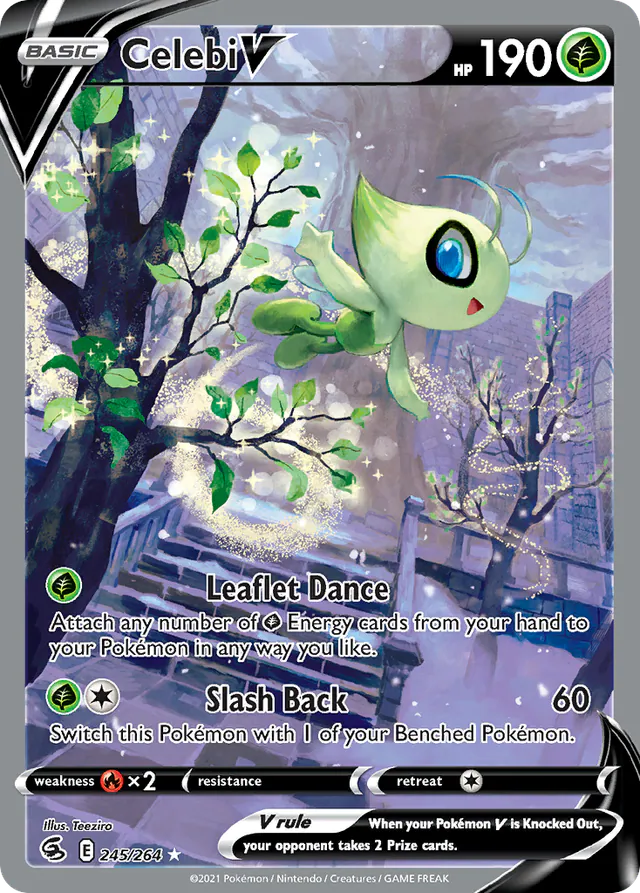 Celebi VSee it on collecto.rs
Sunlight cuts across snow-dusted spruce branches, landing on a tiny green sprite hovering above a quiet winter path. Most Sword & Shield alternate arts demand your immediate focus with explosive energy or dizzying perspective shifts. This card does the opposite. It asks you to look past the character entirely to appreciate the stillness of an alpine landscape painted in gouache tones. The composition belongs more to a field naturalist's sketchbook than an aggressive competitive set.
Fusion Strike arrived as an overwhelming checklist. Nearly three hundred cards competed for attention in booster packs that felt endless to sort through. Amid that noise, this ultra-rare prints an argument for restraint. Where Gengar VMAX downstream on our list uses raw scale to swallow the frame whole, this illustration relies on negative space. The artist lets towering pines and a cold blue sky occupy three-quarters of the canvas. Celebi itself is practically an accent mark, drifting along the bottom edge with a gentle tilt of its head.
That choice reshaped what collectors could expect from modern high-rarity slots. You do not always need a chaotic battle scene or a neon city backdrop to justify an alternate art print. By treating a Mythical Pokémon as a fleeting guest in a real ecosystem, the piece grounds a sprawling expansion. It offers an exhale between the loud, kinetic centerpieces that usually define the era.
When you file this card into your binder, it halts the rhythm of the pages around it. The texture catch on the foil mirrors the bark on the trees, rewarding anyone who stops to tilt it under a desk lamp. If you track your master set on collecto.rs, logging this entry feels different from marking off the standard ultra-rares. It sits in the catalogue not as a tournament powerhouse, but as a deliberate study in atmosphere.
2. Gengar VMAX#
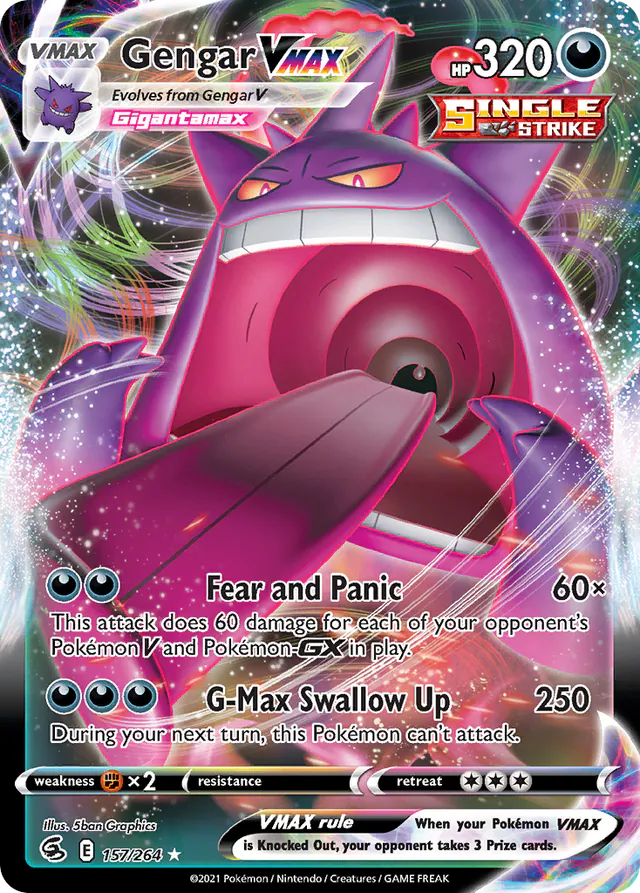 Gengar VMAXSee it on collecto.rs
Three hundred and thirty hit points mark the upper ceiling of what a printed cardboard rectangle was asked to contain in late 2021. That number matters because Gigantamax was always about scale over subtlety, and Gengar VMAX treats the card frame like a doorway it cannot fit through. The artwork does not pose the ghost behind a clean border. It lets the gaping red mouth swallow the bottom third of the card, turning the nameplate and attack text into loose debris caught in the suction.
That scale creates a sharp counterweight to something like Celebi V earlier on this list. Where Celebi relies on quiet perspective, tucking a legendary creature into a wide winter forest to make it feel deliberate, Gengar does the opposite. It abandons negative space completely. Every millimeter of the ultra-rare foil works to convince you that the creature is actively expanding outward. The purple tones are heavy and flat, broken only by yellow eyes and a cavernous red throat that dominates your binder page from two rows away.
Sword and Shield relied heavily on this specific gimmick, but few prints solved the visual challenge of it this directly. Most Gigantamax cards placed the subject in the mid-ground, surrounded by red storm clouds to simulate height. This piece simply walks the camera right up to the teeth. It turns the character into architecture. You get the sense that if you tilted the card, the rest of the room might slide into the maw.
When you log Fusion Strike into collecto.rs, you start to see how unbalanced a set that large can feel without cards like this. A checklist of nearly three hundred cards needs anchors that hold their own weight against the sheer volume of commons. This card provides that anchor without needing an alternate art stamp to do it.
1. Mew V#
 Mew VSee it on collecto.rs
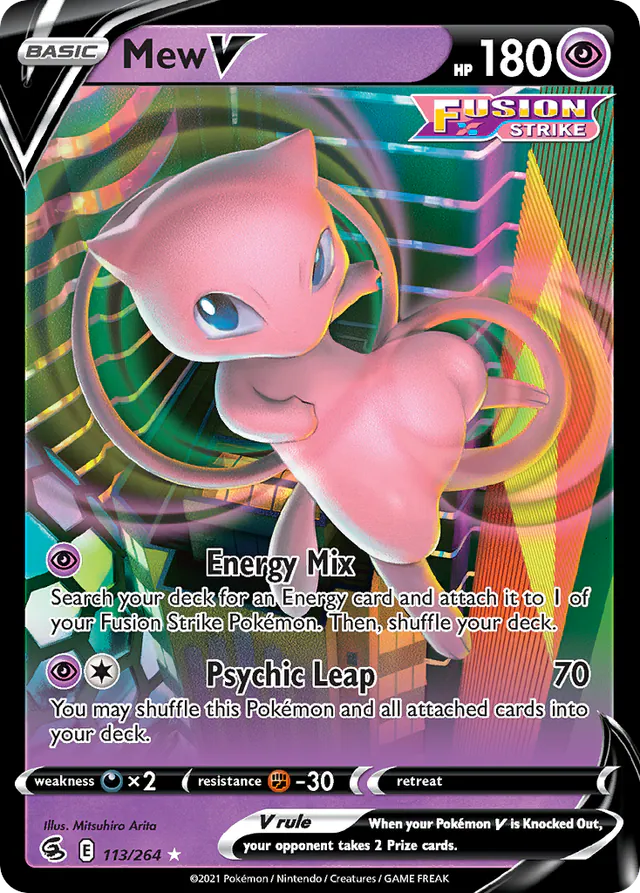
While Gengar VMAX earned its place by taking up as much physical space on cardboard as humanly possible, Mew V does the opposite. It commands the number one spot in Fusion Strike because it does not need bulk to run the room. At just sixty centimeters of mythical pink frame, this ultra-rare card anchored the packaging, defined the artwork direction, and supplied the actual engine that held the set's identity together on tables worldwide.
The card works because it understands economy. The illustration gives you Mew hovering in open air, framed by sharp electric magenta and deep purple tones that telegraph the new Battle Style instantly. In gameplay, its Energy Mix attack set up teammates on turn one, while Psychic Leap let it deal damage and tuck itself safely back into the deck, denying prize cards to anyone hoping for an easy knock out. It turned Fusion Strike from an oversized checklist into a cohesive ecosystem.
Every long-running trading card game has sets that sprawl until they lose focus. Fusion Strike certainly threatened to do that with its sheer scale. Having a singular, recognizable centre of gravity mattered. You can track modern era design choices by looking directly at how Creatures Inc. handled Mew here: clean graphic framing, tight mechanical cohesion, and an art style that gave a classic Generation I icon a brisk modern posture.
If you keep this card in your binder, you are holding the hinge point of the Sword and Shield era. It bridges the gap between classic creature nostalgia and the hyper-tuned mechanical experiments of late-stage V-era design. When you log your copy into collecto.rs, you can note whether yours came from an opening pack or a trade binder, keeping its history clean alongside the rest of your psychic roster.
A set of this size is rarely experienced all at once. Most people meet it piecemeal, card by card, over years of trade binders, local shop display cases, and late-night package deliveries.
That piecemeal reality suits Fusion Strike. The set was too large to consume in one sitting anyway. The joy of a massive checklist comes from how it fragments into personal interests. A player remembers the engine pieces that made a turn-two attack click into place. An illustrator's fan tracks down every card by a specific artist across common and secret rare printings. An alternate art enthusiast looks for the exact textures running across an oversized Pokémon looming over a landscape.
That is the quiet reward of keeping cards. The set label tells you where a piece originated, but how you organize those pieces tells a completely different story. Whether you keep these ten sleeved in a dedicated binder or scattered across broader Pokédex projects, they represent a moment when design, gameplay, and print craft locked together into something durable.
If you want a clear place to track those variants, set checklists, and binder slots as your collection grows, collecto.rs is built for that work. You can log your prints, organize your subsets, and export your data whenever you need it.
Frequently asked questions#
What makes the Fusion Strike expansion unique among Sword & Shield sets?#
Fusion Strike released in late 2021 as the single largest expansion in Pokémon TCG history up to that point, with 284 cards in the standard set list and secret rares. It introduced the Fusion Strike battle style, completing the tactical trio alongside Single Strike and Rapid Strike by focusing on synergy across bench positions.
How does the Fusion Strike battle style work?#
Cards labeled with the Fusion Strike badge interact specifically with one another. Attacks, abilities, and trainer cards scale in effect based on how many Fusion Strike Pokémon you have in play, rewarding decks that commit exclusively to that archetype.
Why do collectors value alternate art cards from this set?#
Alternate arts in the Sword & Shield series broke away from the traditional 3D computer graphics used for standard Ultra Rares. They feature full-bleed storybook illustrations, hand-drawn perspectives, and distinct artistic styles, turning notable Pokémon into self-contained vignettes.