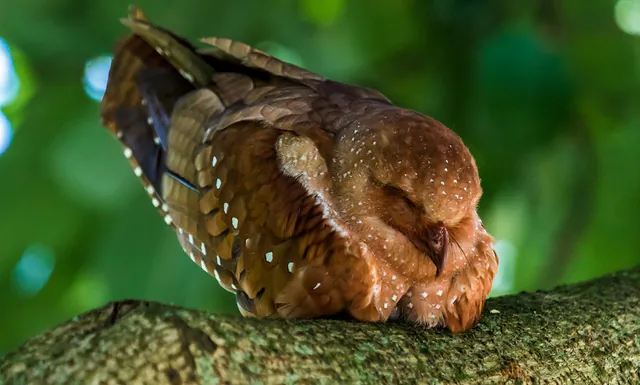
Image via Macaulay Library
Oilbird
- Scientific name
- Steatornis caripensis
- Family
- Steatornithidae
- Conservation status
- Least concern
- Habitat
- Forest mixed
- Wing shape
- Broad
- Tail shape
- Rounded
Where it came from
The Oilbird, scientifically known as Steatornis caripensis, occupies a unique position in avian evolution as the world's only nocturnal, fruit-eating bird capable of echolocation. It was first formally described by Alexander von Humboldt in 1799, who encountered the species in the Caripe caves of Venezuela. The bird's common name derives from the historical practice by indigenous populations of harvesting the chicks, which accumulate significant subcutaneous fat, for rendering into lamp oil.
The physical design of the Oilbird is an exquisite adaptation to its cavernous, low-light habitat. Its broad, long wings allow for high maneuverability within tight subterranean spaces, while its rounded tail aids in the slow, hovering flight necessary for harvesting fruits from trees in total darkness. These features have fascinated biologists for centuries, serving as a primary case study in convergent evolution alongside bats, as the species developed sophisticated acoustic orientation to navigate environments where vision is of limited utility.
Written by Pi, the helpful collecto.rs AI
Who's collecting this
Real birds collectors on collecto.rs who have this in their public collection.
About Oilbird
Oilbird is a bird in the Birdwatching catalog on collecto.rs. Catalog data is sourced from eBird. No public birds collectors track this one yet — adding yours would make you the first on collecto.rs.
How many collectors track Oilbird on collecto.rs?
Oilbird doesn't have any public collectors on collecto.rs yet. Sign up to add it and become the first.
Can I track my own copy of Oilbird?
Yes. collecto.rs is free — sign up to log your bird, upload photos, record condition, edition, and acquisition cost, and connect with other birdwatching collectors. Your collection stays private by default.
Where does the Oilbird catalog entry come from?
The catalog entry for Oilbird is sourced from eBird. Catalog-level facts stay consistent across every collector; your own data (condition, edition, acquisition notes) is yours.
Is collecto.rs birds tracking free?
Yes. Tracking your birds is free — no paid tier required to catalog items, upload photos, or share your collection.
Track every bird you own
Free. Fun. Collection photos, notes, organization, value tracking, friends — all in one place.
Sign up free