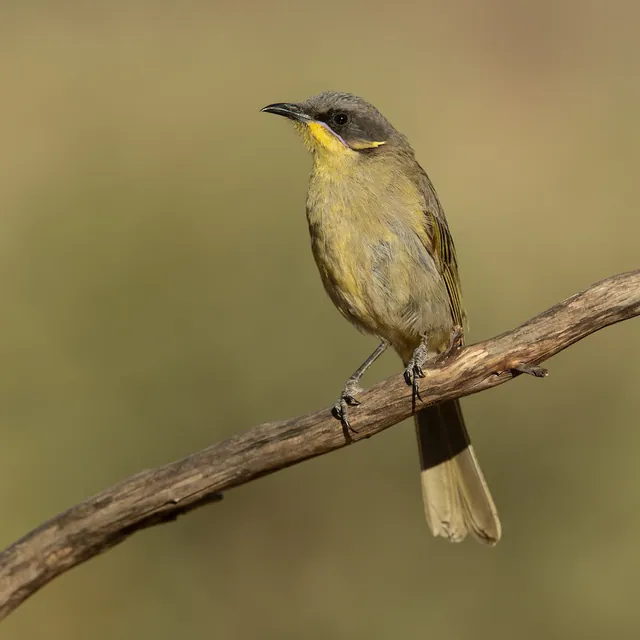
Image via Macaulay Library
Purple-gaped Honeyeater
- Scientific name
- Lichenostomus cratitius
- Family
- Meliphagidae
- Conservation status
- Least concern
- Habitat
- Woodland
- Wing shape
- Rounded
- Tail shape
- Notched
Where it came from
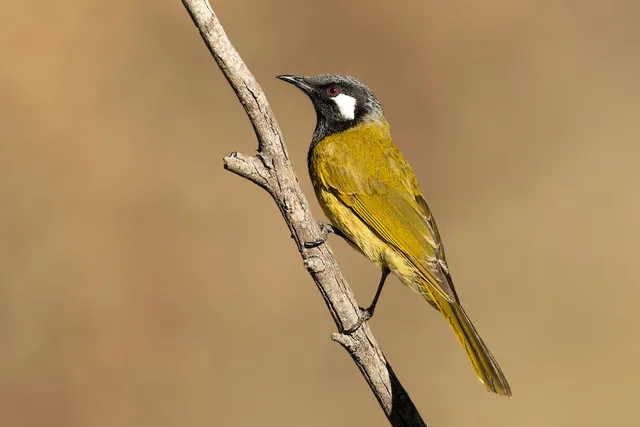
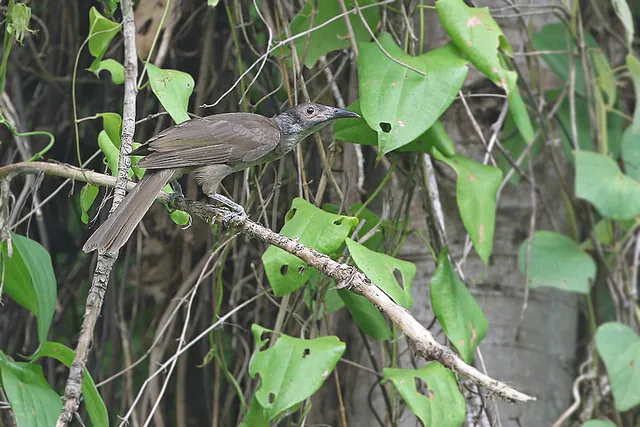
The Purple-gaped Honeyeater was formally described by the ornithologist John Gould in 1841. It is a member of the Meliphagidae family and is primarily found in the semi-arid shrublands and mallee woodlands of southern Australia. Its design, characterized by the distinctive violet-colored skin patch at the gape, serves as a specific diagnostic feature that distinguishes it from related species within the Lichenostomus genus.
Evolutionary adaptation has shaped the bird's rounded wing and notched tail structure to facilitate maneuverability within the dense, tangled undergrowth of its habitat. Observations of the species highlight its reliance on nectar and insects, reflecting a long-standing ecological niche in the Australian landscape. The bird remains a notable subject for ornithologists focused on the biodiversity of arid-zone scrublands.
Written by Pi, the helpful collecto.rs AI
Who's collecting this
Real birds collectors on collecto.rs who have this in their public collection.
About Purple-gaped Honeyeater
Purple-gaped Honeyeater is a bird in the Birdwatching catalog on collecto.rs. Catalog data is sourced from eBird. No public birds collectors track this one yet — adding yours would make you the first on collecto.rs.
How many collectors track Purple-gaped Honeyeater on collecto.rs?
Purple-gaped Honeyeater doesn't have any public collectors on collecto.rs yet. Sign up to add it and become the first.
Can I track my own copy of Purple-gaped Honeyeater?
Yes. collecto.rs is free — sign up to log your bird, upload photos, record condition, edition, and acquisition cost, and connect with other birdwatching collectors. Your collection stays private by default.
Where does the Purple-gaped Honeyeater catalog entry come from?
The catalog entry for Purple-gaped Honeyeater is sourced from eBird. Catalog-level facts stay consistent across every collector; your own data (condition, edition, acquisition notes) is yours.
Is collecto.rs birds tracking free?
Yes. Tracking your birds is free — no paid tier required to catalog items, upload photos, or share your collection.
Track every bird you own
Free. Fun. Collection photos, notes, organization, value tracking, friends — all in one place.
Sign up free