The short version#
Tales of Aria introduced elemental mechanics that altered how resource pitch, defense, and tempo interact across the entire Flesh and Blood card pool.
- Crown of Seeds
- Channel Mount Heroic
- Korshem, Crossroad of Elements
- Rampart of the Ram's Head
- Endless Winter
- Awakening
- Tear Asunder
- Blossoming Spellblade
- Autumn's Touch
- Lightning Surge
Every trading card game reaches a moment where math shifts under the table. In Flesh and Blood, that moment arrived with Tales of Aria. Before late 2021, the game ran on crisp, brutal fundamentals. You pitched red for impact, blue for fuel, and yellow when you had to. You guarded with three cards, hit back with one, and passed the turn. The engine had moving parts, but the gears were clean iron.
Aria brought weather. It introduced the elemental talent pool, split cleanly between Earth, Ice, and Lightning. On the surface, that meant new heroes: Oldhim, Lexi, and Briar. Beneath the surface, it rewired how pitch values, card economy, and turn tempo operate together. Earth turned defense into endurance by rewarding slow, heavy hands that recycle value into the late game. Ice introduced taxation, forcing an opponent to spend frostbitten resources simply to take the game actions they took for granted five minutes prior. Lightning turned go-again into a fuse, chaining attacks that demanded immediate, awkward blocks from an empty hand.
More than that, Aria changed how players evaluate their pitch strip. Suddenly, pitching a card was not just generating resources for a combat chain. It was loading a fuse, fulfilling an elemental requirement, or seeding the bottom of your deck for an endgame that looks nothing like the opening round. Defending ceased to be a simple arithmetic trade of card value against incoming damage. You had to account for action point denial, lingering auras, and equipment that transformed defensive pitch into active board states.
Whether you opened cases on release day or picked up your first cold foil last week, Aria stands as the set where James White and Legend Story Studios proved the game engine could bend without snapping. The ten cards ahead highlight that shift. They represent the designs that forced every deck builder at the table to sit up and rethink how a turn actually resolves.
| # | Item | Set / Year | Rarity |
|---|---|---|---|
| 1 | Crown of Seeds | Tales of Aria | legendary |
| 2 | Channel Mount Heroic | Tales of Aria | majestic |
| 3 | Korshem, Crossroad of Elements | Tales of Aria | fabled |
| 4 | Rampart of the Ram's Head | Tales of Aria | legendary |
| 5 | Endless Winter | Tales of Aria | majestic |
| 6 | Awakening | Tales of Aria | majestic |
| 7 | Tear Asunder | Tales of Aria | majestic |
| 8 | Blossoming Spellblade | Tales of Aria | majestic |
| 9 | Autumn's Touch | Tales of Aria | common |
| 10 | Lightning Surge | Tales of Aria | common |
10. Lightning Surge#
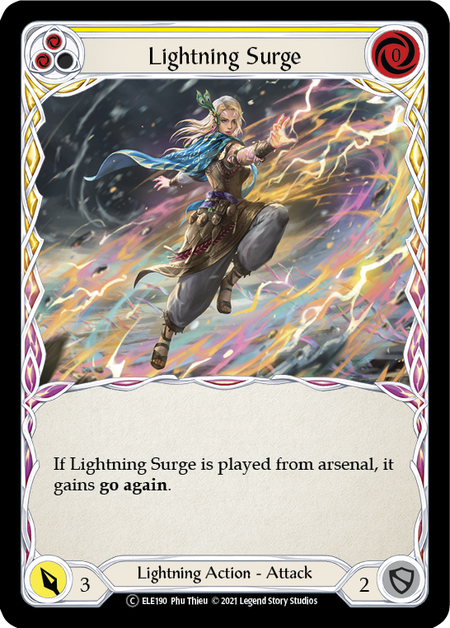 Lightning SurgeSee it on collecto.rs
Zero pitch, four power, and the cleanest conditional keyword in the set. That stat line explains why a plain common from Tales of Aria earned immediate space in constructed decks. Lightning Surge costs zero resources to play. If you played another Lightning card this turn, it gains go again. It does not ask for complex pitch sequencing. It asks you to commit to a cadence and rewards you with action points.
Tales of Aria divided its elemental identity between heavy Earth and fast Lightning. Where Autumn's Touch anchored the Earth side by quietly providing three defense and three resources on rate, Lightning Surge went in the exact opposite direction. Autumn's Touch sat back to build inevitable resource engines. Lightning Surge wanted you to empty your hand immediately. It converted raw tempo into chained attacks, punishing an opponent who hoped you would pause after the first strike.
Commons like this carry a specific weight for people who preserve game history. Rare foils draw the immediate eye in a binder, but the design elegance of an era often lives in the commons box. Lightning Surge shows what the design team understood about pacing during this release cycle. It provided the glue for Briar and Lexi lists that needed reliable chain links without stalling out on cost.
Whether you sleeve it for an active deck or keep a clean copy to represent the set mechanical rhythm, it deserves the slot. Tales of Aria gave the card pool intricate elemental mechanics, yet this card remains one of its most legible statements: play lightning, gain speed, keep moving.
9. Autumn's Touch#
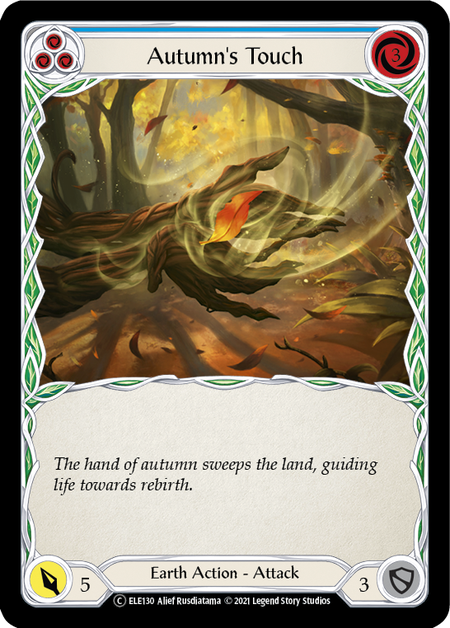 Autumn's TouchSee it on collecto.rs
A draft table littered with token wrappers and discarded foils often leaves this card sitting in the side pile. It looks plain. It has no flashy text box or intricate combo loop, just an honest brown border and the elemental Earth tag. Yet the turn you need three resource points and a block value of three, nothing else in your hand feels quite as stable.
Tales of Aria hinged on the friction between elements, demanding clean pitches to feed heavy elemental thresholds. Autumn's Touch provided that floor. Printed at common, it came in three pitch cycles, but the blue strip did the heavy lifting for Oldhim and Briar alike. It paid for winter cloaks, sustained shield blocks, and funded hammer swings without asking for complex setup. It was the quiet anchor of the defensive Earth engine, soaking up incoming damage before sliding into the pitch zone to guarantee your next turn existed at all.
Where Lightning Surge tests your ability to push continuous tempo with aggressive go-again lines, Autumn's Touch sits on the exact opposite side of Aria's identity. Lightning Surge spends cards to compress time and force awkward blocks. Autumn's Touch buys time back, blunting that exact aggression so your late game can function. It lacks the explosive upside of its lightning-charged peer, but upside means little if your life total hits zero while waiting for pieces to align.
Every set needs load-bearing commons to make its core mechanics work in practice. Tales of Aria leaned hard on its dual-element identities, and those archetypes required a dead-reliable baseline to keep the gears turning. You might remember the set for soaring majestic fusions, but Autumn's Touch is the card that let those decks survive long enough to play them.
8. Blossoming Spellblade#
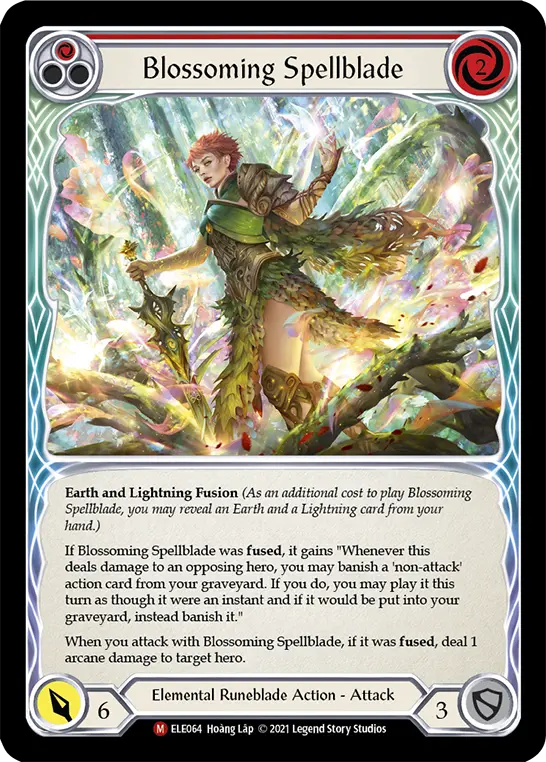 Blossoming SpellbladeSee it on collecto.rs
Tear Asunder wins games by shoving a boulder down your opponent's throat. Blossoming Spellblade plays a different game entirely. Where the Guardian majestic relies on blunt-force disruption to break a turn open, this card asks you to assemble a machine. It demands an Earth card in hand to fuse, an attack action in your graveyard to banish, and a combat chain that actually lets you hit. If any piece wobbles, you are left with three resource cost and a fragile dream. When the gears mesh, it does what Runeblade does at its best: it stitches the split identity of the class together in one swing.
Tales of Aria built its entire identity around these elemental fusions. Some cards treated the mechanic like a tax you paid for a bigger number. Blossoming Spellblade treated it like a bridge. You present physical attack damage and demand arcane defense simultaneously, forcing defense reactions into awkward corners. Hitting means you play the banished non-attack action immediately, extending the chain while refilling resources or stacking runechants on the fly. It is a majestic that rewards players who track their graveyard order as carefully as their life totals.
That design tension gives it an enduring presence in a binder. The foil treatment catches the floral lattice over steel, marking that exact moment Flesh and Blood pushed Runeblade past pure aggression into calculated sequencing. It represents the intricate side of the set, balancing the sheer brute weight of cards like Tear Asunder with puzzle-box play. If you keep an elemental collection on collecto.rs, you can group your Aria majestics by fusion requirements to see how the mechanic evolved across the run. It makes the design leap between straight damage and hybrid turns obvious on the page.
7. Tear Asunder#
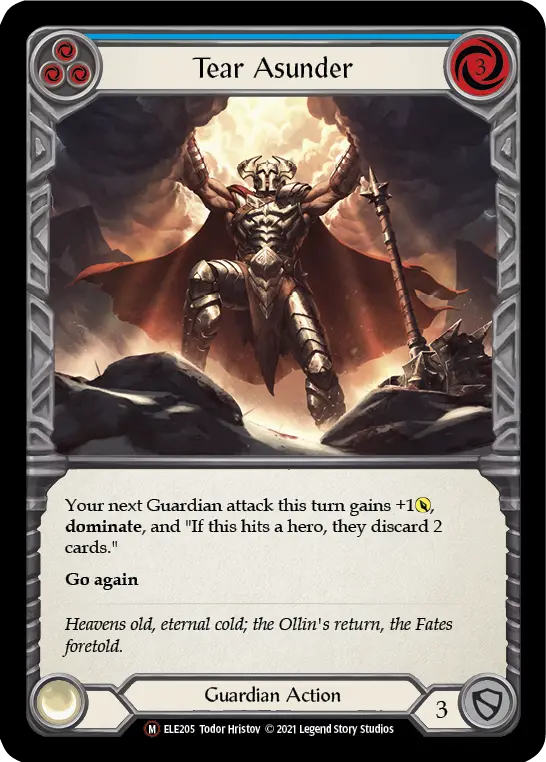 Tear AsunderSee it on collecto.rs
What does complete disruption actually look like across the table? In Tales of Aria, it looks like a blue pitch card that turns an already heavy hammer into a defensive disaster for the opponent. Tear Asunder gave Oldhim the teeth he needed to command a turn cycle completely. Other majestic staples from the set, like Blossoming Spellblade, build their turns around intricate weaving between physical damage and arcane pressure. Tear Asunder ignores that nuance entirely. It asks a Guardian to pitch three resources, pay for an attack action, and strip two cards out of the defender's hand on hit. That pressure warps how an entire match plays out.
Tales of Aria introduced elemental talents that reshaped Flesh and Blood deck construction. Earth cards leaned into endurance and raw stat thresholds, but this attack reaction added genuine teeth to that identity. Giving dominate and a double-discard trigger to an attack forces awkward blocks. It turns full hands of four cards into fragmented turns where the opponent can barely muster an arsenal pass. Even defending with three cards often leaves an opponent empty-handed going into their turn, which is exactly where an Earth Guardian wants to be.
From a collecting perspective, cold foil and majestic printings from this era hold the distinct visual identity of the elemental sets. The framing and the rich green hues of the Earth talent make the card stand out in a binder page alongside the Runeblade and Lightning cards of the period. Keeping track of talent-specific staples like this in your collection ledger helps trace how design teams solved specific class problems early on. Tear Asunder showed that defense in Rathe did not have to be passive. Sometimes the safest way to preserve your own life total is to snap the other player's hand clean in half.
6. Awakening#
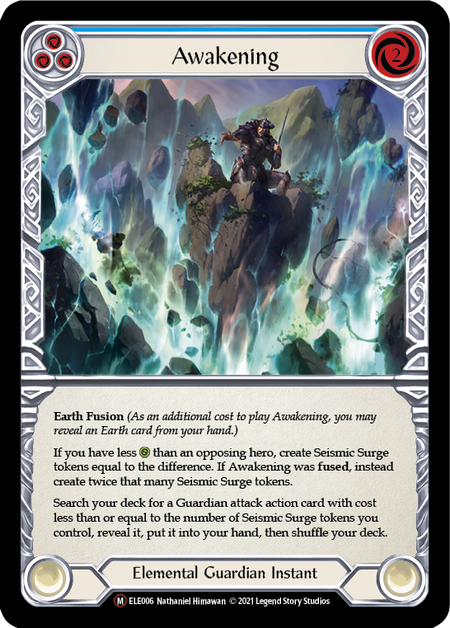 AwakeningSee it on collecto.rs
A tournament table in late 2021 rarely went quiet until a Bravo player checked their life pad, counted the pitch in their discard pile, and pushed four blue cards into the resource zone. You knew the math was happening before they spoke. Two seismic surge tokens appeared on the playmat, and suddenly an empty turn became a lethal swing.
Awakening is a Majestic that fundamentally reworked how Guardian players measured vulnerability. Up to this point in the ranking, cards like Tear Asunder rewarded forward momentum by demanding heavy, aggressive blocks. Awakening flipped the axis entirely. It asked you to sit at a life deficit, absorb hits, and treat low health as an asset rather than a ticking clock. Paying two life per energy counter let you tutor an elemental attack directly from your deck, cheat the resource cost, and throw an immediate problem back across the table.
That tension made it one of the starkest design choices in Tales of Aria. It turned defensive turtling into sudden burst damage, forcing opponents to calculate whether attacking was actually safer than passing the turn. In competitive play, that efficiency eventually proved volatile enough to warrant a ban, which only cemented its status in the history of the set.
As an object, the cold foil printing carries real weight in a binder. The frame captures the split identity of the set, grounding the heavy Earth mechanics alongside the stark presentation Legend Story Studios built for Aria. Whether you sleeve it for an unrestricted format or preserve it in your collection alongside the other Majestics that defined that winter, it marks the exact point where defensive design crossed into sheer threat.
5. Endless Winter#
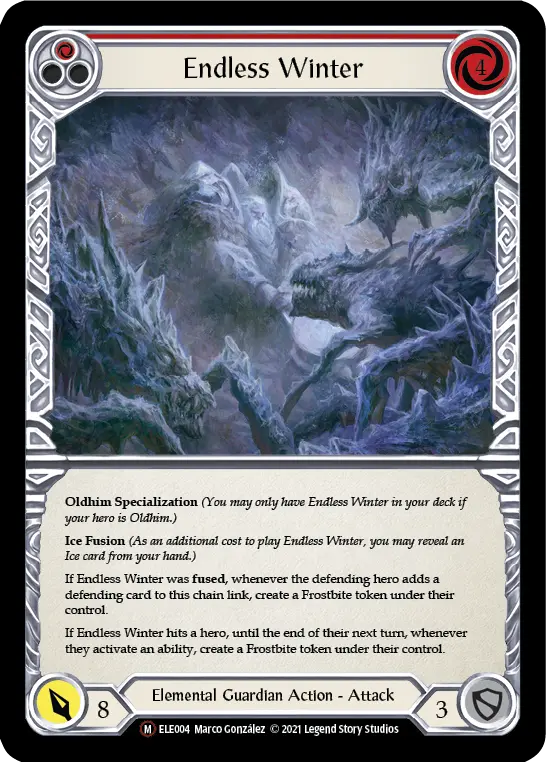 Endless WinterSee it on collecto.rs
Most players remember Tales of Aria for elemental lightning and explosive Runeblade sequences, but the set's identity truly hardened around its frostbite. Endless Winter is the clearest realization of that design. It is not subtle. It does not ask you to assemble complicated setup turns. It costs four resources, swings for eight physical damage, and presents a hit trigger that fundamentally shuts down the opposing turn. You force a Frostbite token, freeze their hero's ability, and freeze all cards in their arsenal. In a game built on card economy, stealing an opponent's entire following turn with a single blow is brutal.
Compare this directly to Awakening, which operates as a calculated comeback mechanism that demands precise life totals to justify its pitch. Endless Winter requires no such bargain. It does not wait for you to fall behind. Instead, it maintains a suffocating tempo advantage from the front foot, leveraging Oldhim’s native resource base to push raw numbers that defensive hands simply fail to answer. Blocking it fully demands three cards from an opponent's hand. Letting it connect often invalidates the remaining ones anyway.
Printed at majestic rarity, the card captures the cold mechanics of Aria in their most punishing form. It defined an archetype by turning the core rhythm of Flesh and Blood into a one-sided equation. Ice did not merely trade blows or race damage; it stripped options until the defender had no legal plays left worth making. Holding a clean copy today means holding the centerpiece of that control legacy. It belongs in the binder because it documents the exact moment Legend Story Studios decided Guardian disruption could be both relentless and absolute.
4. Rampart of the Ram's Head#
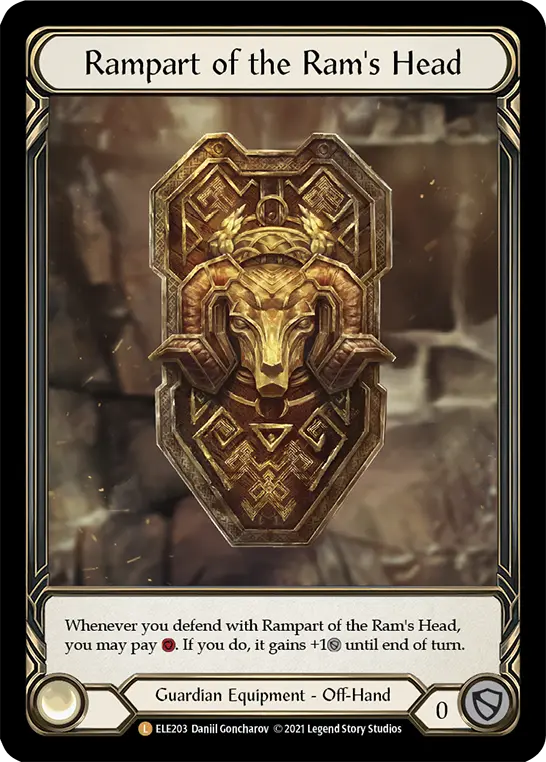 Rampart of the Ram's HeadSee it on collecto.rs
Zero power, zero base defense value, and one simple activated ability that quietly reshaped how Flesh and Blood players evaluated the off-hand slot. Rampart of the Ram's Head arrived in Tales of Aria as an unassuming Legendary generic buckler. On paper, paying a resource to prevent a single point of damage looks modest. In practice, having an on-demand damage sponge that sits safely in your equipment zone until needed altered defensive math for years.
While Endless Winter announced its dominance by brutally freezing your opponent's arsenal and resources in one loud swing, Rampart worked through stubborn subtraction. It shaved odd points off arcane bursts, blunted wide aggro chains, and soaked up the chip damage that usually forces defensive blocks from your hand. You did not run it to close games fast. You ran it to survive long enough to execute your own plan, one point of absorbed damage at a time. It gave Guardian, Runeblade, and Wizard players an efficient sink for leftover floating pitch.
Cold foil copies carry the dense, layered framing that defined Aria's high-rarity print runs. The buckler's curled horns and weathered bronze finish catch light across the textured border, giving the card a heavy, physical presence that matches its role at the table. It is the sort of card you slot into a binder page alongside Crown of Seeds and immediately understand how defensive equipment carried the entire era. If you run one in your deck box, tracking your copy on collecto.rs makes it easy to keep tab on your Tales of Aria equipment lineup alongside the rest of your armory staples.
3. Korshem, Crossroad of Elements#
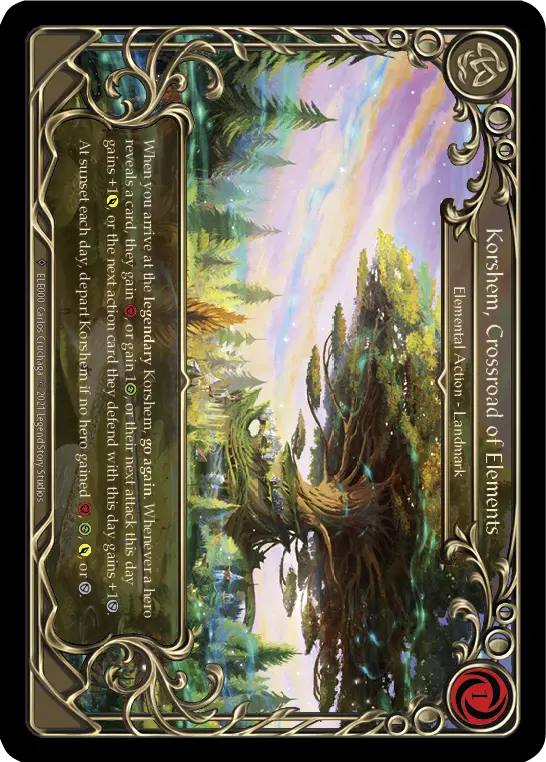 Korshem, Crossroad of ElementsSee it on collecto.rs
Someone at the table slips a thumb under the top foil seal, lifts the pack, and freezes before the rare slot even shows. Cold foil borders carry a matte grey weight that gives them away instantly in hand. Finding Korshem in a fresh pack of Tales of Aria felt like discovering the geographic center of the entire expansion printed directly onto cardboard.
Mechanically, Korshem sits as the grand meeting point for Earth, Ice, and Lightning. It asks you to weave three distinct elements together in a single turn cycle to earn a modest stat boost and a slice of resource generation. Unlike Channel Mount Heroic, which demands your full commitment to an aggressive line and ends matches through sheer raw momentum, Korshem behaves like an environmental anchor. It rarely forced concessions on turn three. Instead, it rewarded the patient deckbuilder who wanted Aria's disparate mechanical halves to sit down at the exact same table.
That patience carries into how the card functions as an artifact today. As the solitary Fabled card of the set, it does not rely on shifting tournament metas to command space in a binder. The illustration captures the serene intersection where the wild elemental paths converge, framing Aria not just as a combat zone for Briar and Oldhim, but as an actual territory with distinct weather and soil. It exists outside the usual class boundaries, slotting cleanly into any collection that tracks the physical lore of the world.
Whether you cracked it during release weekend or picked it up later as the centerpiece of a dedicated regional spread, it remains the set's definitive landmark. You can log it in your collecto.rs catalog under Tales of Aria, track its cold foil finish, and export the record whenever you want a clean view of your landmark staples.
2. Channel Mount Heroic#
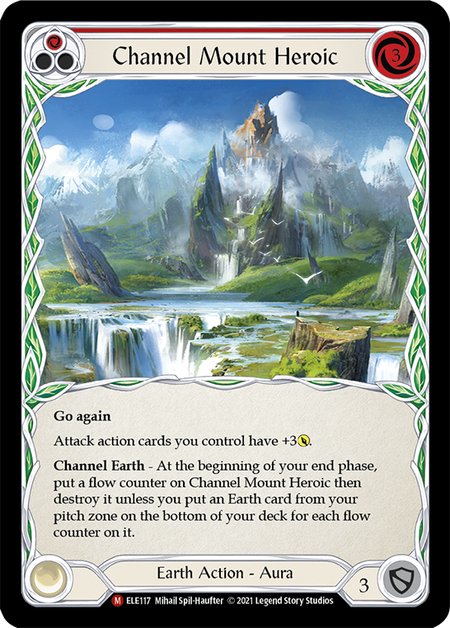 Channel Mount HeroicSee it on collecto.rs
Crown of Seeds taught players how to grind out games one stitch at a time, but Channel Mount Heroic did the exact opposite. It did not ask you to weather a storm. It asked how quickly you could end the match before the aura collapsed under its own weight.
Printed as an Earth Guardian and Earth Runeblade Majestic, the card turns every subsequent attack into a math problem your opponent rarely solves in time. Giving plus three power to attacks under its watch is already generous. Stacking that bonus across go-again chains turns standard combat steps into runaway freight trains. In Briar decks especially, the aura transformed modest physical pokes into lethal breakpoints. Opponents were forced to throw entire hands into the defense step just to survive the turn, forfeiting their own offensive momentum entirely.
The genius of the design sits in the Channel cost. Legend Story Studios built a self-regulating fuse into Aria's signature enchantments. You place an Earth card from your pitch zone under it during your end phase, or the aura goes to the graveyard. The first upkeep feels manageable. The second demands serious resource dedication. By the third, your deck needs to be practically humming with green pitch cards to keep the engine running. In practice, players rarely needed a third turn. The game was usually decided while the first set of counters still rested on the cardboard.
Channel Mount Heroic defines the predatory edge of Tales of Aria. It took the set's elemental affinity and weaponized it into pure velocity. Whether you sleeve it up for competitive play or file a cold foil copy into a binder row, it remains a clean reminder of how narrow the gap was between a stable board state and sudden defeat.
1. Crown of Seeds#
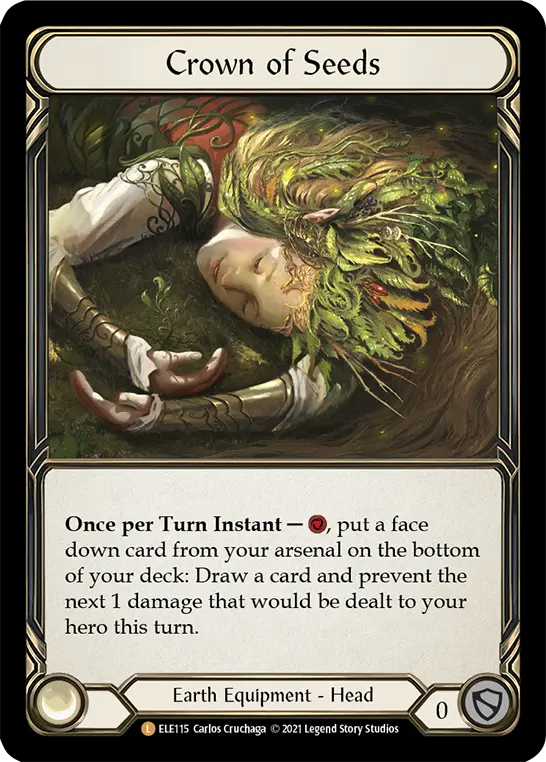 Crown of SeedsSee it on collecto.rs
During a tier-one Swiss round in late 2021, an Oldhim player leaned back, held up a single blue pitch card on their opponent's turn, and tapped their head equipment before declaring a block. The attacker slumped in their chair. Nothing died, no massive damage registered, and the turn ended on an incremental shift of cards that felt impossible to break through. That was the reality Crown of Seeds created the moment Tales of Aria landed.
Printed at legendary rarity, this helm quietly broke the foundational math of combat. Until Tales arrived, defense meant giving up cards from your grip to prevent numbers. Crown asked for a single floating resource, let you prevent one damage, and replaced the pitched card with the top card of your deck. If Channel Mount Heroic represents the set's ceiling for raw offensive pressure, Crown represents its immovable floor. Channel Mount forces opponents to react right now or pack up their dice; Crown grinds that exact brand of aggression down to dust over twenty patient turns.
That interaction fundamentally rewrote competitive deckbuilding. Oldhim and Briar both discovered lines where holding priority on an incoming attack felt active instead of desperate. You were not just soaking hits. You were cycling through your deck, filtering for second-cycle pitch stacks, and shrinking damage calculations by a single point that constantly ruined break points. Flesh and Blood design had to reckon with the card for entire seasons afterward, adjusting card pool limits simply because the card made elemental defense too reliable.
Whether you keep an original cold foil displayed in a hard case or tucked into a binder beside your Earth staples, Crown remains the centerpiece of the set. It defined how a generation of defensive players thought about their turns, and Aria never produced a piece with a longer shadow.
Looking at Tales of Aria in hindsight, its lasting contribution was never just the power level of its signature heroes. It was the way it made players treat the pitch zone as a secondary hand. Cards like Crown of Seeds and Channel Mount Heroic did not simply win games. They asked players to think two turns ahead about the exact color stripes sitting at the bottom of their decks.
That tension changed how Flesh and Blood cards are evaluated across every subsequent set. When defense values can be converted directly into damage prevention without spending card text on the combat chain, the pace of play changes permanently. When an Ice tax can strand a four-card hand before an attack is declared, resource management stops being automatic. Aria tested the boundaries of how much friction the game system could bear, and it built the foundation for every talent mechanic that followed.
If you keep a playset of these in a binder or track their cold foils across printings, you can catalog them directly on collecto.rs. You can log variants, track your set completion, and export your full data whenever you want. Aria proved that a set can remake an entire game system while fitting neatly into a four-pocket page.
Frequently asked questions#
What makes Tales of Aria distinct from earlier Flesh and Blood sets?#
Tales of Aria introduced the Elemental talent system, combining basic classes with elements like Earth, Ice, and Lightning. This required players to balance elemental pitch cards alongside pure class cards to activate Fusion abilities, fundamentally altering deck building and resource management compared to straight-class sets like Welcome to Rathe or Monarch.
Why is Crown of Seeds so significant in Flesh and Blood history?#
Crown of Seeds provided recurring damage prevention by utilizing cards directly from the arsenal. It became a defensive cornerstone for Oldhim and Earth heroes, influencing competitive control strategies until format bans and hero rotations eventually curtailed its tournament lifespan.
Are common and rare cards from Tales of Aria worth collecting?#
Yes. Key non-majestic staples like Autumn's Touch provide essential baseline defense and elemental pitching that transcend individual hero metas. Foil versions of heavily played elemental commons remain staples in historical deck construction and complete set binders.