The short version#
The Doctor Who Commander release succeeded because its designs converted sixty years of narrative television into specific, mechanically distinct Magic cards that reshape how you play.
- Gallifrey Stands
- Displaced Dinosaurs
- The Twelfth Doctor
- Missy
- Flaming Tyrannosaurus
- Cybermen Squadron
- Rose Tyler
- The Face of Boe
- Vashta Nerada
- Ian Chesterton
Universes Beyond sets face a specific trap. Print a famous character with generic text, and the card feels like an advert slapped onto cardboard. Push the reference too hard, and the card becomes an inside joke that collapses the moment you sit down to play a game.
The Doctor Who Commander decks avoided that trap almost entirely. Released in late 2023, the four preconstructed decks carried an unreasonable design burden. They had to represent sixty years of television across four distinct eras, translate time travel into turns and phases, and still function in a format defined by decades of broken combinations.
They worked because the designers did not treat the television lore as decorative paint. They treated narrative constraints as game mechanics. Suspend, an older mechanic about waiting out time counters, became the literal engine of temporal drift. Historic spells, sagas, and paradox triggers tied narrative continuity directly to board states. The cards do not simply depict moments from television history. They force you to solve the same strange logistical problems the characters faced.
Whether you picked up the decks to play them out of the box, split them for parts, or binder-sleeved every variant for a character run, the set rewards close attention. Ten cards in particular show what happens when the mechanical identity of a card aligns completely with the narrative logic of its source.
| # | Item | Set / Year | Rarity |
|---|---|---|---|
| 1 | Gallifrey Stands | Doctor Who | rare |
| 2 | Displaced Dinosaurs | Doctor Who | uncommon |
| 3 | The Twelfth Doctor | Doctor Who | rare |
| 4 | Missy | Doctor Who | rare |
| 5 | Flaming Tyrannosaurus | Doctor Who | rare |
| 6 | Cybermen Squadron | Doctor Who | rare |
| 7 | Rose Tyler | Doctor Who | rare |
| 8 | The Face of Boe | Doctor Who | rare |
| 9 | Vashta Nerada | Doctor Who | rare |
| 10 | Ian Chesterton | Doctor Who | rare |
10. Ian Chesterton#
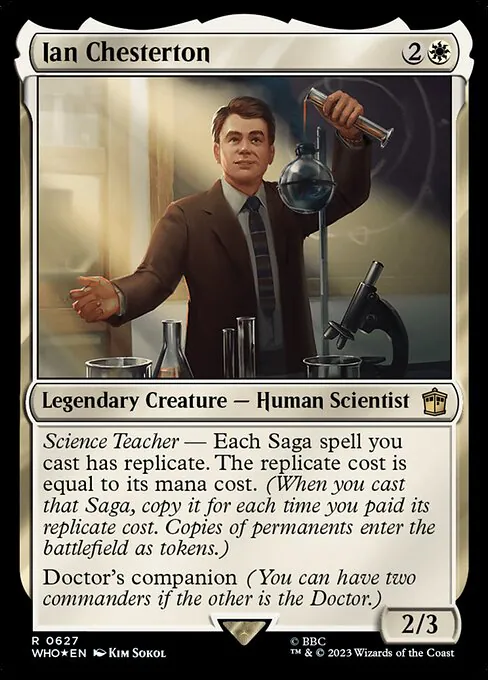 Ian ChestertonSee it on collecto.rs
A London fog rolls across a scrap merchant yard in 1963, and two schoolteachers step into a police box that is far larger than it has any right to be. Ian Chesterton did not ask for a tour of time and space. He demanded an explanation, pushed past the controls, and became the template for every mortal companion who followed.
Translating sixty years of television into cardboard requires choices. For a creature like Vashta Nerada, the design reaches backward into Magic history, using shadow to capture carnivorous dust you cannot touch. Ian Chesterton takes the opposite route. He looks forward, tying himself directly to Sagas, one of the modern game's most narrative card types. His Science Teacher rule gives every Saga spell you cast replicate. You pay the mana cost again, and you duplicate the chapter-based story as an enchantment token.
Mechanically, it turns a cautious high school teacher into an engine for historical reenactment. Pair him with an early Doctor, cast an enchantment that tells an old story, and duplicate it. You are not simply playing cards; you are running parallel experiments. Kim Sokol captures that exact posture in the art. Chalk in hand, practical tweed, ready to test a hypothesis against impossible odds. The rare stamp feels earned not through raw combat stats, but through how neatly the rules mimic a human mind insisting on empirical evidence.
Ian anchors the bottom of this list because he shows the design philosophy at its most deliberate. He does not rely on obscure keyword soups or explosive combat steps to feel like himself. He simply watches history unfold, takes notes, and makes sure the class pays attention twice. If you track your deck builds on collecto.rs, you already know the satisfaction of tagging a card that does one clean, thematic job without fuss.
9. Vashta Nerada#
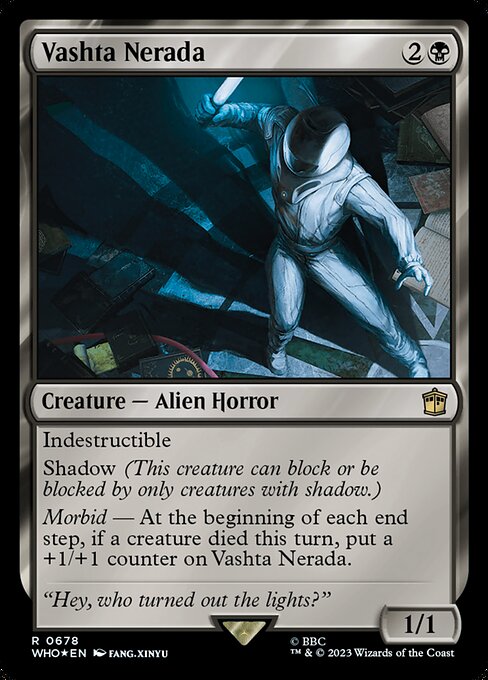 Vashta NeradaSee it on collecto.rs
Most villains in Universes Beyond arrive with pages of rules text meant to simulate an entire episode. Vashta Nerada takes the opposite path, relying on a keyword printed in 1997 to carry the dread.
Shadow means this creature cannot block creatures without shadow, and creatures without shadow cannot block it. In the context of Tempest block, shadow represented a physical displacement into another dimension. Here, the mechanic translates the silence of a carnivorous swarm living inside darkness. You simply cannot touch them. Pairing shadow with indestructible reinforces the horror. Most board wipes stall; Fang Xinyu’s art shows empty spacesuit visors and encroaching gloom that do not clear away easily. Then the morbid trigger takes over. Whenever anything dies on any turn, the swarm grows. The card quietly accrues counters simply because a commander table plays its normal game.
Where Ian Chesterton looks backward to the earliest black-and-white serials by linking history directly to Sagas, Vashta Nerada looks across the mechanical history of Magic itself to solve an adaptation problem. It avoids inventing bespoke tokens or introducing complex tracker mechanics. Instead, the design team reached into the deep archive of abandoned evergreen rules to make a creature feel untouchable. Even the flavor text keeps things simple, using the line that defined the two-part library story without adding commentary.
Cards like this stand out in a collection because they capture why crossover sets work when done with restraint. It is a rare card that does not ask you to build an entire deck around its specific gimmick. It exists as an efficient, persistent threat that functions on clean interaction and memory of older tournament formats. When you catalog pieces like this on collecto.rs, you are tracking the moments where outside storytelling aligned cleanly with the game's foundational rules.
8. The Face of Boe#
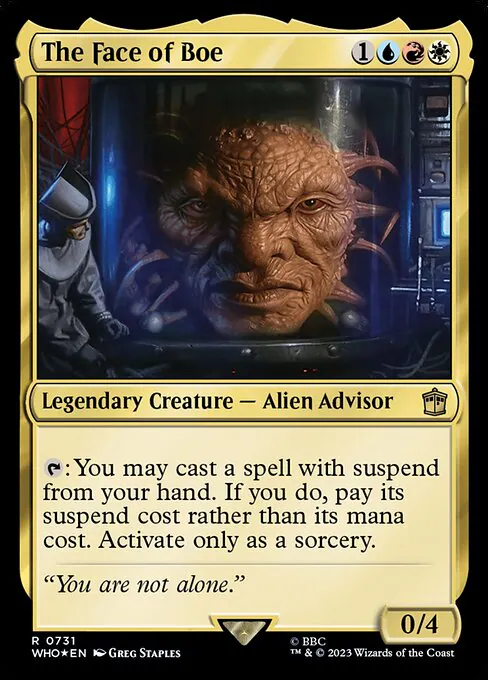 The Face of BoeSee it on collecto.rs
What happens when you let a giant head in a tank ignore fifteen years of game pacing? You get an engine that completely retools how suspended cards enter play.
Suspend originally asked for patience. You exiled a spell from your hand, paid a smaller mana investment, and waited out several turns while time counters slowly trickled away. The Face of Boe cuts that waiting period entirely. Tap it at sorcery speed, pay the suspend cost, and the spell simply casts straight from your hand. In a vacuum, that reads like an efficient setup. In practice, it breaks the central restriction placed on an entire class of older cards.
Take cards like Inevitable End or Ancestral Vision. Magic designed those spells without an ordinary mana cost precisely so you could never cast them directly from your hand. You had to suspend them and wait, or jump through elaborate hoops with cascade and electrodominance. This card turns that multi-turn windup into an immediate action for one or two mana. Where Rose Tyler builds around the slow accumulation and removal of those time counters, Boe bypasses the countdown completely. Rose wants you to live inside the delay mechanic. Boe treats the delay as an unnecessary formality.
Greg Staples captured the character with the right balance of age and quiet presence, accompanied by the line from New Earth that gave viewers pause back in 2007. It works so well because it feels mechanically tied to the narrative. The oldest being in the galaxy does not need four turns to see an outcome arrive. It simply knows what is coming, and it lets you have the spell right now.
7. Rose Tyler#
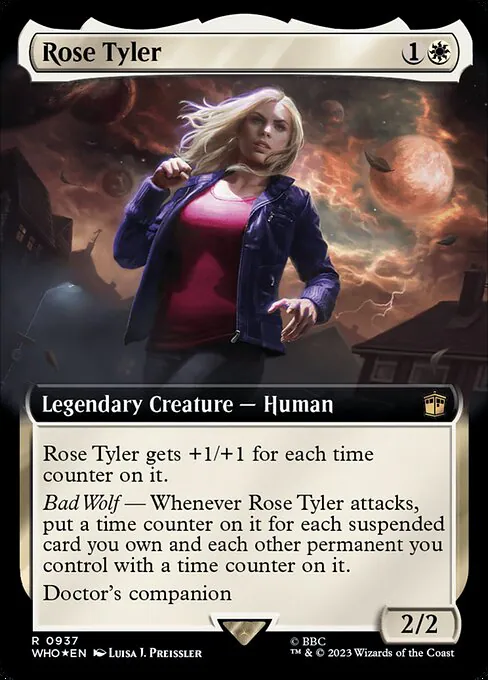 Rose TylerSee it on collecto.rs
Two mana for a 2/2 is baseline rate in white. Rose Tyler does not stay at that size for long. Her rules text ties her power directly to time counters, letting her scale each turn she attacks by checking every suspended card you own and every other permanent with a time counter under your control. She turns the delay of the suspend mechanic into direct board pressure.
That dynamic creates a different axis of threat than her list neighbour, The Face of Boe. Where Boe operates as an enabler, sitting back to cheat activation costs and clear bottlenecks from your hand, Rose is the payoff that demands an immediate answer on the battlefield. She thrives in the company of cards like Inspiring Refrain or Ancestral Vision, turning exile piles into stat buffs before those spells ever resolve. Her Bad Wolf ability counts existing counters across your whole field, meaning Vanishing sagas and time-travel triggers feed her as well.
Luisa J. Preissler captures her mid-stride against a backdrop of swirling golden energy, framing the transition from shop girl to universal fixed point. The art balances narrative grit with character focus, echoing the grounded tone of the 2005 revival. In foil, the halo of the time vortex catches the light against the brickwork behind her.
The Doctor’s Companion keyword gives her flexible deckbuilding homes across multiple colour pairings. Partner her with the Ninth Doctor to double upkeep untaps, or pair her with the Tenth to stack suspend triggers faster. She anchors the theme by turning waiting into an offensive strategy. If you catalog your Universes Beyond sets on collecto.rs, you can group her alongside your suspend staples or track her in companion pairings to see how your commander builds overlap.
6. Cybermen Squadron#
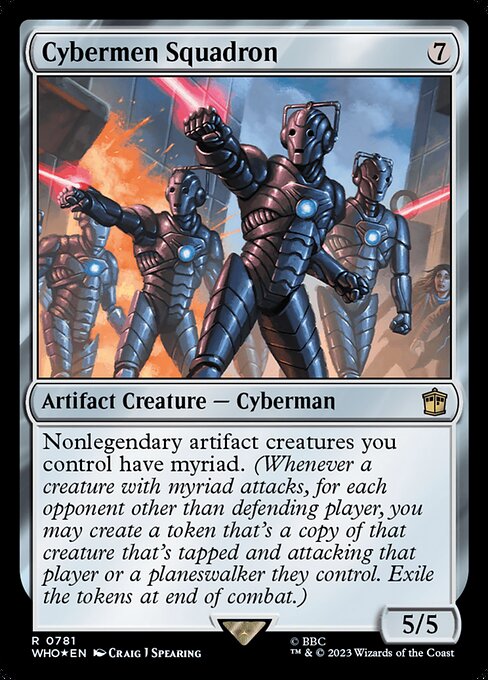 Cybermen SquadronSee it on collecto.rs
You might expect the ultimate Cybermen card to assemble an engine out of graveyard scraps or slowly convert your opponents' dead creatures into steel. It does neither. Instead, Craig J Spearing paints an advancing line of Mondasian Cybermen, and the card simply gives myriad to every nonlegendary artifact creature you control. It turns a patient board state into sudden, terrifying arithmetic.
Myriad is usually an isolated keyword. Designers drop it onto a single threat to let it punch through three opponents at a Commander table without falling behind on damage. Cybermen Squadron hands that multiplier to an entire army category. Swing with a Solemn Simulacrum, and you fetch extra basic lands while threatening two new targets. Swing with a Wurmcoil Engine or an ancient Myr Battlesphere, and the game ends before the second combat step finishes resolving. The rules text is lean. It forces you to look at every grey card in your trade binder through a wider lens.
That mechanical clarity sits in sharp contrast to Flaming Tyrannosaurus right behind it on this list. Where that card leans directly into television spectacle and the sprawl of the paradox mechanic, Cybermen Squadron strips the Doctor Who universe down to its scariest foundational idea. The Cybermen do not care about time rifts, paradox counters, or clever narrative loops. They multiply. They convert raw materials into uniform, marching numbers. It is an artifact lord that behaves less like an assembly worker and more like an industrial plague.
If you track your Commander decklists in collecto.rs, you already know the card has migrated far beyond preconstructed decks. It has become a permanent consideration for anyone building around Thopters, constructs, or old-school brown frames. It does its job quietly, until suddenly there are six of them.
5. Flaming Tyrannosaurus#
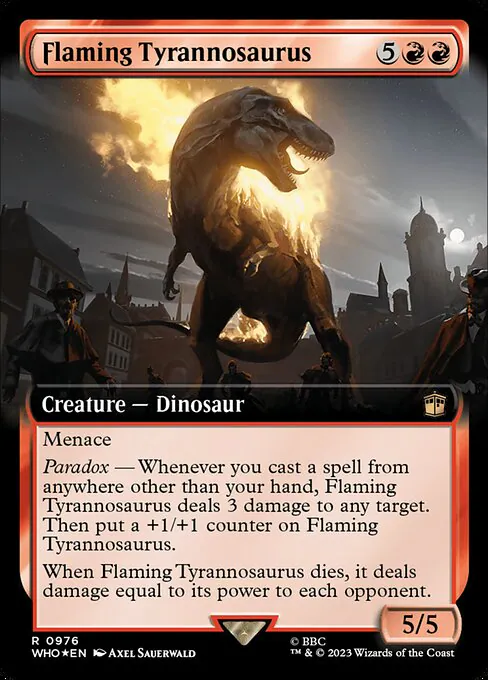 Flaming TyrannosaurusSee it on collecto.rs
In the autumn of 2014, Peter Capaldi stepped into Victorian London, looked up at Parliament, and watched a bewildered prehistoric reptile spit actual fire into the sky. It was completely unhinged television. It was also the exact moment Doctor Who reminded everyone that it refuses to take itself too seriously, even when the budget finally allows for cinematic smoke effects.
Axel Sauerwald captures that specific television bravado here without winking at the camera. The card looks heavy, ridiculous, and slightly tragic. Mechanics-wise, it gives the paradox mechanic real teeth. Whenever you cast a spell from anywhere other than your hand, Flaming Tyrannosaurus shoots three damage at any target and grows a +1/+1 counter. Exile cards, cascade spells, and suspend triggers suddenly turn into direct removal or face burn. When it finally leaves the board, it throws its accumulated power directly at each opponent's life total.
That closing blast gives it an edge over Cybermen Squadron just ahead of it. While the Cybermen ask you to build a wide artifact board and protect an army of copies through combat, this dinosaur works entirely on its own terms. It punishes removal spells simply by existing. Wipe the board, and everyone else pays the tax on its size immediately.
This card earns its place in the middle of the set by nailing the tone of modern Doctor Who. You get five generic and two red mana for menace, scaling burn, and an exit trigger that leaves a crater behind. You do not have to overthink it. It rewards the set's primary timing mechanic while putting a giant, burning predator onto a playmat. If you keep your collection organized on collecto.rs, you can tag this alongside your impulse-draw engines and see how neatly its paradox triggers line up across formats.
4. Missy#
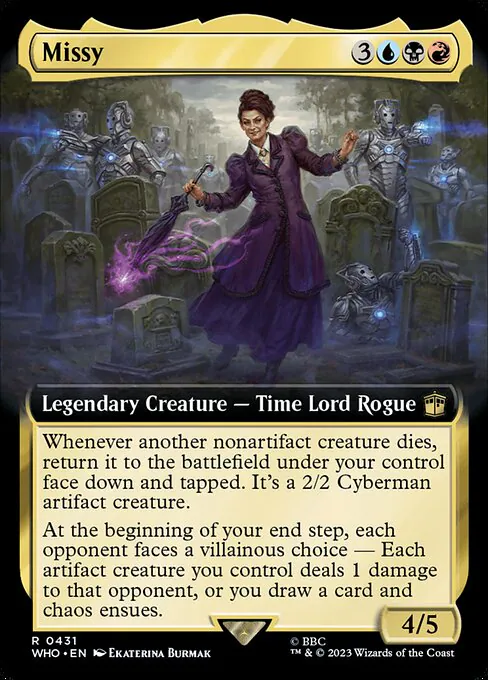 MissySee it on collecto.rs
The Doctor's companions spend their turns building small engines out of clues and extra land drops, but Missy simply repurposes your losses into an army. Every time another nonartifact creature dies, it returns to your side of the board tapped and face down as a 2/2 Cyberman artifact creature. She does not care who owned it first. A sweeper from across the table stops being a setback and turns into a full garrison in silver armor.
Where The Twelfth Doctor uses demonstrate to invite the rest of the table into polite negotiations over exiled spells, Missy forces a colder sort of math. At your end step, each opponent faces a villainous choice: let your artifact creatures ping them for one damage apiece, or hand you a fresh card while chaos ensues. Neither option helps them stabilize. The mechanical pressure mirrors the character cleanly, turning a multiplayer format into an exercise where every death feeds your board state.
Ekaterina Burmak's art captures that exact balance of poise and menace, framing her against the London skyline with an open parasol. The rare stamp sits on a card that anchored the villain precon, yet it functions just as comfortably leading a dedicated morph shell or an aristocrats build in black, blue, and red. It does not lean on complicated counters or novel tokens to do its job. The card takes Magic's oldest face-down creature framework and uses it to convert someone else's board wipe into your win condition.
Cataloging cards like this on collecto.rs keeps your variant printings, foils, and precon commanders organized in one place with clean export options whenever you want to retool a list. Missy earns her spot here by giving Grixis villain decks a focused mechanical identity that feels distinctly patient and entirely self-serving.
3. The Twelfth Doctor#
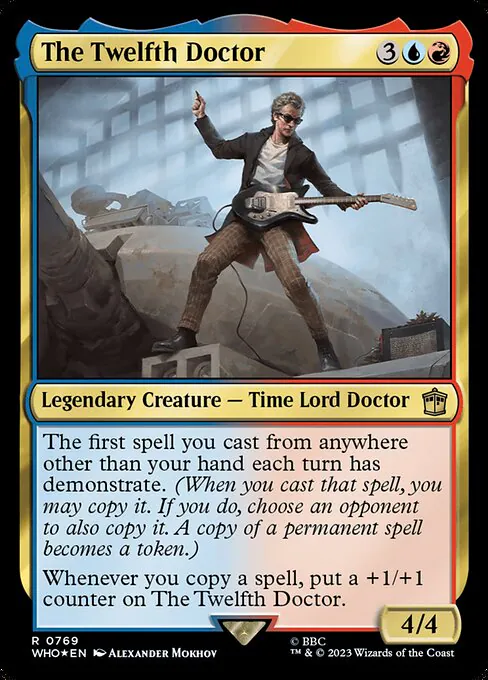 The Twelfth DoctorSee it on collecto.rs
Peter Capaldi's Doctor stands alone on a crumbling stone bridge, red-lined velvet coat catching the wind while electric chords echo off ancient masonry. Alexander Mokhov captures that specific, stubborn grief in paint. On cardboard, that stubbornness translates into an invitation to make a mess together.
The card gives the first spell you cast from anywhere other than your hand each turn the demonstrate mechanic. You copy that spell, and an opponent of your choice gets a copy too. Every time you copy something, The Twelfth Doctor takes a +1/+1 counter. It asks you to look around the four-player table and find an accomplice. You are not simply running cards from exile for pure card advantage. You are handing another player a loaded weapon and betting your copy hits harder.
That dynamic creates a sharp contrast with Missy just above him in this list. Where Missy runs an extortion racket on opposing deaths to amass Cybermen alone, Twelve negotiates every single resolution out loud. You can offer a player behind on mana their own copy of an exiled ramp spell. You can dangle a removal piece in exchange for a truce. The politics happen immediately, right on the stack, rather than waiting for an attack phase.
He pairs naturally with suspend, cascade, and foretell. Because the ability triggers on each turn, you can cast an exiled counterspell during an opponent's turn and suddenly offer a third player the chance to stop a game-ending threat. It is chaotic, but it stays grounded in deliberate decision-making. You grow your commander into a serious physical presence while giving everyone else just enough rope to hang themselves. It plays like the era it represents: loud, a little reckless, and entirely unwilling to leave the room quietly.
2. Displaced Dinosaurs#
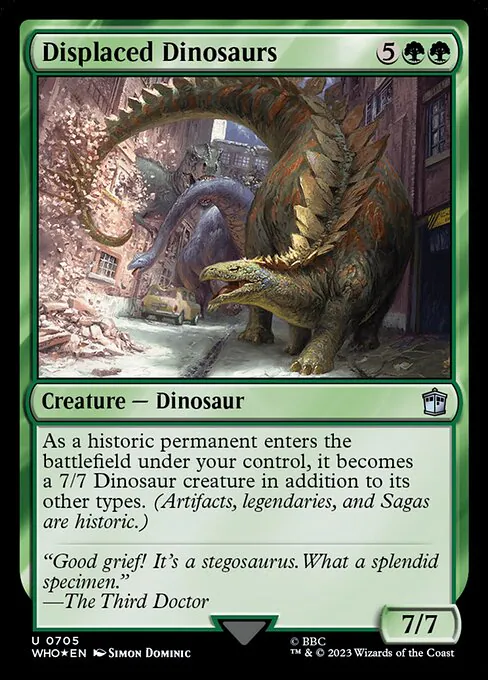 Displaced DinosaursSee it on collecto.rs
What happens when your mana rocks decide to bite back? In green, answers usually involve Craterhoof Behemoth or an Overrun variant. Displaced Dinosaurs takes a stranger route, turning every artifact, legendary permanent, and Saga you play into a 7/7 Dinosaur creature the moment it touches the battlefield. A Sol Ring is suddenly the biggest body in play. A Treasure token hits the table with the frame of an apex predator. It converts quiet setup steps into an immediate, lumbering presence.
While Gallifrey Stands asks you to carefully curate six decades of Time Lords to assemble an intricate win condition, this card demands almost nothing beyond standard deck construction. You just play the utility spells you were already running and let Simon Dominic's bewildered prehistoric reptiles do the heavy lifting. The conversion is not an activated ability or an end-of-turn trigger. It happens as the permanent enters, dodging common timing windows and catching defensive lines off balance.
The card pays homage to "Invasion of the Dinosaurs," a six-part 1974 serial starring Jon Pertwee. The quote from the Third Doctor captures the era perfectly: "Good grief! It's a stegosaurus. What a splendid specimen." It sits at uncommon, which makes its punch on the board feel even more absurd. You do not need to hunt down rare variants or intricate combo packages to see it warp a game. Drop it on turn seven, cast a signet, and watch your mana ramp trample over whatever defense your opponent left open.
If you track your Commander decklists on collecto.rs, you can log printings like this alongside your classic green staples. The card proves that Universes Beyond shines brightest when it pairs deep television lore with rules text that fundamentally scrambles how you view your own cards.
1. Gallifrey Stands#
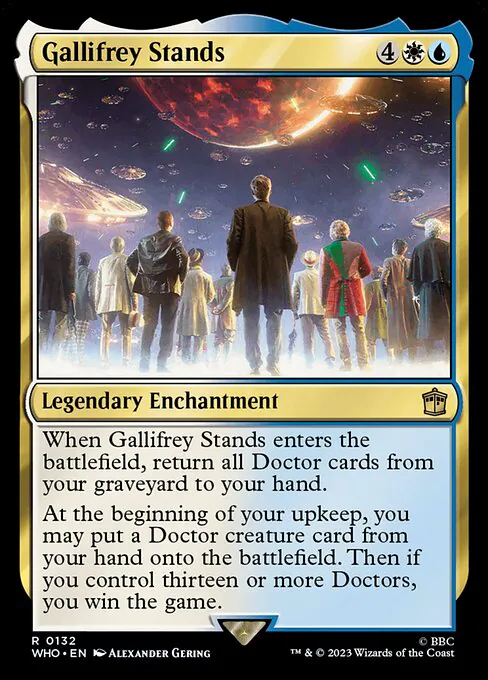 Gallifrey StandsSee it on collecto.rs
Thirteen Doctors on the battlefield wins the game on the spot. It is an absurd requirement on paper, demanding an upkeep trigger, a stocked board, and six decades of televised history gathered under your control. Yet Wizards printed it at rare, handing the entire expansion its thematic capstone on a single enchantment.
Alexander Gering illustrates the moment from the fiftieth anniversary special, capturing the gathering of TARDISes locking around their doomed homeworld. The mechanics follow the narrative beat with clean precision. When the card enters, every Doctor in your graveyard returns to your hand. Each turn after that, another slips directly onto the board for free. Where Displaced Dinosaurs brute-forces a victory by turning every utility relic into an immediate seven-power trampler, Gallifrey Stands asks you to assemble a living narrative across dozens of turns. It trades raw combat pressure for pure thematic payoff.
Building around this card is an exercise in genuine patience. You need Changeling spells, clone effects, or the sheer audacity of running fifteen distinct incarnations in a single ninety-nine-card deck. Most alternate win conditions in Magic feel clinical, asking for a count of counters or an empty library. This one asks for a family reunion. Your opponents see it coming from turns away, giving them ample time to find an answer, which only makes pulling it off feel earned. It binds the entire Universes Beyond release together by rewarding you for collecting the universe in full, turning an impossible television sequence into a tabletop reality. If you sleeve up the set with any intention of honouring what made the collaboration work, this is the card that belongs at the centre of your table.
Adapting sixty years of television requires a point of view. A careless approach would have leaned on nostalgia alone, leaning on recognizable faces without building the mechanical framework to support them. Instead, the design team matched the peculiar rhythms of the television series to the rulebook.
Time travel in Magic usually means taking extra turns. Here, it meant manipulating the wait, pulling resources from outside your hand, and turning mechanical delay into board advantage. The cards work because they demand you play differently. When a deck asks you to track suspended spells, paradox triggers, and historical card types simultaneously, it pulls you into the cadence of the fiction without breaking the engine of the game.
Whether these cards anchor your favorite Commander deck or fill out a dedicated binder project, they hold their own. You can track your variants, foiling options, and deck inclusions on collecto.rs, where your collection stays cataloged, organized, and entirely exportable.
Frequently asked questions#
Are Magic: The Gathering Doctor Who cards legal in Commander?#
Yes. Every card printed in the Doctor Who release is legal in Commander, Legacy, and Vintage formats. They are not legal in Standard, Pioneer, or Modern unless a specific card was already legal through a prior printing in those sets.
Can Doctor Who cards be played with regular Magic cards?#
Yes. Universes Beyond releases use the standard Magic: The Gathering card frame and back. All Doctor Who cards use standard Magic rules and timing windows. You can shuffle them into any Commander deck with traditional fantasy cards without special accommodations.
What makes the Doctor Who set distinct mechanically?#
The set leaned heavily into time counters, suspend, sagas, and the paradox mechanic, which triggers whenever you cast spells from zones other than your hand. It also introduced Doctor's companion, a variant of the partner mechanic that pairs specific characters with any Doctor.