The short version#
The hardest cards to track down are defined by structural scarcity rather than sheer market hype, living in odd subsets, promotional anomalies, and historic misprints.
- Ancestral Recall
- Shy Town
- Ophiomancer
- Squee, the Immortal
- Thrumming Hivepool
- Simic Signet
- Order of the Ebon Hand
- Breeding Pool
- Hallowed Fountain
- Dust Bowl
Scarcity in Magic: The Gathering usually gets reduced to price. A card shows up on a tournament stream, a buyer clears out the available copies online, and by morning the market decides it is rare. But price measures demand, not presence. The cards that take years to track down are rarely the ones dominating the top tables on Sunday. They are the ones that slipped through the cracks of how cards get printed, distributed, and owned.
Structural scarcity is different from market hype. It belongs to the odd subsets, the promotional experiments that went nowhere, and the print runs intended for a single room in a specific city. A card might have a total population of a few hundred copies simply because it was included in a box set sold exclusively to attendees at a tournament in 1996, or because a foil process turned an entire batch into something unplayable out of the pack.
When you look for these cards, the standard avenues tend to fail. Marketplaces list them as out of stock indefinitely. Trade binders at your local shop do not have them because the people who own them rarely trade them. Finding one usually means knowing someone who held onto a weird piece of product from a decade ago, or watching forum threads for a collector liquidating a niche binder.
This list is not about the Power Nine or the latest foil serialized drop. It is about ten cards that are genuinely hard to acquire because of where they came from and how few exist in the wild. Some are misprints that survived quality control. Others were distributed in ways that made sense on paper but left almost no footprint in the actual market. If you are building a set around any of these, prepare to be patient.
| # | Item | Set / Year | Rarity |
|---|---|---|---|
| 1 | Ancestral Recall | Intl. Collectors' Edition | rare |
| 2 | Shy Town | Black Lotus Unknown Planechase | common |
| 3 | Ophiomancer | Commander Collection: Black | rare |
| 4 | Squee, the Immortal | Dominaria Promos | rare |
| 5 | Thrumming Hivepool | Edge of Eternities Promos | rare |
| 6 | Simic Signet | Secret Lair Drop | rare |
| 7 | Order of the Ebon Hand | Pro Tour Collector Set | common |
| 8 | Breeding Pool | Zendikar Expeditions | mythic |
| 9 | Hallowed Fountain | Zendikar Expeditions | mythic |
| 10 | Dust Bowl | Zendikar Expeditions | mythic |
10. Dust Bowl (Zendikar Expeditions)#
 Dust BowlSee it on collecto.rs
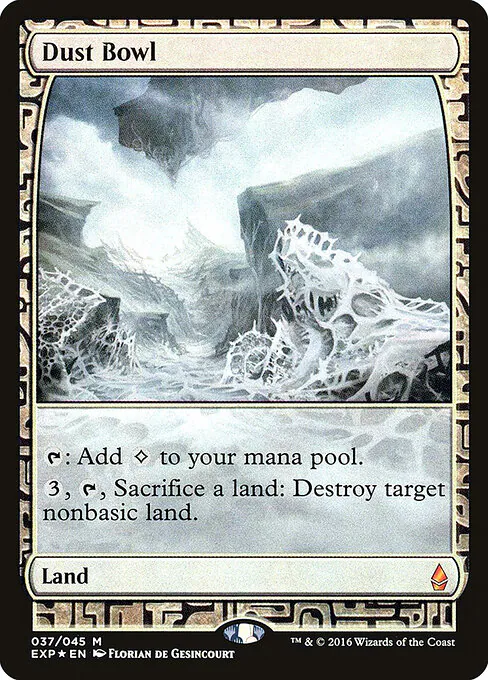
One in 144 packs. That was the estimated math when Zendikar Expeditions debuted in 2015, introducing the Masterpiece Series to Magic: The Gathering. Opening a box of Battle for Zendikar yielded no guarantees. You could draft a full case and never see a foil, full-art land with that distinct copper-trimmed frame. Dust Bowl sits at the intersection of that structural shift and four lines of rules text designed to break mana bases.
The card itself carries history from the Mercadian Masques block, where nonbasic land destruction was a necessity. Florian de Gesincourt took that original utility and set it against the jagged, floating hedron landscapes of Zendikar. The rules text remains simple. Tap it for colourless mana. Pay three, tap it, and sacrifice a land to destroy any target nonbasic land. In formats where players construct manabases out of fetchlands and duals, a reusable land-destruction engine sitting in a land slot shifts the pace of a match instantly.
While cards like Hallowed Fountain from the same set drew immediate attention for their role in fix-heavy tournament decks, Dust Bowl represents a different kind of scarcity. Hallowed Fountain filled a demand created by aggressive mana curves across multiple formats. Dust Bowl, by contrast, relies almost entirely on its structural odds and specific utility. It was printed as a mythic rare within a sub-category that was already rarer than the conventional mythic slot. You could not plan to open one. You bought cases and hoped, or you traded with the one player at the local shop who managed to pull it from a prize pack. It established the modern blueprint for foil-only inserts, proving that manufactured scarcity could create genuine, lasting friction for completionists.
9. Hallowed Fountain (Zendikar Expeditions)#
 Hallowed FountainSee it on collecto.rs
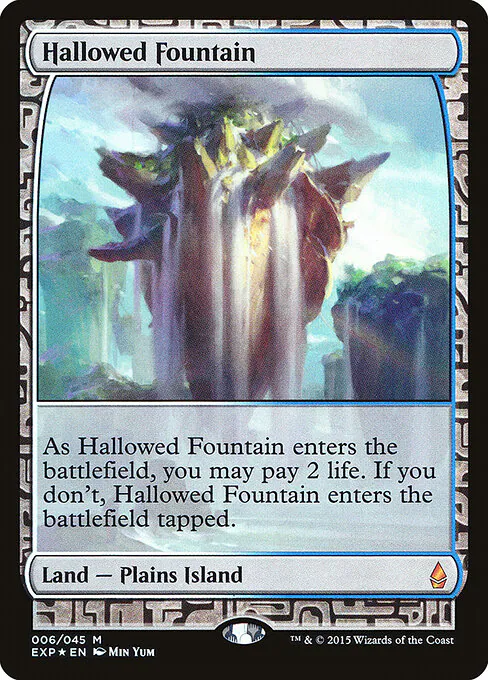
You can find a copy of Hallowed Fountain for a few dollars if you just need the card text for a deck on Friday night. Finding Min Yum’s full-art masterpiece version from Zendikar Expeditions is a different project entirely. Magic players call these dual-type lands fixing, but collectors know them as the foundation of the modern game’s economy.
When Wizards of the Coast put these foil-only inserts into Battle for Zendikar packs, they set a new baseline for pull-rate scarcity. Opening a specific Expedition meant cracking roughly twenty-one booster boxes. That math makes it significantly harder to pull than its cycle neighbour, Dust Bowl, which shared the same mythic slot but did not carry the same heavy demand from players who actually play the game. Hallowed Fountain sits right at the intersection where tournament viability meets deliberate manufacturing limits.
The land gives you a choice when it enters: pay two life to use it immediately, or let it enter tapped. That decision point has been a staple of competitive play since the original Ravnica block. Putting that exact game effect into an edge-to-edge frame with a dedicated foil treatment changed the card from a standard utility piece into a permanent fixture of high-end binders.
Cards like this rarely stay on the open market for long. Once a player finishes a set of four for a blue-white deck, those copies tend to stay locked in that deck for years. The supply does not shrink because the cards are destroyed; it shrinks because the people who buy them actually use them. If you hold one of these, log the condition and set details in your catalog so you have an accurate record of the precise printing.
8. Breeding Pool (Zendikar Expeditions)#
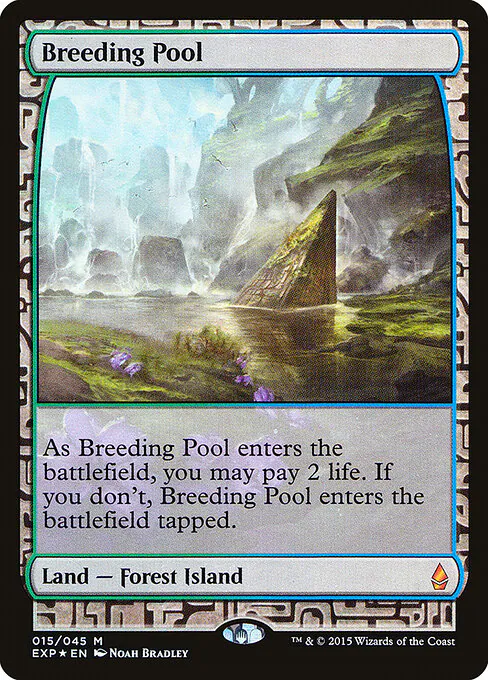 Breeding PoolSee it on collecto.rs
You crack a foil pack of Battle for Zendikar, slide past the commons, and spot a full-art frame glowing back at you. That specific moment happened in roughly one out of every 132 packs. Hitting a dual land you actually needed for a deck happened even less often.
Breeding Pool provides green and blue mana, the foundation for some of the most consistent strategies in competitive formats. Players need four copies, not one. When Zendikar Expeditions arrived in 2015, it put those essential game effects into a foil-only, borderless treatment featuring art by Noah Bradley. Collectors and players grabbed them immediately. Most of those copies went straight into double-sleeved Commander decks and stayed there.
Unlike the boxed distribution of Order of the Ebon Hand, these shock lands were hidden inside standard booster boxes as ultra-rare masterpieces. They were never printed in a dedicated set of their own. You could open three sealed cases of Battle for Zendikar and miss this specific land entirely. The combination of high utility at the table and a brutal pull rate created a permanent supply squeeze.
Today, finding a clean copy means convincing someone to take apart a working deck or part with a binder page they built a decade ago. The card text is simple: pay two life, or the land enters tapped. Paying that cost on turn one often decides a match. The foil glass-frame treatment makes it look like an artifact from another era of the game.
If you have one in a binder, it probably took several trades or a very lucky pack to get it there. Log it in your collection with the exact set code and foil condition, so you always know where your mana base stands.
7. Order of the Ebon Hand (Pro Tour Collector Set)#
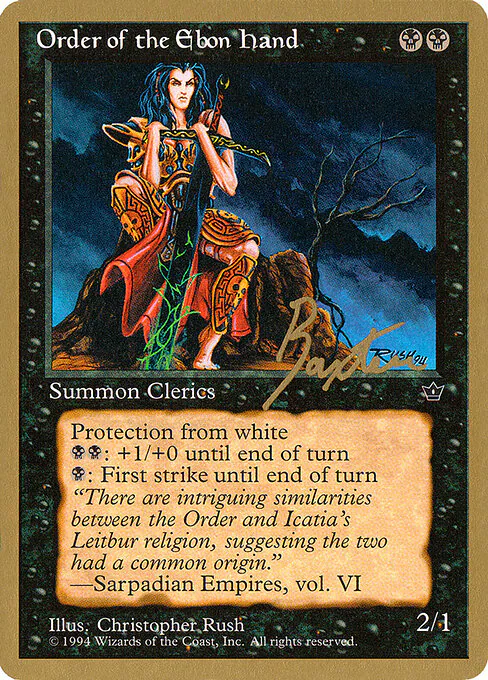 Order of the Ebon HandSee it on collecto.rs
A player at Pro Tour New York in 1996 opened a wooden box, pulled out a complete set of decks from the top tables, and realized none of the cards had standard Magic backs. They were printed with gold borders and a tournament branding stamp. The set was meant as a souvenir of a competitive milestone, not a booster product meant for drafting or standard play.
That distribution model created a unique scarcity. Order of the Ebon Hand was a common in Fallen Empires, printed by the millions. You can still buy original booster packs for less than a cup of coffee. The Pro Tour Collector Set version is a different story. Because the set was sold as a single complete boxed package with a limited print run, no additional copies ever entered the market through traditional pack cracking. You could not chase one in a draft. Either you owned the box, or you traded with someone who was willing to break theirs apart.
Unlike the Simic Signet entry on this list, where scarcity comes from modern print-to-order windows and specific art treatments, this card is hard to find because of a ninety-six distribution experiment that Wizards of the Coast never repeated in quite the same way. The gold borders meant these cards were illegal in sanctioned tournament play, so many sets were split up, discarded, or played unsleeved until the backs were ruined.
Christopher Rush provided the art for this print, depicting the knight in heavy armor against a bleak horizon. The card rules remain classic black-mana flexibility: protection from white, a single black mana for first strike, and two black mana for a power boost. Finding a pristine copy today means locating someone who kept a tournament souvenir intact for nearly thirty years.
6. Simic Signet (Secret Lair Drop)#
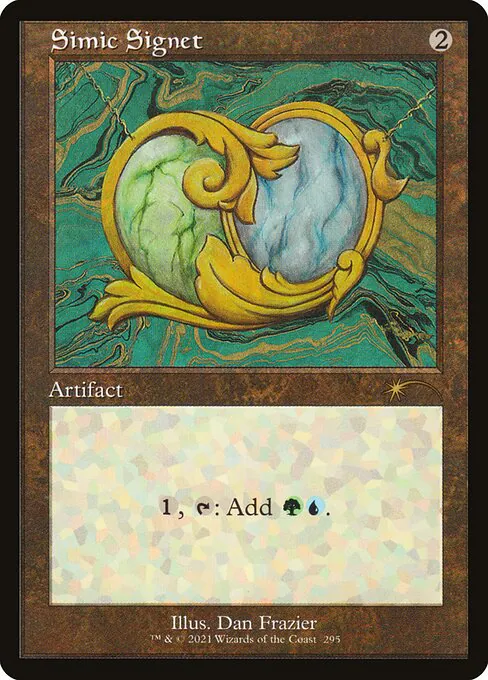 Simic SignetSee it on collecto.rs
What happens when a foundational format staple gets printed once, inside a window that closes in four days? You end up with a card that costs more time than money to track down.
Simic Signet is not an obscure card. Players put it in Commander decks every day to fix their mana and accelerate their turns. You can pick up an original print from Dissension for under a dollar. The Secret Lair Drop version illustrated by Dan Frazier is a completely different prospect. Wizards of the Coast offered it during a limited print-to-order window, decorated with classic retro frame treatment and Frazier's distinctive digital-meets-traditional shading. When the order window shut, the total supply was fixed forever.
Unlike the Order of the Ebon Hand from the 1996 World Championship decks, which sat in sealed retail boxes on store shelves for months, this Signet required you to actively purchase a specific online drop during a specific week. If you missed the notification, your only option was the secondary market. Buyers bought these drops to open and play, not to vault away in trade binders. That means the surviving pool of mint, unplayed copies is considerably smaller than the overall print run suggests.
Finding one now means searching through individual seller listings rather than browsing vendor booths at a weekend tournament. It sits in a strange corner of scarcity where the card text is common, but this specific physical object is genuinely hard to locate. If you are logging one in your collecto.rs catalog, the set name and artist credit matter just as much as the rules text.
5. Thrumming Hivepool (Edge of Eternities Promos)#
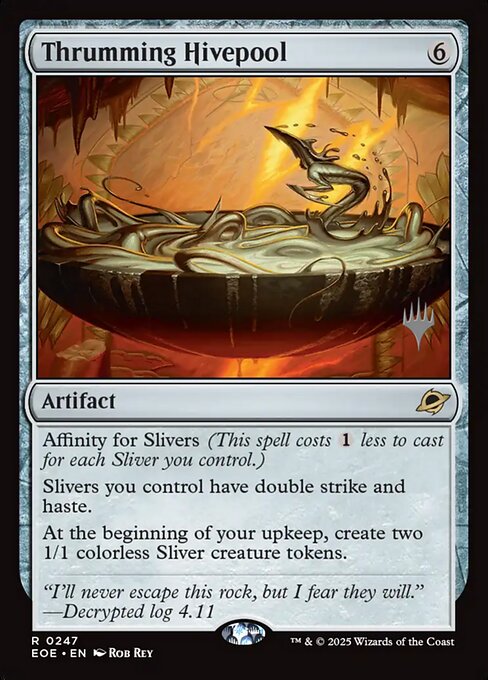 Thrumming HivepoolSee it on collecto.rs
You do not find Thrumming Hivepool in a booster pack, regardless of how many boxes you rip on release day. Standard retail shelves never saw this card. It skipped store inventories entirely, distributed through specific event allocations for the Edge of Eternities promos. When cards bypass the traditional pack-cracking supply line, the usual math around pull rates falls apart. Distribution shifts from factory output to human logistics: who showed up, which stores received their kits, and how many organisers left the leftover envelopes sitting in a back-room drawer.
That distribution model separates this card from Squee, the Immortal further down this list. Where Squee relies on store-level promotional allocations that scaled with weekly tournament turnout, Thrumming Hivepool sat behind a rigid event barrier. If a local shop missed its designated window or skipped the event entirely, its entire player base missed the allocation. No secondary shipments arrived to fill the gap.
Rob Rey painted a wide, churning swell of silver forms, capturing the unsettling momentum of the creature type. Textually, the card hits every historic marker a Sliver collector looks for. It grants double strike and haste to your board while generating two 1/1 colorless Sliver tokens on your upkeep. The affinity for Slivers clause reduces its casting cost for every creature already on your field. The flavor text reads, "I'll never escape this rock, but I fear they will." —Decrypted log 4.11.
If you hold a copy, catalog it under Edge of Eternities Promos with the rare indicator. collecto.rs lets you tag event-specific variants so your promo runs sit cleanly alongside standard set printings, with full CSV export available whenever you want to back up your data.
4. Squee, the Immortal (Dominaria Promos)#
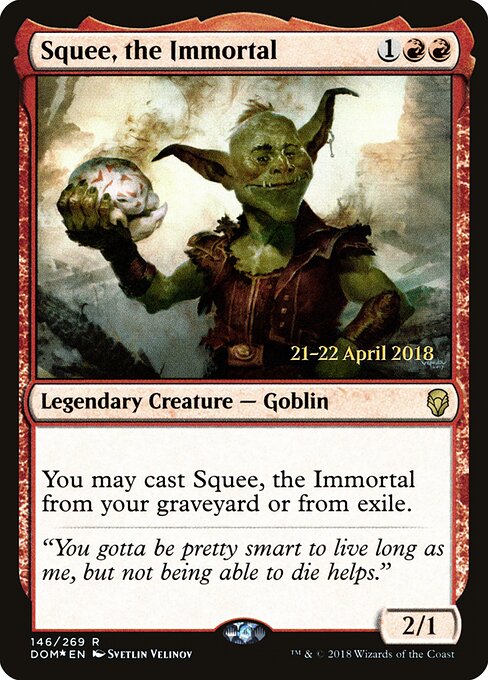 Squee, the ImmortalSee it on collecto.rs
One per store. That was the baseline allocation for this specific buy-a-box promo when Dominaria landed in local game shops in 2018. If a shop hosted a small Friday Night Magic crowd, they received a single copy to hand across the counter. Larger shops got a few more, but the total supply was tied directly to local foot traffic rather than printer capacity. Unlike Ophiomancer, which entered the market inside every Commander 2013 box shipped to retail shelves, Squee bypassed big-box distributors entirely.
Svetlin Velinov painted the art for this rare, capturing a goblin who simply refuses to stay buried. His mechanical text matches that stubbornness: you may cast this card from your graveyard or from exile. The flavor text dryly notes that you gotta be pretty smart to live long, but not being able to die helps. It is a flavor-forward card that players loved instantly, which created an immediate preservation problem.
Promos given to active players usually went straight into double-sleeved tournament decks or unsleeved casual piles. A card meant to be played hard rarely sits in a binder waiting for a collector. Finding a copy that survived the weekend without edge wear is harder than finding one in a local store's display case on release day. Most of them spent six months sliding across damp playmats before anyone thought to preserve them.
If you have one sitting in a top loader, add it to your collecto.rs account under Dominaria Promos. You can tag the condition, note whether it came from your local shop's counter, and export your entire card inventory to a CSV file whenever you want.
3. Ophiomancer (Commander Collection: Black)#
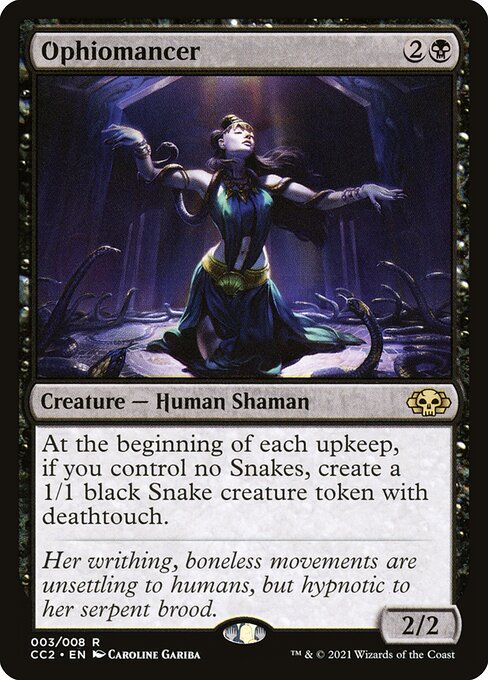 OphiomancerSee it on collecto.rs
Most scarce Magic cards owe their rarity to old age or bad distribution. Ophiomancer is different. Wizards of the Coast printed it in 2013, then locked it inside a single boxed set seven years later. If you wanted a copy from Commander Collection: Black, you bought the entire box from a local game store during a short retail window. You could not pull it from a booster pack. You could not find it in a regular draft box. That distribution choice created a quiet supply bottleneck for a card every mono-black Commander deck wants to run.
Caroline Gariba's art for this printing captures the core engine. At the start of every upkeep, if you do not have a Snake, you get a 1/1 black Snake token with deathtouch. It gives you immediate board presence that deters attackers and provides endless sacrifice fodder. That utility keeps the card tucked away in personal binders rather than trade folders.
Promotional cards like Squee, the Immortal rely on store event turnout to filter into the market, but boxed releases face a different hurdle. Once the initial allocation leaves shop shelves, supply freezes entirely. No second print run arrives to soften the demand. The foil version from the premium box edition is even harder to track down down, as stores received far fewer of those units.
When you track down a copy for your binder, keeping track of specific printings matters. You can log your Ophiomancer in your collecto.rs account under Commander Collection: Black, tag the foil finish, and keep your inventory current alongside the rest of your Commander staples.
2. Shy Town (Black Lotus Unknown Planechase)#
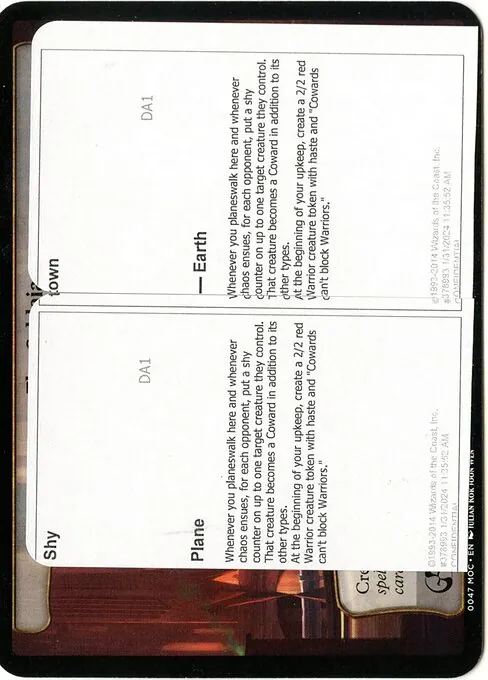 Shy TownSee it on collecto.rs
A sheets-and-cutters error in 2021 pushed a handful of test-frame oversized cards into the wild before anyone on the production line caught it. They were never meant to leave the building. Instead, a few slipped past quality control inside factory-sealed Planechase bundles, printed on thin stock with blank backs and internal layout text intact. Shy Town is the stranger of those mistakes.
Unlike Ancestral Recall, where Wizards of the Coast printed a known quantity for a commercial set and called it a day, Shy Town exists in an gray zone. It is a plane card that gives opponents' creatures shy counters, turns them into Cowards, and sends haste-driven Warriors across the board every upkeep. The mechanic feels like a joke from an Un-set, but the physical card sits on the rigid test-frame layout Wizards uses to check font kerning and ink saturation before a full run.
That test frame is what makes it brutal to hunt down. Regular Planechase cards are already awkward to store. They do not fit in standard binder sleeves or deck boxes, so people tossed them into closet bins or left them behind at game stores. A misprinted test card in that oversized format had almost zero chance of surviving twenty minutes, let alone twenty years. Most went straight into the trash when players realized they could not use them in a sanctioned match.
Finding one now requires digging through estate lots, unsorted playmats, and oversized binder pages that collectors forgot they owned. It is not just hard to find because the print run was tiny. It is hard to find because almost nobody knew to keep it.
1. Ancestral Recall (Intl. Collectors' Edition)#
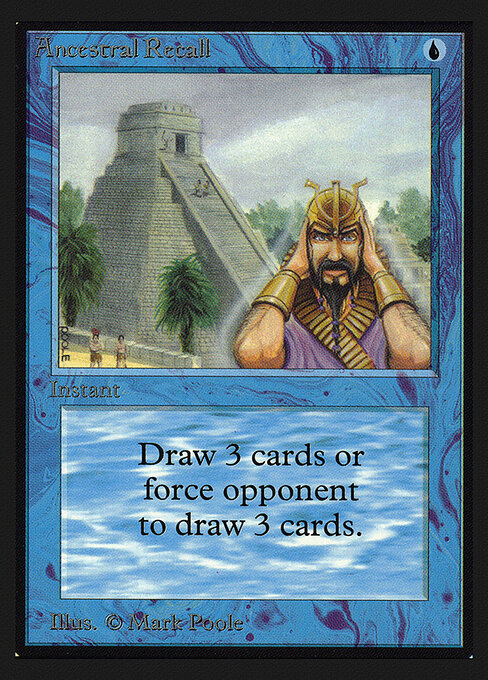 Ancestral RecallSee it on collecto.rs
A player opens a sleek black box in late 1993, lifts out a gold-bordered card, and realizes it cannot legally sit in a tournament deck. Wizards of the Coast printed these sets for collectors and stores to hold as reference sets. They featured sharp square corners and a distinct gold back. Most were opened, split up, or lost to draft nights where players clipped the corners with fingernail clippers to slip them into sleeves.
That makes this version of Ancestral Recall a strange, absolute physical wall. While test-frame releases like Shy Town pushed scarcity through tiny experimental print runs, this release locked a fixed number into existence on a single day and never revisited it. Once those boxes were opened and modified, the pool of pristine copies shrank forever.
Mark Poole drafted the artwork for one of the most efficient spells ever printed. The card text is deceptively simple: target player draws three cards. For a single blue mana, that effect breaks the math of any game it enters. In Alpha or Beta, the card commands five-figure sums because of its power in early competitive play. In this release, the card attracts a different kind of obsession.
You cannot pull this card from a booster pack. You cannot find it by hunting through dusty bulk bins at a local store. It exists only because a specific product left the factory floor with a strict ceiling on its production run. Finding an untouched copy with clean square corners intact means finding a piece of the game's history that survived decades of deliberate destruction. It sits at the top of this list because its scarcity is not a matter of luck or market trends. It is a matter of simple arithmetic.
Tracking down cards like these changes how you interact with the game. You stop checking standard marketplace inventory every morning and start talking to specific people who remember when a particular set landed. You learn which regional events had poor turnout, which promo boxes were damaged in transit, and which print runs had anomalous foil layers. The search becomes less about spending power and more about persistence.
That persistence is the point. When a card is hard to find because of its history rather than its place in a competitive deck, owning it feels different. It marks a specific moment in the game’s physical manufacturing, preserved because someone decided to keep it in a sleeve instead of tossing it into a bulk box.
If your collection relies on tracking oddities, misprints, or obscure promotional sets, keeping those details organized matters. You can catalog your binder, document rare variants, and keep your data exportable over at collecto.rs.
Frequently asked questions#
What makes a Magic card genuinely hard to find?#
Genuinely scarce cards come from limited distribution channels, non-standard print runs, or specific historical contexts rather than simple secondary market demand. While many rare game pieces are easy to buy if you have the funds, structurally scarce cards rarely surface for sale regardless of budget.
Are test prints and promotional variants harder to find than regular set cards?#
Yes. Regular booster set cards, even mythic rares, are printed in massive quantities. Promotional variants, regional releases, and historical inserts like International Collectors' Edition prints had set allocation numbers from day one, meaning their maximum existing pool is fixed forever.
How do you track down hyper-scarce individual cards?#
Tracking ultra-scarce cards usually requires monitoring specialist collector communities, regional auction houses, and private trade networks. Many of these items never reach standard public inventory lists on primary retail platforms.