The short version#
The List functions as Magic's curated historical archive inside modern packs, pairing classic art and rules text with a tiny Planeswalker stamp in the lower left corner.
- Ancient Tomb
- Elbrus, the Binding Blade // Withengar Unbound
- Eternal Witness
- Aboleth Spawn
- Mindslaver
- Gisela, Blade of Goldnight
- Geth's Grimoire
- Deathcoil Wurm
- Dune-Brood Nephilim
- Bubbling Muck
Cracking a modern booster pack usually means looking for the set's flagship mechanics, the newest art treatments, and whatever rare is currently driving constructed formats. But starting with Zendikar Rising, Wizards of the Coast introduced a subtle curveball. Tucked into the token slot of select packs was a card from a rotating pool of three hundred reprints known simply as The List. These are not functional redesigns or full-art updates. They are exact historical prints, complete with their original set symbols, frame styles, and expansion iconography. The only difference is a tiny, white Planeswalker symbol stamped into the lower left corner.
That small stamp transforms how these cards sit in a collection. It bridges the gap between old-border nostalgia and modern foil-etched reality. You might open a pack from a set released last month and find a common from Urza's Destiny or a commander staple from Fifth Dawn. The List operates like a roving historical archive embedded directly inside current sealed product. It pulls cards out of obscure side expansions, forgotten core sets, and long-out-of-print Commander decks, dropping them back into circulation without altering the original presentation.
For anyone building a binder around specific artists, mechanical oddities, or historical frames, The List is a quiet goldmine. It preserves the original layout, the classic typesetting, and the original rules text—even when that text has since been updated in the official rules database. It treats the physical history of the game as something worth holding onto as it was, rather than constantly updating it to match current design standards.
Here are ten cards from The List that best show what makes this reprint strategy so interesting: forgotten commons, mechanical anomalies, and pieces of original art that still hold up decades later.
| # | Item | Set / Year | Rarity |
|---|---|---|---|
| 1 | Ancient Tomb | The List | uncommon |
| 2 | Elbrus, the Binding Blade // Withengar Unbound | The List | mythic |
| 3 | Eternal Witness | The List | uncommon |
| 4 | Aboleth Spawn | The List | rare |
| 5 | Mindslaver | The List | rare |
| 6 | Gisela, Blade of Goldnight | The List | mythic |
| 7 | Geth's Grimoire | The List | uncommon |
| 8 | Deathcoil Wurm | The List | rare |
| 9 | Dune-Brood Nephilim | The List | rare |
| 10 | Bubbling Muck | The List | common |
10. Bubbling Muck#
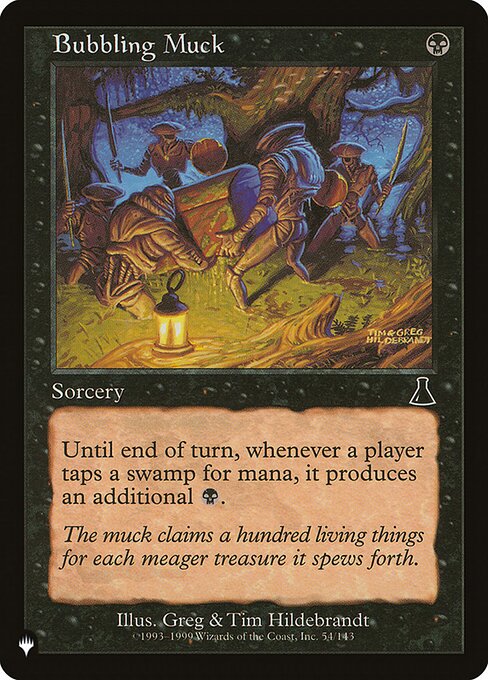 Bubbling MuckSee it on collecto.rs
Black decks usually pay life to gain mana advantage. Bubbling Muck asks for a single swamp instead, doubling the output of every swamp you tap for the rest of the turn. It is the color-shifted cousin of High Tide, swapping blue's island reliance for a burst of dark acceleration that can end a game on turn four. Greg and Tim Hildebrandt's art leans into that trade-off, showing a murky bog swallowing everything in sight to yield a tiny handful of glowing treasure.
While four-color oddities like Dune-Brood Nephilim earn their spot on The List through weird mechanical identity, Bubbling Muck sits here for a simpler reason. It represents pure, functional deck-building history. The card was originally printed in Urza's Destiny at common, meaning it shaped kitchen-table formats and early tournament builds alike. Getting a fresh copy through The List keeps a foundational mana engine accessible without altering its original rules text or rarity.
That preservation matters for how people construct black commander decks today. You do not need an expensive reserved list artifact when a humble common turns five basic swamps into ten black mana. The List excels at dropping these historical utility pieces back into circulation, complete with their original planeswalker symbol stamped in the lower left corner.
Keeping track of these functional prints is where a clean catalog helps. When you log Bubbling Muck in collecto.rs, you can tag the specific List print alongside your original Urza's Destiny copies, keeping your deck lists accurate and your inventory exportable whenever you want to move cards between builds.
9. Dune-Brood Nephilim#
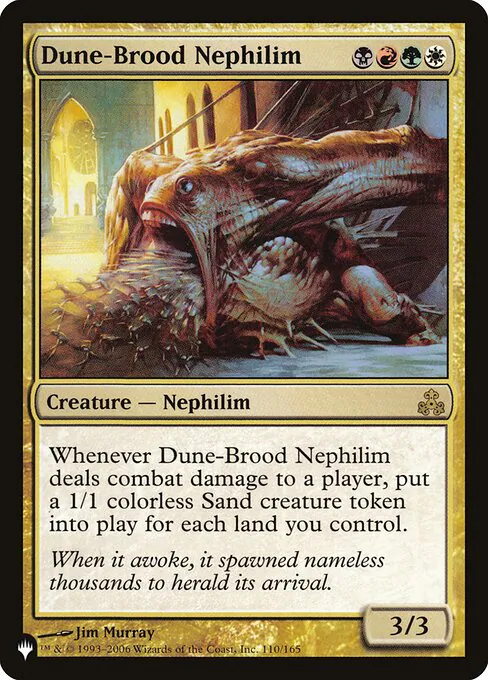 Dune-Brood NephilimSee it on collecto.rs
You tap four lands of four different colors and slide a card onto the mat that looks like an accounting error from 2006. Your opponent pauses to read it. They read it a second time. That quiet pause is why four-color Nephilim cards exist on The List.
Dune-Brood Nephilim belongs to a five-card cycle from Guildpact that stood alone for a decade. Before Commanders was a official format, four-color cards were a mechanical dead end. Magic design avoided them because combining four colors usually meant losing a set's identity. Guildpact printed them anyway. Dune-Brood turns combat damage into a Sand token for every land you control. Connect once with eight lands out, and you suddenly control nine creatures. Jim Murray’s artwork leans into that absurdity, framing a sprawling monstrosity that looks entirely detached from traditional creature design.
That oddness is what makes its presence on The List matter. While cards like Deathcoil Wurm show how creature stats and mana costs used to scale in a simpler era, Dune-Brood Nephilim shows how experimental the game got when designers pushed against structural limits. A card like Deathcoil Wurm asks for seven mana to hit hard. Dune-Brood asks for four specific mana symbols and an open defender, then multiplies your board state instantly.
Niche cards from awkward historical cycles often get buried when sets rotate out of print. They do not fit into standard set reprints because they demand specific mana bases or token support that the rest of the set lacks. The List bypasses those drafting constraints entirely. It acts as a permanent museum for design experiments that deserve to stay in circulation. If you log Dune-Brood Nephilim in your collecto.rs catalog, it tracks right alongside your classic mana rocks and modern staples, keeping the odd history of four-color design visible in your collection.
8. Deathcoil Wurm#
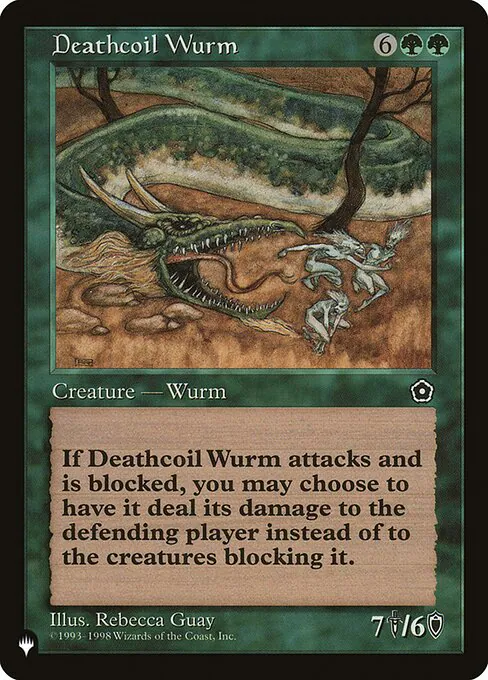 Deathcoil WurmSee it on collecto.rs
Eight mana gets you a 6/6 creature. In 1999, Portal Second Age asked for that entire investment, handed you a giant snake, and called it a day. Today, an eight-drop creature usually comes with three paragraphs of text, triggers a board wipe on entry, and probably draws you five cards just for casting it. Deathcoil Wurm belongs to an era when big meant big, and the rules stayed out of the way.
Its single rule is a good one. You may have Deathcoil Wurm assign its combat damage as though it were not blocked. That bypasses whatever chump blockers your opponent throws in front of it and puts six damage straight into their life total. It is simple, heavy, and direct. Where a card like Geth's Grimoire relies on an entire engine of discard effects to generate value over four turns, this Wurm turns eight lands into an immediate timer. You do not need to build around it. You just need to tap your lands and attack.
What makes this printing on The List interesting is the art. Portal Second Age used a minimalist card layout that gave illustrators a wider canvas, and Rebecca Guay filled it with delicate line work and soft watercolours. Putting her distinct, ethereal style on an eight-mana monster creates a contrast you rarely see on modern threat cards. The List retains that original frame and artwork, complete with the subtle planeswalker symbol stamped in the bottom-left corner.
Placing Deathcoil Wurm in your binder next to modern creatures gives you a clear look at how threat design has changed. It is a snapshot from a time when combat damage went through, creatures were straightforward, and a rare card could be simple without being weak.
7. Geth's Grimoire#
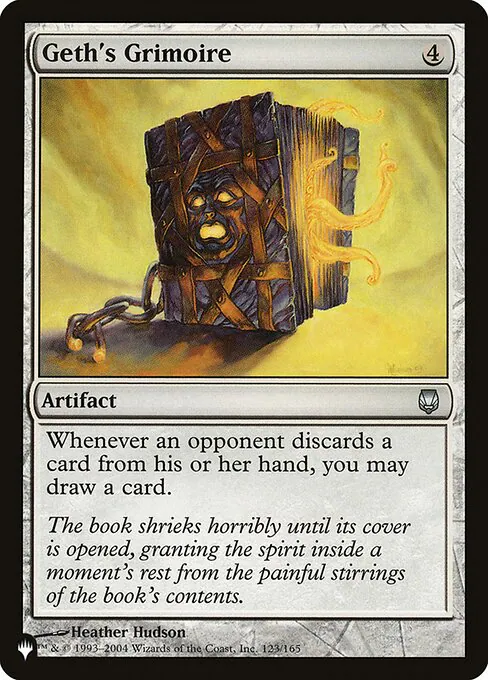 Geth's GrimoireSee it on collecto.rs
Have you ever built a deck around an artifact that makes everyone else at the table uncomfortable? Geth's Grimoire belongs to that exact family. Originally printed in Darksteel, this uncommon artifact carries a simple triggered ability: whenever an opponent discards a card, you may draw a card. In a four-player game, an innocent wheel effect or a modest discard spell suddenly turns into a massive draw engine for four mana.
That interaction is precisely why its inclusion in The List matters. Older blocks were full of specialized utility pieces that flew under the radar in two-player constructed formats. When multiplayer Commander became the dominant way people gather to play, cards like this gained an entirely new context. Reprinting it through The List puts a dedicated synergy piece back into circulation without requiring a full main-set slot.
It sits in an interesting position compared to a raw stat monster like Deathcoil Wurm. Where the Wurm shows how simple creature power used to be priced, the Grimoire shows how game engines have aged. A big Wurm eventually gets blocked or removed. A quiet artifact that turns your opponents' empty hands into your full hand tends to run away with the game if left alone for two turns.
Heather Hudson's illustration captures the strange, visceral tone of the original Mirrodin block. The dark aesthetic fits the flavor text, which describes a book that shrieks until someone opens it to give the trapped spirit a brief pause from its contents. It is a specific, eerie piece of fiction attached to an uncommon card. If you are cataloging a Commander collection, pieces like this show how deep the game's mechanical history actually runs.
6. Gisela, Blade of Goldnight#
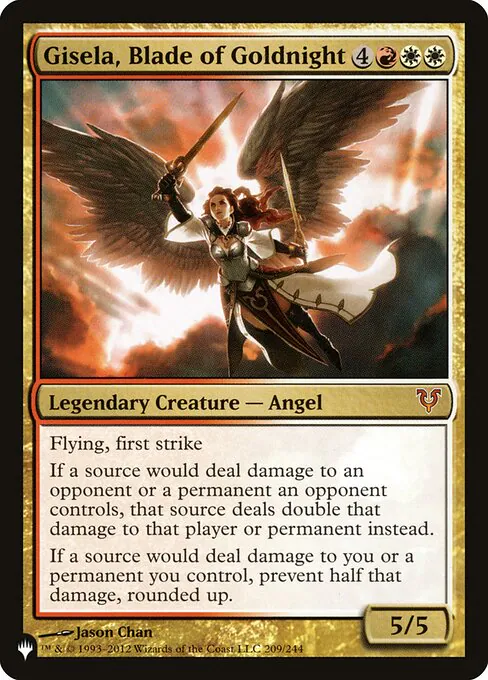 Gisela, Blade of GoldnightSee it on collecto.rs
You do not cast Gisela for subtle board state management. The List brings back plenty of cards that slowly pull you ahead, like Geth's Grimoire building card advantage over six turns of discarded cards. This is not one of those. You cast Gisela to rewrite the math at the table the moment she touches the mat.
Jason Chan's art captures her suspended in gold light, four wings spread, sword drawn. The stats back up the image. Seven mana gives you a flying, first-strike 5/5 angel that fundamentally breaks combat rules for everyone else in the game. Any damage coming toward your opponents or their permanents doubles instantly. Any damage headed your way drops by half, rounded up. A lightning bolt hitting your opponent deals six damage. That same bolt hitting your face deals one.
Mythic commanders from Avacyn Restored carried a specific kind of raw, unvarnished power. They were built for tables where people wanted big, swingy legendary creatures that did not require a five-card combo to change a game. When Wizards pulled Gisela into The List, they preserved that exact era of design. She turns every creature you control into a lethal threat while turning your opponent's best attackers into minor inconveniences.
That asymmetry makes her an anchor for red and white Commander builds. You drop her when the board is crowded, and suddenly every single block becomes a disaster for the rest of the table. If you are tracking your physical prints of The List, Gisela sits in that sweet spot of high-impact mythics that remind you why curated reprint sets exist in the first place.
5. Mindslaver#
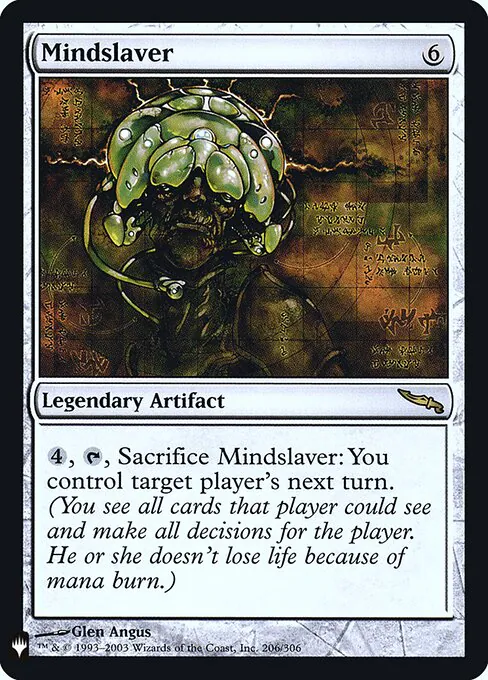 MindslaverSee it on collecto.rs
Someone across the table cracks a fetchland, untaps their lands, and passes you their hand. For one turn, you are playing two decks at once. You tap their mana inefficiently, cast their best removal spell targeting their own creature, and swing their commander into a bad block. Mindslaver does not just change the board state. It temporarily removes the other player from the game while their cards stay on the mat.
Glen Angus captured that loss of agency in the original Mirrodin art, showing a bronze helmet wiring directly into a metallic skull. When it printed in 2003, four mana to cast and four to activate felt like a heavy investment. Early artifact design often traded efficiency for absurdly large mechanics that disrupted the fundamental rules of play. The List brings that exact disruption back into rotation without forcing you to hunt down original Mirrodin boosters.
That willingness to break the game's core structure makes it a very different pull than Gisela, Blade of Goldnight. Where Gisela speeds up a game through sheer numbers and double damage, Mindslaver turns the match into a psychological puzzle. You are not just dealing damage. You are using an opponent's own win conditions against them.
The List works best when it surfaces cards that alter how a table operates. Mindslaver requires four mana to deploy, four to crack, and a complete understanding of whatever deck your opponent is running. If you keep a physical record of your MTG collection on collecto.rs, you can tag your List printings alongside your original Mirrodin block cards to track how these iconic artifact designs have shifted over twenty years.
4. Aboleth Spawn#
 Aboleth SpawnSee it on collecto.rs
Your opponent casts a creature, smiles, and begins reading a wall of text off the card to explain how they are about to draw four cards and destroy your best permanent. You pay two mana, flash in a fish with tentacled tendrils across Sam Burley's dark underwater art, and steal that entire paragraph for yourself. That is the quiet terror of Aboleth Spawn.
First printed in Commander Legends: Battle for Baldur's Gate, this rare creature represents the specific utility that makes Commander-focused additions to The List so effective. It does not wait for your turn. It sits in your hand until an opponent attempts a massive enter-the-battlefield trigger, then copies that ability while forcing them to pay two extra mana just to target your counter-play. In a multiplayer format built around absurd, game-ending creature triggers, Probing Telepathy turns an opponent's momentum directly against them.
While Mindslaver relies on massive mana costs to take over an opponent's turn through raw artifact force, Aboleth Spawn operates on tactical leverage for just three mana. It punishes greedy play without requiring you to build your entire deck around it. That subtle, highly specific defensive profile is why it earns a spot on The List. It gives players access to a creature that turns every opponent's best entry effect into shared real estate.
On collecto.rs, you can log your copy under The List, tag Sam Burley as the artist, and track your specific set printings alongside your other blue utility cards. If you ever decide to reorganize your commander binder or export your full collection to a spreadsheet, your entry data moves with you.
3. Eternal Witness#
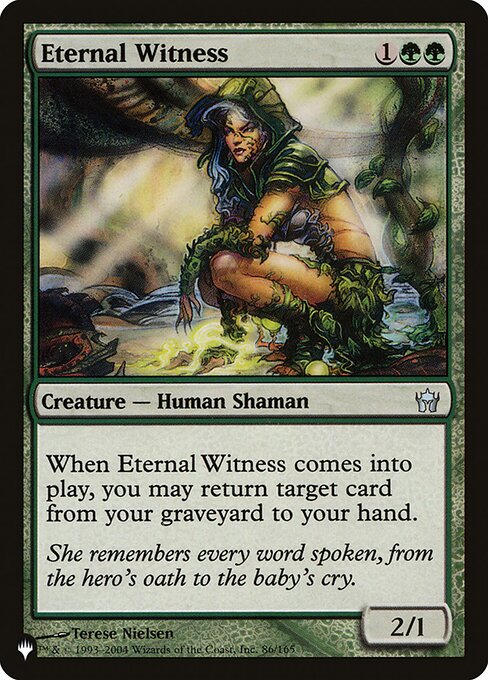 Eternal WitnessSee it on collecto.rs
A five-mana demon like Elbrus, the Binding Blade demands a deck built around its theatrical arrival. Eternal Witness costs three mana, arrives as a modest 2/1, and simply gets you back the best card in your graveyard. It lacks the dramatic flair of a flipping equipment, but it wins games by being useful every single time you cast it.
First printed in Fifth Dawn back in 2004, this card solved a perpetual problem for green decks. Green usually ramps mana or drops large creatures. Reclaiming any card type—a spell, a land, another creature—without restrictions was traditionally reserved for heavier black or blue costs. Eternal Witness put that recursion onto a cheap creature body. If you run ways to blink or bounce creatures, the effect repeats until your opponent runs out of answers.
That utility made it a staple across Modern, Commander, and Cube formats for two decades. Its inclusion on The List brings Terese Nielsen's original artwork back into circulation with the subtle planeswalker symbol tucked in the lower-left corner. The card text remains unchanged: when it enters the battlefield, you target a card in your graveyard and put it back into your hand. The flavor text still notes that she remembers every word spoken, from the hero's oath to the baby's cry.
Cards like this anchor a collection. Big flashy rares draw attention in a display binder, but functional uncommons carry the memory of actual play. If you are cataloging your Fifth Dawn originals alongside your List printings on collecto.rs, keeping track of different set symbols and frame styles helps show how a single piece of design survives twenty years of game evolution.
2. Elbrus, the Binding Blade // Withengar Unbound#
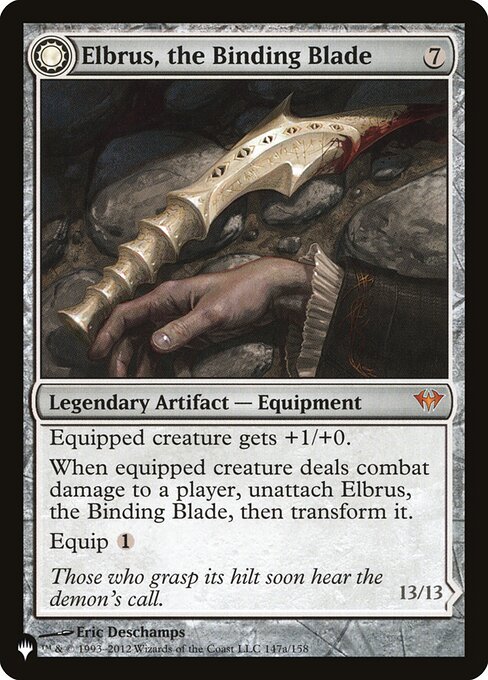 Elbrus, the Binding Blade // Withengar UnboundSee it on collecto.rs
Seven mana is a steep investment for a piece of Equipment that grants a paltry +1/+0. The math looks terrible until that equipped creature connects with a player's life total. Then the dagger flips, the colorless artifact vanishes, and Withengar Unbound enters the battlefield as a 13/13 legendary Demon with flying, trample, and intimidate. It also gains thirteen +1/+1 counters whenever a player loses the game. Eric Deschamps captured that transformation with twin illustrations that turn a single Dark Ascension card into a two-act play.
Double-faced cards were still a fresh mechanic when world designers built Innistrad. Elbrus showed how far creative teams could push the frame to tell a story through mechanics. Those who grasp its hilt soon hear the demon's call, and the card forces you to work for that payoff. You need a evasive creature to carry the blade, one mana to equip it, and a clear path to an opponent's face. The payoff is purely theatrical.
While Eternal Witness earned its place on this list by quietly fixing your graveyard every turn, Elbrus occupies the opposite end of design philosophy. It is loud, fragile, and absurdly ambitious. It exists because the game occasionally needs cards that turn a Commander pod into a monster movie. The List preserves these creative leaps alongside strict utility staples. Pulling this mythic from a booster pack reminds you that Magic design is at its best when it takes massive flavor risks.
1. Ancient Tomb#
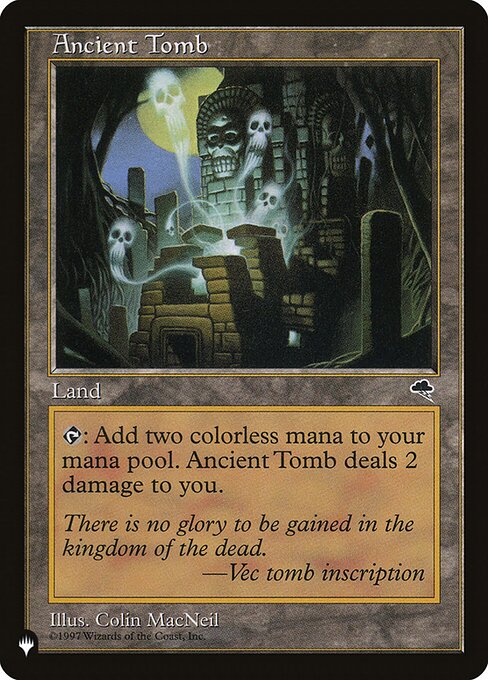 Ancient TombSee it on collecto.rs
How much life are you willing to trade for two turns of acceleration on move one? That choice defines Ancient Tomb, a land that turns your own life total into raw speed. It taps for two colorless mana at the cost of two damage to you every single time. Where Elbrus, the Binding Blade requires a theatrical setup to deliver its payoff, Ancient Tomb skips the theater entirely. It comes into play untapped, costs no mana to play, and changes the pace of the match before your opponent plays their first land.
That raw speed puts this card at the upper bound of what opening a List slot can yield. Magic history contains plenty of lands that produce extra mana, but few do it with this little friction. The drawback is immediate and real. Take six damage over three turns and you feel it, especially if the rest of the table notices what you are building. The flavor text from the original Tempest printing frames the bargain plainly: there is no glory to be gained in the kingdom of the dead. Colin MacNeil’s art captures that bleakness, presenting a quiet, cavernous stone threshold that belies the explosive starts the card enables.
Within the structure of The List, Ancient Tomb serves as a reminder of how wildly power profiles have shifted across the decades. It sits at uncommon in this iteration, carrying the small white planeswalker symbol in the lower left corner that marks its origin. You pull it, sleeve it, and suddenly your deck operates on a completely different curve. If you keep track of your pulls on collecto.rs, logging a card like this gives you a clean record of your high-impact printings alongside the rest of your set.
The List works because it respects the physical history of the game. It does not try to modernize a frame from 1999 or adjust a mana symbol to fit current brand guidelines. It simply reproduces the card as it existed when it first left the factory, adding just enough of a mark to show where it came from this time around.
That approach makes these versions distinct objects in their own right. A original Planeshift printing tells one story about where your collection was at a specific point in time. A List re-print of that same card tells a different one—about opening a current booster pack and hitting a specific piece of the game's past instead of a modern foil draft common. Both versions have a place in a binder, depending on how you build.
If you collect these stamped reprints, or keep a separate archive of original-frame printings as they circulate back into modern sets, collecto.rs gives you a clean place to track them. You can catalog every card in your collection by its exact printing, mark the specific set symbol, and keep your data organized without clutter. Your binder stays sorted, and your data remains yours to export whenever you want.
Frequently asked questions#
What is The List in Magic: The Gathering?#
The List is a rotating stock of cards from throughout Magic history that Wizards of the Coast inserts into Set Boosters and Play Boosters. Printed with their original frame and art, cards from The List are distinguished by a small Planeswalker symbol printed in the lower-left corner.
How do you identify a card from The List?#
Look at the bottom left corner of the card. A card from The List uses its original expansion symbol and set collection details, but features a small white Planeswalker symbol stamped in the bottom-left border.
Are cards from The List legal in Standard?#
Opening a card from The List does not change its format legality. A card printed on The List is only legal in formats where that specific card was already allowed, such as Commander, Legacy, or Vintage.