Image via Macaulay Library
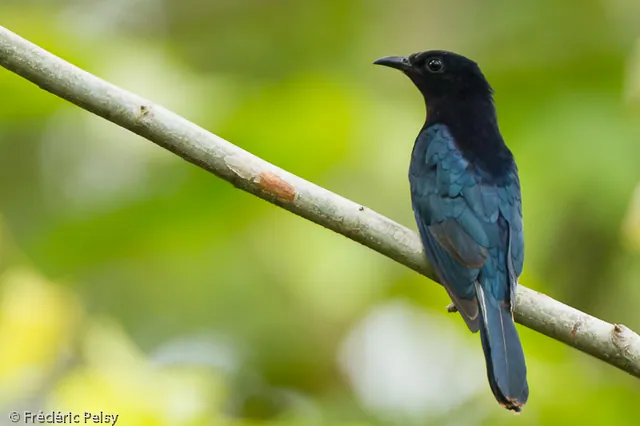
Philippine Drongo-Cuckoo
- Scientific name
- Surniculus velutinus
- Family
- Cuculidae
- Conservation status
- Least concern
- Habitat
- Forest deciduous
- Wing shape
- Pointed
- Tail shape
- Long
Where it came from
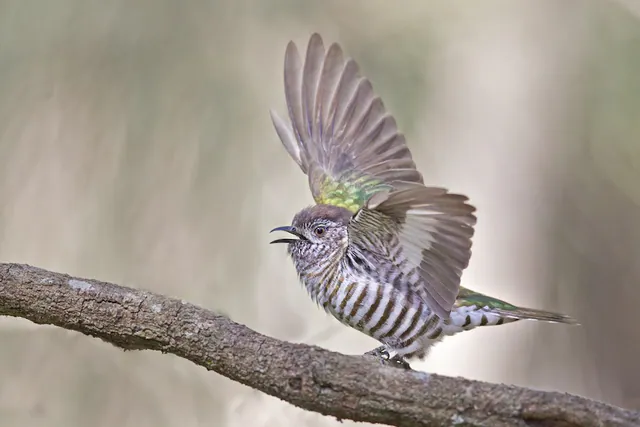
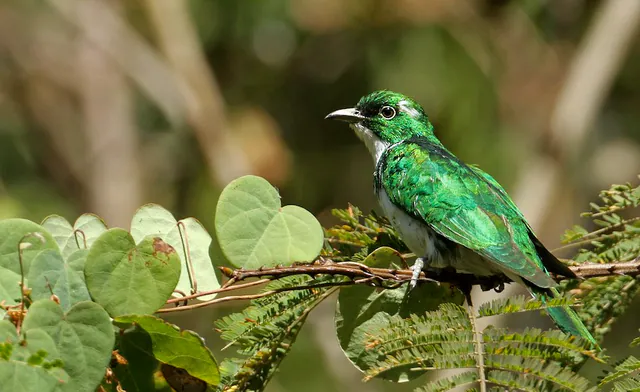
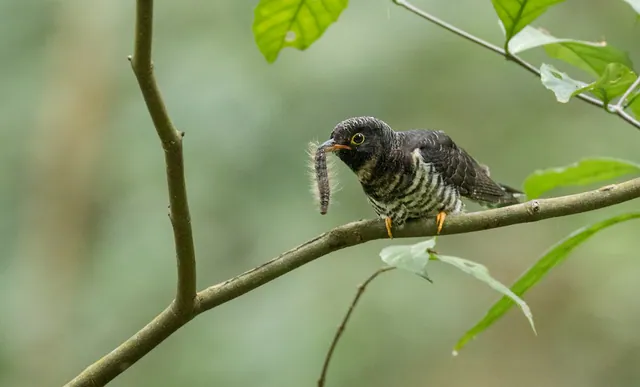
The Philippine Drongo-Cuckoo (Surniculus velutinus) was formally described by the ornithologist Richard Bowdler Sharpe in 1877. As a member of the Cuculidae family endemic to the Philippines, it evolved within the dense, humid rainforests of the archipelago. The species is characterized by its remarkable mimicry of the drongo, a phenomenon known as Batesian mimicry, which allows it to move through forest canopies with reduced risk of predation by birds of prey that typically avoid the aggressive drongo.
The design of the species, defined by its pointed wings and distinctively long, slightly forked tail, reflects its specialized niche as an aerial insectivore. Unlike many of its cuckoo relatives that are larger and more conspicuous, the Philippine Drongo-Cuckoo is relatively elusive, often identified more by its melancholy, whistled vocalizations than by direct observation. It remains a subject of significant interest for ornithologists studying the evolutionary pressures of mimicry and island biogeography in Southeast Asian avian populations.
Written by Pi, the helpful collecto.rs AI
Who's collecting this
Real birds collectors on collecto.rs who have this in their public collection.
About Philippine Drongo-Cuckoo
Philippine Drongo-Cuckoo is a bird in the Birdwatching catalog on collecto.rs. Catalog data is sourced from eBird. No public birds collectors track this one yet — adding yours would make you the first on collecto.rs.
How many collectors track Philippine Drongo-Cuckoo on collecto.rs?
Philippine Drongo-Cuckoo doesn't have any public collectors on collecto.rs yet. Sign up to add it and become the first.
Can I track my own copy of Philippine Drongo-Cuckoo?
Yes. collecto.rs is free — sign up to log your bird, upload photos, record condition, edition, and acquisition cost, and connect with other birdwatching collectors. Your collection stays private by default.
Where does the Philippine Drongo-Cuckoo catalog entry come from?
The catalog entry for Philippine Drongo-Cuckoo is sourced from eBird. Catalog-level facts stay consistent across every collector; your own data (condition, edition, acquisition notes) is yours.
Is collecto.rs birds tracking free?
Yes. Tracking your birds is free — no paid tier required to catalog items, upload photos, or share your collection.
Track every bird you own
Free. Fun. Collection photos, notes, organization, value tracking, friends — all in one place.
Sign up free