The short version#
Metal Raiders is the release where the early game developed its teeth, balancing memorable anime staples with mechanical depth that reshaped play.
- Change of Heart
- Sangan
- Black Skull Dragon
- Seven Tools of the Bandit
- Magician of Faith
- Heavy Storm
- Mask of Darkness
- Kazejin
- Thunder Dragon
- Baby Dragon
Legend of Blue Eyes White Dragon showed people what a duel looked like. Metal Raiders taught them how to play one.
When the set landed in 2002, the game was still running on schoolyard momentum. Decks were piles of normal monsters chosen for their attack stats, paired with whatever spells came out of starter boxes. If you had a bigger monster than your friend, you usually won. Strategy was an afterthought. The anime drove the binder, and the binder drove the playground.
Metal Raiders broke that pattern immediately. Combining cards from two Japanese sets—Booster 7 and Revival of Black Demons Dragon—it injected real structure into the North American card pool. It added counter traps. It introduced effect monsters that punished blind aggression and turned resource management into an actual discipline. Suddenly, dropping a high-attack monster into face-down cards was a mistake that could cost you the game.
Yet the set did not abandon the spectacle. It managed to balance heavy competitive utility with cards that carried immediate screen presence. You pulled the pieces of Gate Guardian from the exact same foil packs that gave you tournament staples. You got fusion material that fueled early combos, and you got showpieces that looked right at the front of a nine-pocket page.
That balance makes Metal Raiders hold up two decades later. It was the release where Yu-Gi-Oh! grew teeth, moving from a novelty into an enduring card game without losing its dramatic streak. Whether you still sleeve these up for vintage formats or you keep a clean copy in a binder row, these ten cards capture the shift.
| # | Item | Set / Year | Rarity |
|---|---|---|---|
| 1 | Change of Heart | Metal Raiders | ultra-rare |
| 2 | Sangan | Metal Raiders | rare |
| 3 | Black Skull Dragon | Metal Raiders | ultra-rare |
| 4 | Seven Tools of the Bandit | Metal Raiders | ultra-rare |
| 5 | Magician of Faith | Metal Raiders | rare |
| 6 | Heavy Storm | Metal Raiders | super-rare |
| 7 | Mask of Darkness | Metal Raiders | rare |
| 8 | Kazejin | Metal Raiders | super-rare |
| 9 | Thunder Dragon | Metal Raiders | common |
| 10 | Baby Dragon | Metal Raiders | common |
10. Baby Dragon#
 Baby DragonSee it on collecto.rs
A foil wrapper tears open under fluorescent school cafeteria lights. Nine cards fan out in your fingers, eight of them common cardstock that smells of fresh print, and right there in the middle sits a tiny orange creature with oversized wings. It was 2002, and nobody cared that its stat line topped out at twelve hundred attack.
Baby Dragon arrived in Metal Raiders as common filler. By competitive standards, it offered nothing to protect your life points or clear a threat. Yet early Yu-Gi-Oh! ran on two engines: actual tournament utility and the Saturday morning cartoon. If you watched Joey Wheeler face down Mai Valentine, this little dragon carried an entire narrative arc on its shoulders. You ran it because you wanted to play Time Wizard, hit the roulette spin, and age it into Thousand Dragon. That combo rarely worked in practice, but the fantasy kept thousands of playground decks glued together.
That reliance on nostalgia separates it from something like Thunder Dragon further up our list. Where Thunder Dragon pointed straight toward the modern game by turning hand discards into instant card advantage, Baby Dragon anchored the set to its anime origins. It was pure flavour. You kept it because you liked the character who played it, or because Kazuki Takahashi drew it with enough personality to make a weak Level 3 monster feel like an underdog friend.
Cards like this often end up tucked into beat-up shoeboxes rather than rigid top-loaders. When you log your Metal Raiders binder on collecto.rs, you can mark the exact print condition of your childhood copy alongside your pristine holos. It earns the final spot on this list because Metal Raiders was not just a competitive inflection point. It was the moment the game learned to sell a feeling.
9. Thunder Dragon#
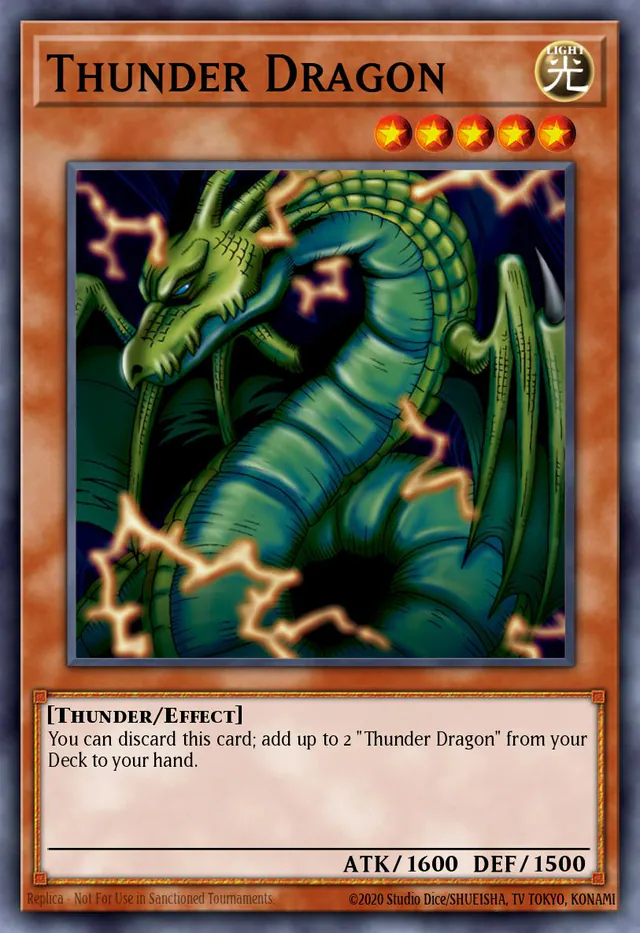 Thunder DragonSee it on collecto.rs
Kazejin asked you to assemble three massive tributes just to put a single boss monster on the table. Thunder Dragon asked for none of that. It arrived as a common in Metal Raiders and immediately went to work from your hand.
Early Yu-Gi-Oh! was often a contest of raw stats. You summoned a monster, compared attack numbers, and traded resources across the front row. Thunder Dragon bypassed that rhythm entirely. Discarding one copy from your hand let you fetch up to two more directly from your deck. It was deck thinning before most players had a formal name for the concept. You trimmed cards you did not need, loaded the graveyard, and added two bodies to hand for costs like Graceful Charity or Polymerization.
The artwork fit the transition era of the game. It was not polished or sleek. It was an awkward, two-headed serpent coiled against a stark background, looking more like an ancient woodcut than modern trading card art. In a booster box packed with flashy holos and showpieces, it looked like pack filler. Then you read the text.
Mechanically, Thunder Dragon laid ground rules that competitive formats still lean on decades later. The idea that card advantage could come from discarding rather than summoning started right here. You did not even need to summon the Twin-Headed Thunder Dragon listed on the original fusion monster cards. The value was in the search effect itself.
Whether your copy sits in an old binder or heads a retro format deck, it represents the exact moment the rules of the table began to tilt toward card management. It proved that a common cardboard utility piece could outlive the set's loudest boss monsters simply by doing one practical job without friction.
8. Kazejin#
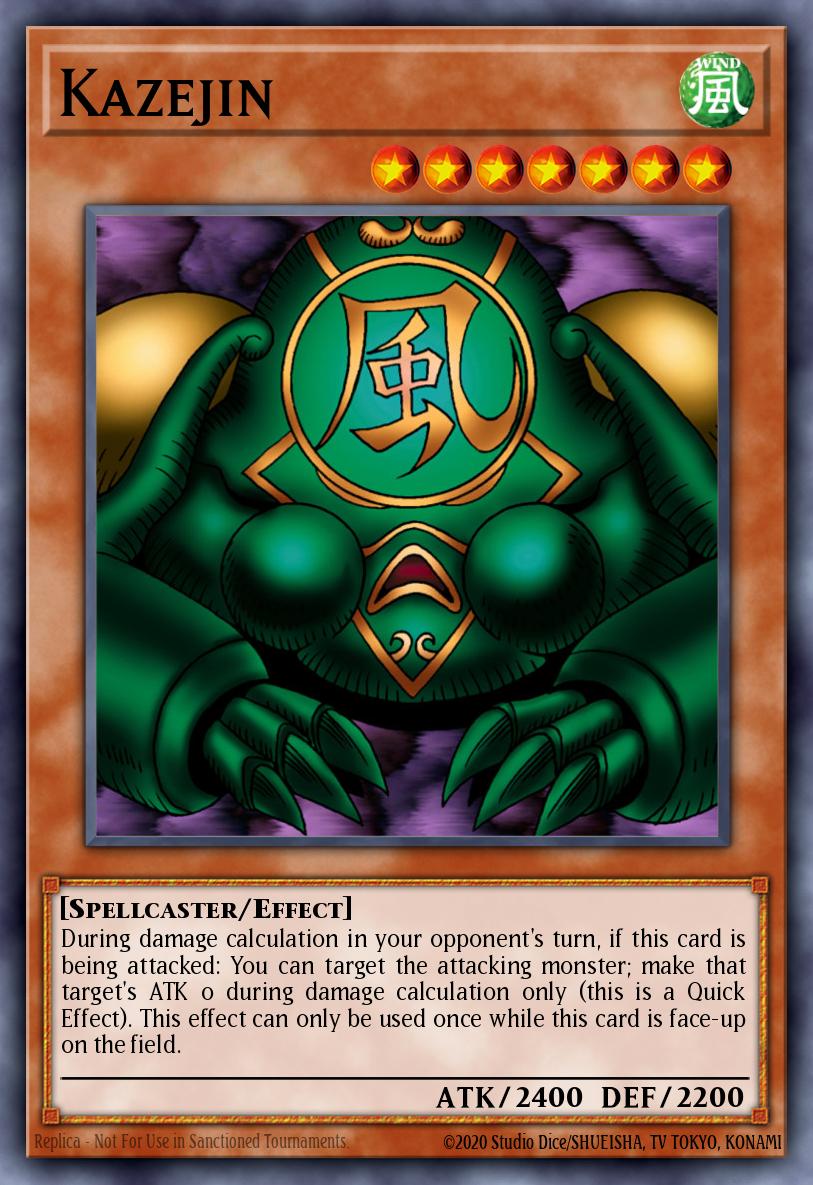 KazejinSee it on collecto.rs
How many tributes were you honestly willing to pay in 2002? Metal Raiders asked that question often, but Kazejin asked it with absolute conviction. Sitting at Level 7 with 2400 Attack and 2200 Defense, the green spellcaster demanded two tributes just to reach the field. In exchange, you received a body capable of contesting the era's biggest threats, alongside a reactive damage-negation effect that could trigger once during damage calculation. It was expensive, slow, and undeniably dramatic.
Where Thunder Dragon solved problems by leaving your hand immediately to trim your deck, Kazejin took the opposite route. It demanded that you invest heavily in the board. It represented an era where Konami designed boss monsters as theatrical set pieces rather than fluid combo tools. As one third of the requirements for Gate Guardian, Kazejin existed to make a statement. You did not sleeve it up because it optimized your opening turn. You ran it because sitting a towering monster on the table and daring your opponent to swing into its effect was the entire point of playing the game on a Saturday afternoon.
As a Super Rare in Metal Raiders, it carried visual weight that matched that ambition. The foil finish catches the harsh wind lines of Kazuki Takahashi's artwork, giving the card a presence that later reprints rarely capture. Metal Raiders built its reputation on introducing pivotal utility, but it also cemented the visual language of high-stakes summoning. Kazejin captures that exact pivot point in early design. If your binder tracks the evolution of boss monsters, or if you keep your early sets logged card by card on collecto.rs, this foil slot marks where the game leaned hard into spectacle.
7. Mask of Darkness#
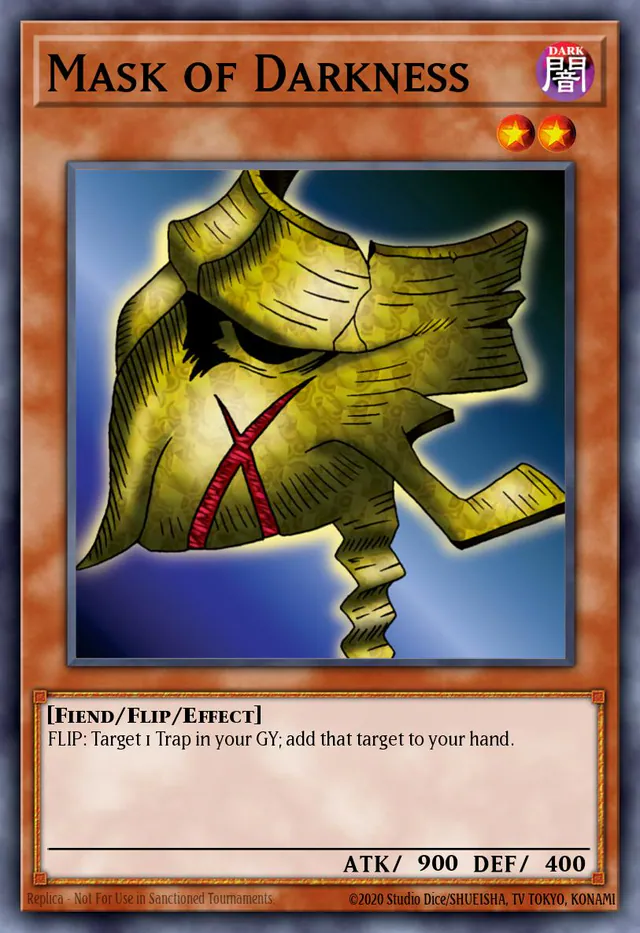 Mask of DarknessSee it on collecto.rs
Nine hundred attack points and four hundred defense. On paper, it was frail enough to lose a battle to almost any standard summon in 2002. Yet Mask of Darkness changed how the game handled its most decisive effects.
Early Yu-Gi-Oh! was defined by scarcity. You ran Mirror Force or Trap Hole, and when that single card hit the graveyard, your safety net vanished with it. Metal Raiders shifted that balance by introducing targeted trap recursion. Flipping this Fiend monster face-up meant pulling any trap right back to your hand. It turned defensive stops from finite answers into renewable resources.
That dynamic explains why it sits right next to Heavy Storm on this list. While Heavy Storm taught you the harsh risk of setting too many backrow cards at once, Mask of Darkness rewarded you for playing the attrition game carefully. If an opponent swept the board clean, flipping this card on the following turn let you salvage your best line of defense immediately. It softened the blow of full-field wipes without relying on brute force.
There is also a quiet charm in its rarity tier. Printed as a regular Rare in the set, the card features simple silver foil lettering over standard glossy art. It lacked the prismatic flash of the secret rares, but it appeared in decklists far more consistently than the flashy boss monsters of the era. The art itself is strange and unsettling, showing a grim iron face framed by jagged purple edges and gold accents. It looks like an ancient relic salvaged from a tomb, which fits the mechanics perfectly. If you are cataloging classic flip effect cards from this era, this print captures the precise moment where resource recursion became a real strategy.
6. Heavy Storm#
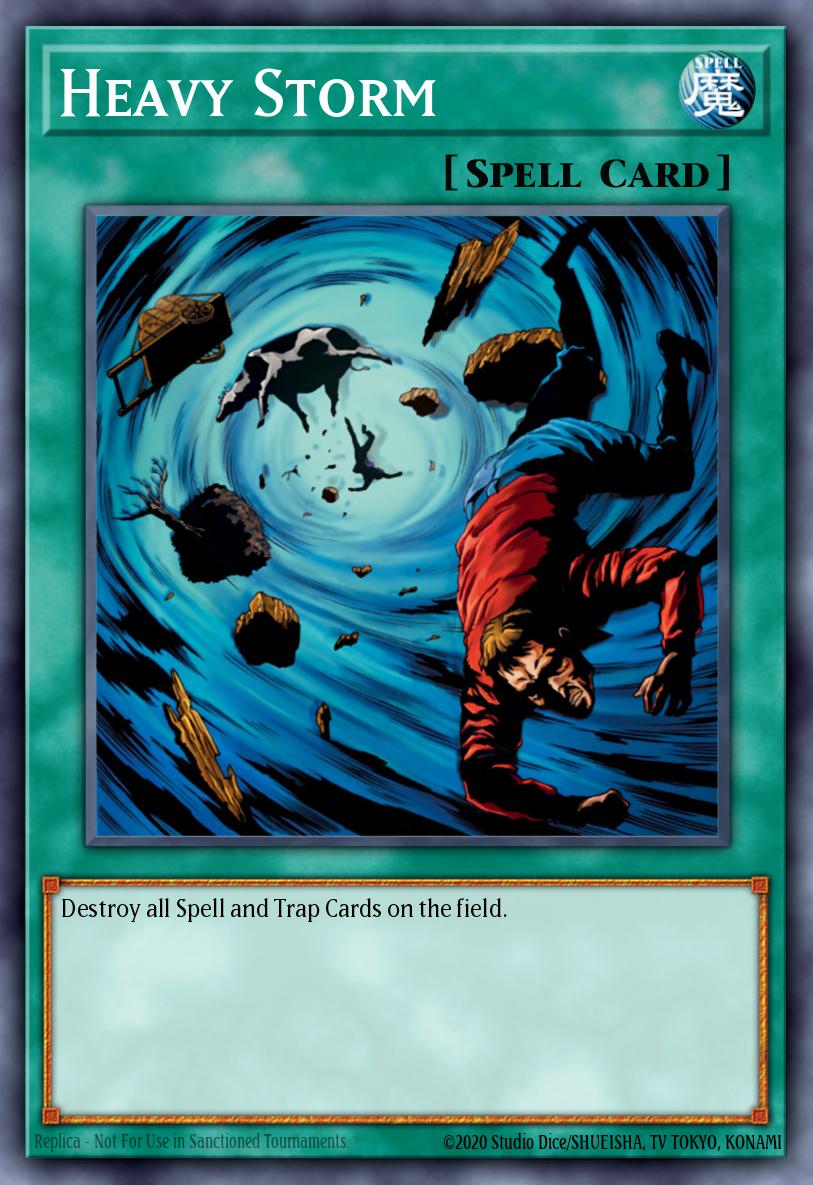 Heavy StormSee it on collecto.rs
You did not set five cards face down because you were confident. You set them because you were scared.
Early duels encouraged bad habits. Players treated the backrow like an attic, piling in Trap Holes, Wabokus, and field spells until the cardboard ran out of physical table space. Heavy Storm ended that tendency overnight. It was not gentle about it, either. It cleared every Spell and Trap card on the field without asking questions, returning the board to zero with a single activation.
Unlike Magician of Faith, which asked you to patiently flip a monster to buy back an old mistake, Heavy Storm demanded immediate forward motion. It was ruthless, but it was honest. If your opponent spent four turns constructing a fortress of continuous spells and defensive nets, you paid zero tributes, activated this Super Rare normal spell, and swept the lane clean. If you had cards out there too, they went straight to the graveyard alongside the rest. It forced both players to look each other in the eye and play real monsters again.
That balance changed how people built decks. You learned to hold cards in hand. You learned that an unplayed Trap card in your grip was often safer than a face-down Trap card on the mat. For collectors filing Metal Raiders into a binder today, Heavy Storm marks the exact moment the game developed discipline. The foil lettering across the top of that familiar green frame represents the first genuine reset button in Yu-Gi-Oh! history. You can log it in your collecto.rs account under your early spell staples, tag it by set, and export the list whenever you reorganize your retro formats. It is a plain reminder of the card that taught an entire generation to stop crowding the mat.
5. Magician of Faith#
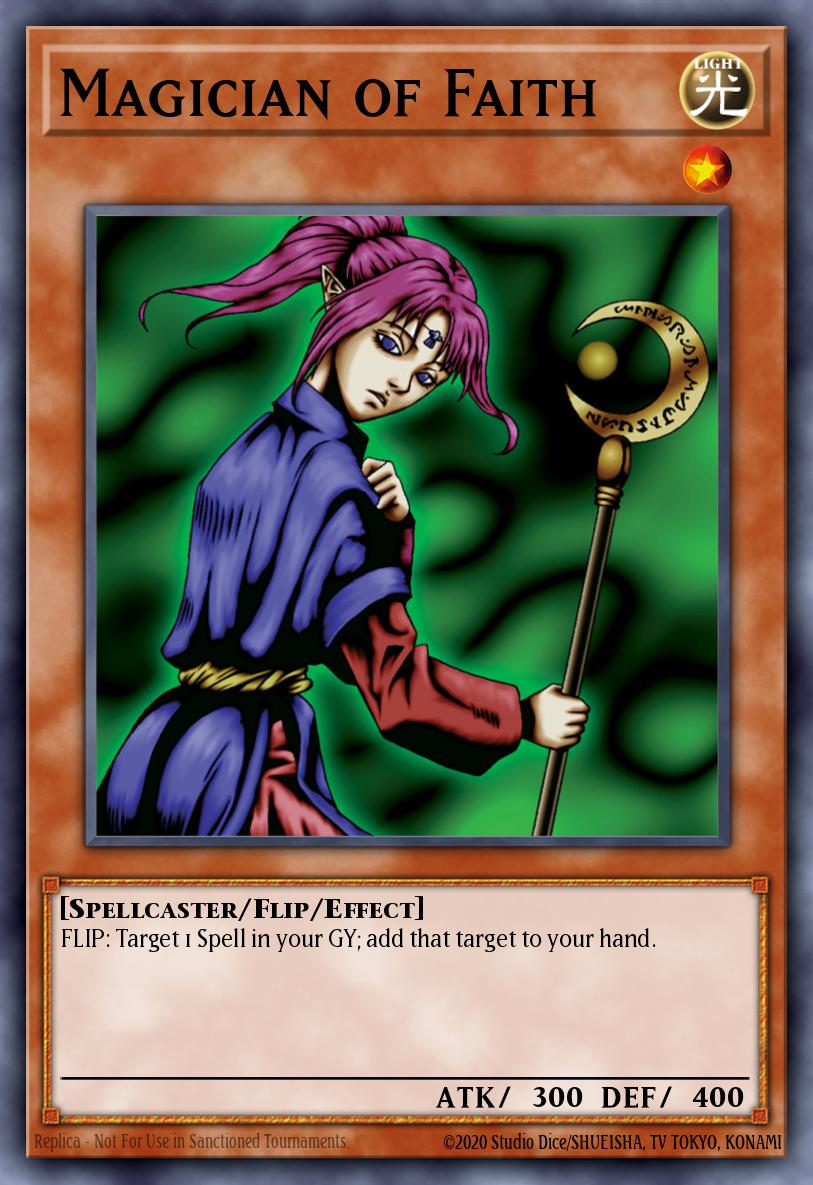 Magician of FaithSee it on collecto.rs
Your opponent spent their turn carefully playing around your backrow, only to watch you flip face-up a small spellcaster with three hundred attack points. The table went quiet because you both knew what was coming next. Reaching into the graveyard to pull back Raigeki or Pot of Greed was an unmatched feeling in early 2002. It was legal, but it never felt entirely fair.
That simple flip effect gave players second chances with the most broken magic cards in the format. You did not run Magician of Faith for board presence. You set her face-down and waited. If she survived an attack or lasted until your turn, she let you repeat the most devastating play you had already made. In a game state where resources were thin, looping a single spell card could crack a match wide open.
Where Heavy Storm acted as a clean reset button that taught players not to overcommit their backrow, Magician of Faith did the opposite. She encouraged greed. Why settle for wiping the board once when you could dig the exact same spell back out of the dirt a turn later? Heavy Storm cleared the slate for everyone, but this card tilted the ledger strictly in your favor.
Printed as a rare in Metal Raiders, she saw widespread play across playground duels and early competitive tables alike. Eventually, that recycling loop proved too warping for organized formats, landing her on the forbidden list for years. A pristine copy from this set still carries the weight of those slow, tense matches. If you track early format staples in your binder, you can catalog your copy on collecto.rs to keep its condition, printing, and set details documented in one place alongside the rest of your vintage deck.
4. Seven Tools of the Bandit#
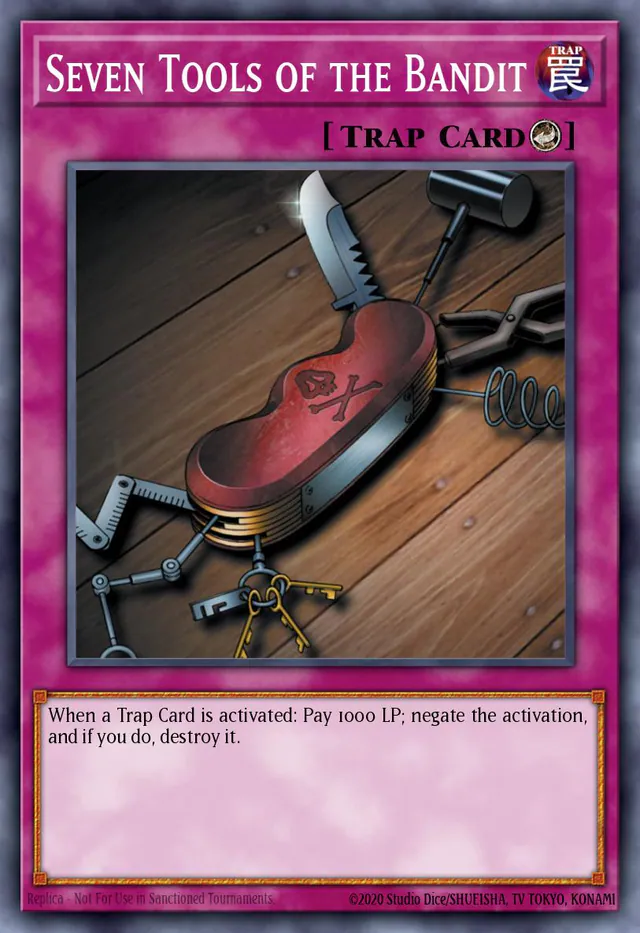 Seven Tools of the BanditSee it on collecto.rs
Early duelists guarded their life points like family heirlooms, but Seven Tools of the Bandit asked you to treat that tally as fuel instead. Up until this card landed in Metal Raiders, losing life points meant you were inching closer to defeat. Paying a flat one thousand life points just to negate a trap felt steep to anyone staring at an eight-thousand-point starting pool. Yet the math told a different story the second your opponent flipped a Mirror Force to wipe your entire front row. Trading an eighth of your starting life to keep four monsters alive was not a sacrifice. It was highway robbery.
That dynamic makes Seven Tools hit differently than something like Black Skull Dragon. While that lumbering fusion monster demanded specific tributes to push thirty-two hundred attack onto the board, Seven Tools gave you permission to play the game on your terms for the cost of a modest entry fee. It introduced the Counter Trap symbol to our vocabularies and gave tournament play its first real taste of tempo control. You were no longer just reacting to threats on the field; you were paying admission to dictate what was allowed to happen in the first place.
In the Ultra Rare slot, the card stands out because it looks like a field kit rather than an eldritch beast. The artwork features a Swiss Army knife of petty crime, complete with lockpicks and wire cutters set against a muted mechanical plate. If you keep an ungraded copy in a binder or track your set on collecto.rs, you already know how the early foil stamping catches the light across the serrated steel blades. It marks the exact moment Yu-Gi-Oh! shifted from a playground battle of stats into a resource management game.
3. Black Skull Dragon#
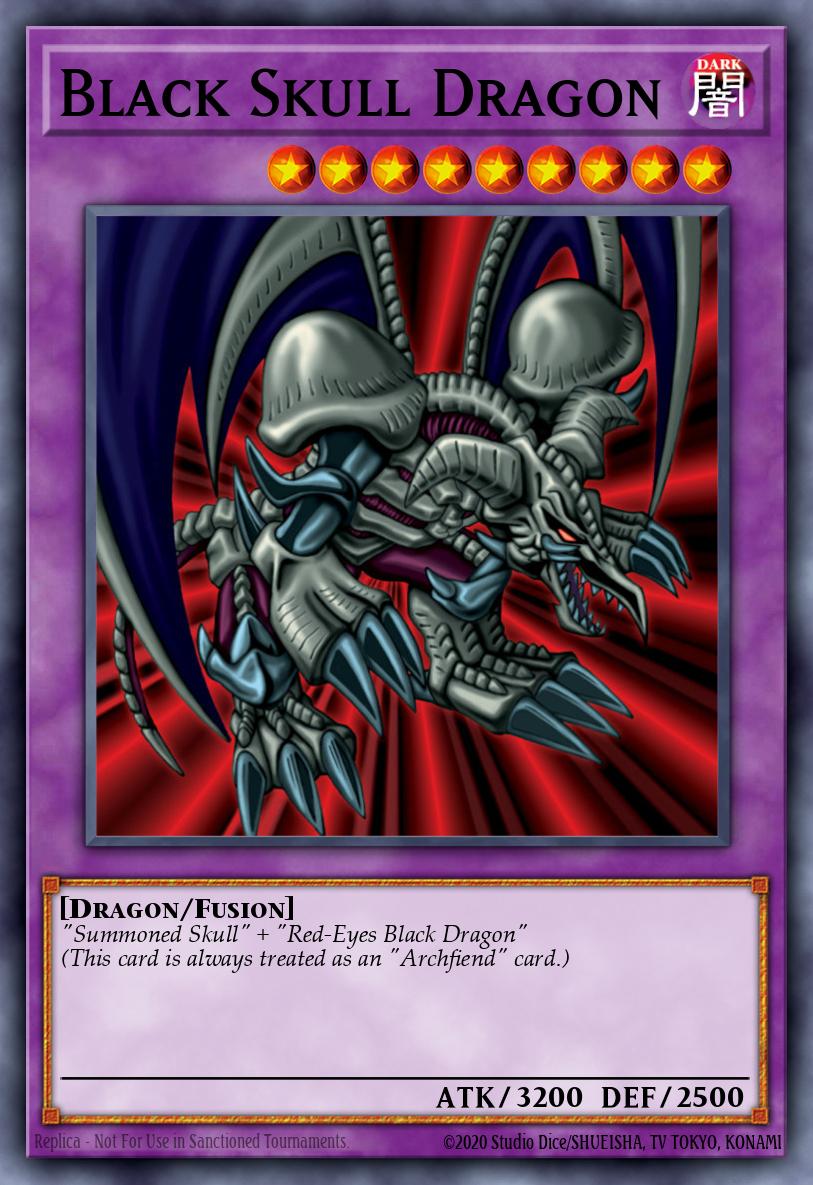 Black Skull DragonSee it on collecto.rs
Two specific monsters sit in your graveyard, Polymerization drops to the field, and a single card lands squarely in the center monster zone. In 2002, nothing on the table answered thirty-two hundred attack points through combat alone. Blue-Eyes White Dragon held the ceiling at three thousand from the base set onward. Black Skull Dragon cleared that ceiling by two hundred points, shifting what an endgame board looked like. It demanded Summoned Skull and Red-Eyes B. Dragon. That was a high cost when hand advantage decided matches, but the payoff ended games on contact.
Where Sangan worked quietly from the opening turn to fetch you pieces and keep your options alive, Black Skull Dragon arrived to cash in that preparation. It ignored the creeping resource grind of the early turns and forced an immediate response. If your opponent lacked a trap card or a direct removal spell, the match ended in two swings. The ultra-rare foil caught every glare across a kitchen table. It gave Red-Eyes B. Dragon a competitive purpose that the base card sorely lacked on its own.
Fusions in Metal Raiders carried real risks. Discarding two specific boss monsters alongside a fusion spell left your hand empty if a trap stopped the summon. Even so, the sheer attack stat kept this card in extra decks long after alternative fusions appeared. It remains a definitive snapshot of early Yu-Gi-Oh!, where victory often came down to whoever could field the single largest body before their opponent drew an answer. If you keep an MRD binder section today, the dark purple frame of this fusion monster marks the exact point where attack thresholds broke wide open.
2. Sangan#
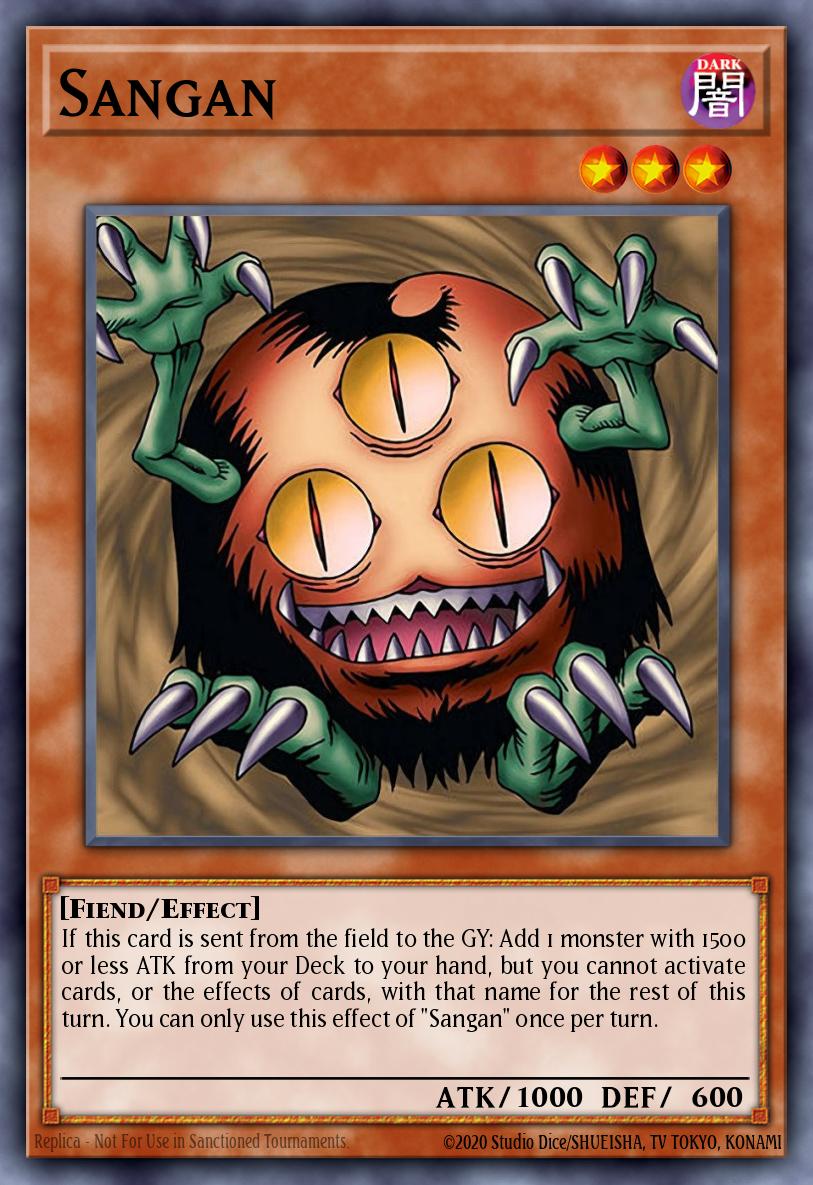 SanganSee it on collecto.rs
A thousand attack points is nothing to brag about, yet this three-eyed ball of brown fur dictated the tempo of matches for years. When it hit the graveyard from the field, you reached directly into your deck for any monster with fifteen hundred or fewer attack points. That was not a conditional luxury. It was an unconditional tutor sitting at Rare in Metal Raiders, quietly reshaping how players viewed card economy.
Early tournament play rewarded raw presence, but losing a monster usually meant taking a loss in hand size. Sangan broke that rule entirely. Set face-down, it served as an uninviting wall that turned your opponent's battle phase into your private fetch engine. It found Witch of the Black Forest, Magician of Faith, or your combo pieces before the turn came back to you. While Black Skull Dragon demanded two specific tributes and Polymerization just to force raw damage through, Sangan kept your hand stocked for pennies, ensuring you never actually ran out of answers.
That level of utility made it an immediate staple across playground duels and competitive tables alike. It eventually spent over a decade shifting between the Limited and Forbidden lists before receiving errata to rein in its timing. Early prints from Metal Raiders capture the creature before all the text revisions and archetype restrictions took over. The silver Rare stamp on its name against the non-foil portrait gives it a grounded, utilitarian presence in a binder. It looks like what it was: a functional workhorse that did not need holofoil gloss to completely alter the flow of the game.
1. Change of Heart#
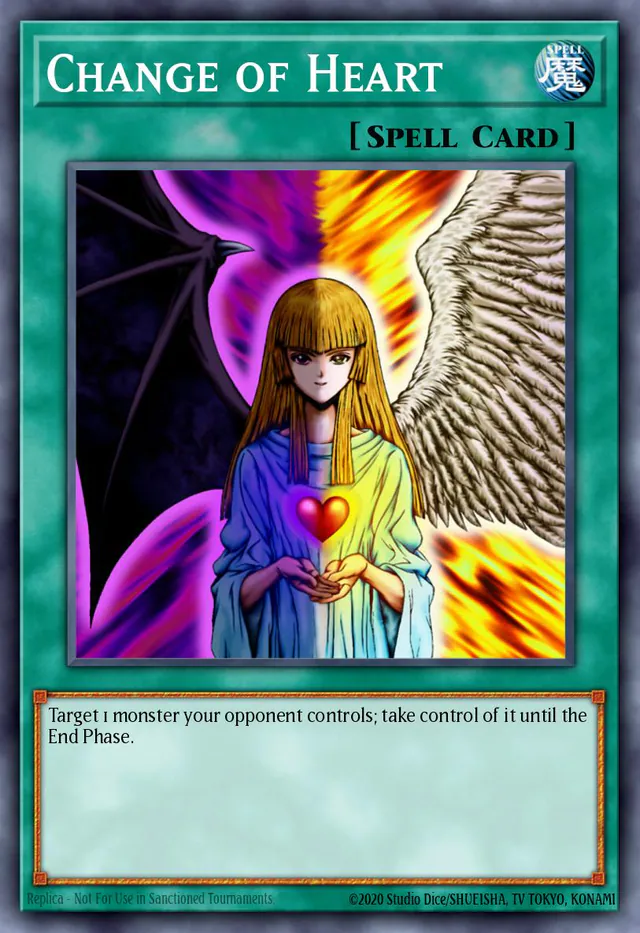 Change of HeartSee it on collecto.rs
What happens when your best play becomes someone else's winning move? Early Yu-Gi-Oh! was defined by resource management, but this ultra-rare normal spell ignored the math entirely. You activated it, pointed across the mat, and borrowed their strongest monster for the turn. No tribute required. No discard cost. No life point deduction. Just a complete reversal of momentum printed on a single sheet of foil.
While cards like Sangan slowly ground out advantage by digging a replacement out of your deck, Change of Heart simply ended the debate. It turned an opponent's anchor into your finisher. You could swing directly with their own boss monster, use it as tribute fodder for your own summon, or flip a dangerous effect back in their face. It answered every threat while creating an immediate lethal threat of your own, making any defensive wall irrelevant the second it hit the table.
The artwork carries that split identity cleanly. Half-angel and half-demon, it captured the era's gothic visual tone better than almost anything else in the set. You immediately understood the card just by looking at the frame. It stayed on the forbidden list for well over a decade because it gave you everything for nothing, turning lost games around with zero setup.
Holding an original print today brings back the reality of that 2002 schoolyard format. You keep it in the binder because it represents the peak of early power design, right at the top of the set list. If you want to track yours across different printings and conditions, collecto.rs lets you catalog every copy and export your checklist whenever you like.
Metal Raiders marks the line between an anime tie-in finding its feet and a trading card game building an identity. After this set, you could no longer build a deck simply by adding up attack values. You had to plan for your opponent's backrow. You had to anticipate what was waiting face-down in defense position. You had to think about card advantage before anyone called it that.
That legacy shows up in the cards that survived it. Some ended up banned for years because their effects were too clean, too strong, and entirely free. Others became permanent fixtures in goat format decks, relied on by players who prefer the deliberate pacing of the early era. A few remain pure visual nostalgia, anchored to Saturday morning broadcasts and the specific texture of early Konami foiling.
If you hold any of these cards—whether as mint first editions or beat-up copies carried in tin boxes across multiple moves—they belong in an archive that treats them with care. You can catalog them on collecto.rs alongside your full binders, track their printings, and keep the records organized. Export your data whenever you need it. The early era gave the game its foundation, and those cards are worth documenting properly.
Frequently asked questions#
What makes the Metal Raiders booster set significant in Yu-Gi-Oh! history?#
Released in 2002, Metal Raiders combined the Japanese sets Revival of Black Demons Dragon and Metal Raiders. It expanded the card pool beyond simple attack stats by introducing counter traps, powerful search engines, and game-altering flip-effect monsters. Many cards from this set established core mechanics that endured for years in classic formats.
Why do card codes differ between MRD and MRD-EN printings?#
Original North American printings from 2002 used the simple 'MRD' prefix followed by the number. Later worldwide English releases, European prints, and subsequent reprints introduced regional identifiers such as 'MRD-EN' or 'MRD-E'. These small code differences help collectors pinpoint the precise release era and geographic origin of an individual copy.
Which rarities debuted in the English release of Metal Raiders?#
Metal Raiders followed the standard early core booster structure, containing commons, rares, super rares, ultra rares, and secret rares. It is particularly noted for iconic high-rarity fusion monsters and spell cards that became focal centerpieces in binders alongside dependable common-rarity staples.